Back Pain Chair Statistics 2026: Key Data on Sitting, Ergonomics, and Workplace Risk

Back pain and chair-related workstation problems are closely connected in desk-based work. The latest evidence shows that low back pain remains one of the world’s biggest disability burdens, while office-based studies continue to find high rates of back symptoms, long sitting time, poor workstation comfort, and measurable productivity losses when ergonomics are ignored.
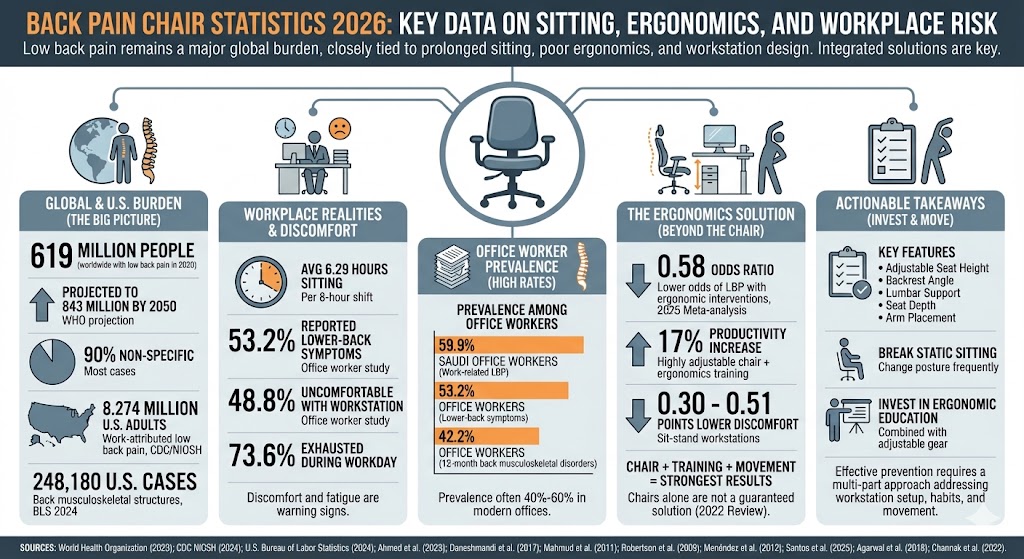
Key Back Pain Chair Statistics
- 619 million people were living with low back pain worldwide in 2020.
- WHO projects global low back pain cases will rise to 843 million by 2050.
- About 90% of low back pain cases are considered non-specific.
- CDC/NIOSH estimated 8.274 million U.S. adults had low back pain attributed to work, an average prevalence of 5.68%.
- BLS reported 248,180 U.S. cases involving the exterior and musculoskeletal structures of the back in 2024 among cases with days away from work.
- In one office-worker study, employees spent an average of 6.29 hours of an 8-hour shift sitting.
- That same study found 53.2% reported lower-back symptoms and 48.8% did not feel comfortable with their workstation.
- A Saudi office-worker study found 59.9% reported work-related low back pain.
- In that Saudi study, 19.9% experienced low back pain at least weekly and 21.7% said pain limited their activities.
- A university office-worker ergonomics study reported a 42.2% 12-month prevalence of back musculoskeletal disorders.
- A 2025 meta-analysis found ergonomic interventions were associated with lower odds of low back pain at follow-up, with an odds ratio of 0.58.
- A prior public-sector study cited in later ergonomics research reported a 17% increase in productivity when a highly adjustable chair was combined with ergonomics training.
Office Worker Back Pain Prevalence
The strongest chair-related numbers usually come from office-worker studies rather than the general population. Across modern office settings, back pain prevalence often lands in the 40% to 60% range, which makes seating design, lumbar support, posture, and workstation setup central parts of any prevention strategy.
| Label | Bar | Value | ||
|---|---|---|---|---|
| Saudi office workers with work-related low back pain |
| 59.9% | ||
| Office workers with lower-back symptoms |
| 53.2% | ||
| Office workers with 12-month back musculoskeletal disorders |
| 42.2% |
Max = 59.9. Widths: Saudi office workers with work-related low back pain 100.00%, Office workers with lower-back symptoms 88.81%, Office workers with 12-month back musculoskeletal disorders 70.45%
What These Prevalence Numbers Mean
For a chair-focused article, the important pattern is not just that back pain is common. It is that desk-based workers report back symptoms at high rates even in settings where physical demands are relatively low. That points attention toward prolonged sitting, static posture, poor lumbar support, monitor and keyboard placement, seat adjustability, and movement frequency during the day.
It also shows why chair statistics should not be interpreted as meaning the chair alone causes or solves the problem. The evidence points to a broader ergonomics picture that includes the chair, the desk, the screen, worker habits, and how long people stay in one position without postural change.
Workstation Comfort and Back-Pain Burden
Office-worker surveys show that discomfort and fatigue often sit beside back pain. That matters because workstation dissatisfaction is one of the clearest warning signs that the chair and broader setup are not supporting the worker well enough.
| Label | Bar | Value | ||
|---|---|---|---|---|
| Exhausted during the workday |
| 73.6% | ||
| Uncomfortable with workstation |
| 48.8% | ||
| Activities limited by low back pain |
| 21.7% | ||
| Weekly low back pain episodes |
| 19.9% |
Max = 73.6. Widths: Exhausted during the workday 100.00%, Uncomfortable with workstation 66.30%, Activities limited by low back pain 29.48%, Weekly low back pain episodes 27.04%
What the Intervention Evidence Shows
The most useful takeaway for employers and buyers is that multi-part ergonomics programs usually look stronger than chair-only fixes. A large office ergonomics study found that workers who received ergonomics training, with or without a highly adjustable chair, showed lower musculoskeletal risk than controls. A later study discussing the same intervention model cited a 17% productivity gain when a highly adjustable chair was paired with ergonomics training.
A newer meta-analysis also supports the broader ergonomics approach. Across 24 randomized controlled trials, ergonomic interventions were associated with lower overall work-related musculoskeletal pain and lower odds of low back pain specifically. At the same time, a 2022 systematic review focused on chair interventions alone concluded that the evidence remained low quality and conflicting, so chairs by themselves should not be treated as a guaranteed solution.
That balance is important. The numbers support investing in adjustability, worker training, and movement more than simply swapping in a different chair and hoping the problem disappears.
Chair Design, Sitting Time, and Movement
One of the most practical findings in this area is that changing posture during the day matters. A meta-analysis on sit-stand workstations found that low back discomfort improved, with effect estimates ranging from 0.30 to 0.51 points lower on a 10-point discomfort scale. That is not a cure, but it suggests that breaking static sitting can meaningfully improve comfort in sedentary jobs.
For readers comparing chairs, the real question is usually whether the chair makes healthy position changes easier. Adjustable seat height, backrest angle, lumbar support, seat depth, and arm placement can all help workers maintain better posture, but the data suggests those features work best when paired with ergonomic education and more frequent movement.
Selected Findings
| Finding | Value | Takeaway |
|---|---|---|
| Global low back pain cases | 619 million | Back pain is already a massive global health burden. |
| Projected global cases by 2050 | 843 million | The problem is expected to grow, not shrink. |
| Lower-back pain odds with ergonomic interventions | 0.58 | Broader ergonomic programs appear more effective than isolated chair swaps. |
| Productivity gain from adjustable chair and training | 17% | Better seating can matter financially when paired with training. |
| Sit-stand workstation effect on low back discomfort | 0.30 to 0.51 points lower | Reducing static sitting can improve comfort during the workday. |
Conclusion
The best back pain chair statistics point to a clear conclusion: back pain in desk-based work is common, costly, and closely connected to prolonged sitting and poor workstation setup. But the evidence does not support treating the chair as a magic fix. The strongest results come from combining an adjustable chair with ergonomics training, better workstation habits, and more frequent posture changes through the day.
Sources
- World Health Organization. Low back pain. 2023.
- CDC NIOSH. Step 1: Identify Risk Factors | Ergonomics. 2024.
- U.S. Bureau of Labor Statistics. Employer-reported workplace injuries and illnesses, 2024.
- Ahmed IAB et al. The Prevalence and Risk Factors of Low Back Pain Among Office Workers in Saudi Arabia. 2023.
- Daneshmandi H et al. Adverse Effects of Prolonged Sitting Behavior on the General Health of Office Workers. 2017.
- Mahmud N et al. Ergonomic Training Reduces Musculoskeletal Disorders among Office Workers: Results from the 6-Month Follow-Up. 2011.
- Robertson M et al. The Effects of an Office Ergonomics Training and Chair Intervention on Worker Knowledge, Behavior and Musculoskeletal Risk. 2009.
- Menéndez CC et al. A Replicated Field Intervention Study Evaluating the Impact of a Highly Adjustable Chair and Office Ergonomics Training on Visual Symptoms. 2012.
- Santos W et al. Efficacy of Ergonomic Interventions on Work-Related Musculoskeletal Pain: A Systematic Review and Meta-Analysis. 2025.
- Agarwal S et al. Sit-Stand Workstations and Impact on Low Back Discomfort: A Systematic Review and Meta-Analysis. 2018.
- Channak S et al. The Effects of Chair Intervention on Lower Back Pain, Discomfort and Trunk Muscle Activation in Office Workers: A Systematic Review. 2022.