

10 Best Battery Load Testers for Accurate Automotive Testing in 2026

The best battery load testers help you determine whether a battery is genuinely healthy or only showing a temporary surface charge. The right tool can also identify weak cranking performance, charging problems, and batteries that are nearing replacement.
This roundup compares 10 battery load testers for cars, trucks, RVs, motorcycles, golf carts, and other 6V, 12V, or 24V applications. It includes simple analog load checkers and digital testers that report CCA, alternator output, charging status, and cranking results.
Best 10 Battery Load Testers Picks for 2026
Versatile Garage Tester

- Tests 6V and 12V batteries up to 1,000 CA
- Checks battery, charging, and starter systems
- Analog meter with simple rocker-switch operation
Best For: Multi-vehicle garage testing
Compact Digital Analyzer

- Tests 100–2,000 CCA 12V batteries
- Provides health, cranking, and charging tests
- Compact design with protected copper clamps
Best For: Portable 12V battery diagnostics
Color-Coded Load Checker

- Tests 6V and 12V starter or deep-cycle batteries
- Performs load, starter-draw, and charging checks
- Color-coded display and heavy-duty clamps
Best For: Simple automotive and marine testing
Heavy-Duty Quick Tester

- Uses a 130A load test for 6V and 12V batteries
- Produces results in about 10 seconds
- Large display and top- or side-post clamps
Best For: Fast heavy-duty battery checks
Easy 12V Diagnostics

- Checks 100–2000 CCA 12V batteries
- Tests battery, cranking, and charging systems
- Backlit display with built-in safety protection
Best For: DIY owners testing common 12V lead-acid batteries
Professional 12V/24V Testing
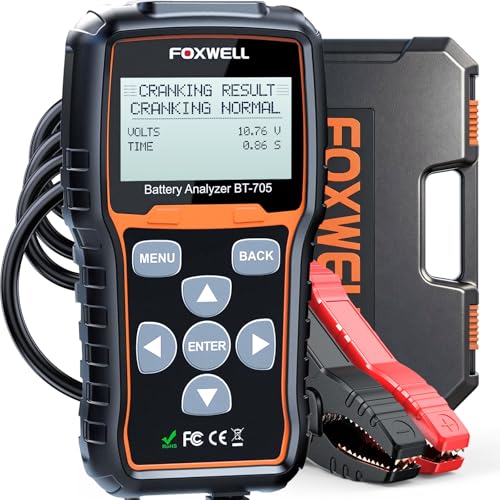
- Tests 12V and 24V systems from 100–2000 CCA
- Guided GOOD, RECHARGE, or REPLACE results
- Long 5.9-foot cable and hard carrying case
Best For: Garages, fleets, and mixed-voltage vehicle maintenance
Simple High-Current Load Testing

- Tests 6V and 12V batteries up to 1,000 CCA
- Applies a 100-amp 12V load
- Analog meter with protective casing and handle
Best For: Basic garage and shop load checks
Versatile Value
QWORK 12V 100A Battery Load Tester

- Tests 6V and 12V batteries
- Handles up to 1,000 CCA
- Includes alternator testing and a rugged carry-friendly case
Best For: Mixed vehicle owners needing portable 6V/12V testing
Professional-Grade Pick

- Tests 12V/24V batteries from 100–2,000 CCA
- Checks battery, cranking, and charging systems
- Color display, memory function, warranty, and technical support
Best For: Broad vehicle coverage and more complete diagnostics
Simple 12V Choice
MOTOPOWER MP0515A Battery Tester

- Tests 12V batteries from 100–2,000 CCA
- Includes cranking and charging-system tests
- Compact design with storage bag and 2-year warranty
Best For: Routine 12V car-battery checks at home
Versatile Garage Tester – Schumacher BT-100
The Schumacher BT-100 is a practical choice among battery load testers when you need one tool for battery health, charging-system performance, and starter-motor-draw checks. Its 6V and 12V compatibility, analog meter, and color-coded clamps suit a broad range of vehicles.
Best For: Garage owners testing car, truck, RV, marine, motorcycle, ATV, and lawn-tractor batteries.
Pros:
- Tests 6V and 12V batteries up to 1,000 CA.
- Combines battery, charging-system, and starter-draw testing.
- Simple rocker switch and highly visible analog meter.
- Works with gas and diesel vehicles across multiple applications.
Cons:
- Its analog readout is less detailed than a digital analyzer.
- The 100A 12V and 50A 6V load-test ratings may not suit higher-capacity testing needs.
Choose the BT-100 if you value straightforward operation and broad vehicle coverage over advanced digital reporting.
Compact Digital Analyzer – TOPDON BT100
The TOPDON BT100 stands out among battery load testers for compact, menu-driven testing of 12V lead-acid batteries. It reports state of health, state of charge, voltage, current, and rating while supporting several common battery types.
Best For: DIY users, garages, and auto shops that want portable 12V battery, cranking, and charging-system analysis.
Pros:
- Supports 100–2,000 CCA flooded, AGM, EFB, and GEL batteries.
- Performs battery health, cranking, and charging-system tests.
- Compact 9-ounce design fits easily in a glove box or center console.
- Polarity-reverse prevention and spark-proof copper clamps add connection protection.
Cons:
- Only supports 12V batteries.
- Requires proper attachment before the unit powers on.
- Testing should be performed with the vehicle ignition turned off.
The BT100 is a strong fit when portability, broad 12V battery compatibility, and readable digital analysis matter more than 6V support.
Color-Coded Load Checker – Battery Tender 026-0020
The Battery Tender 026-0020 is a straightforward option among battery load testers for checking battery condition, starter-motor draw, and charging-system performance. It handles both 6V and 12V starter or deep-cycle batteries with a single-toggle operation.
Best For: Vehicle owners and technicians testing automotive, marine, powersport, and RV batteries up to 1,000 cranking amps.
Pros:
- Performs 100A load tests on 12V batteries and 50A tests on 6V batteries.
- Supports starter and deep-cycle batteries.
- Color-coded display helps identify results quickly.
- Rubber-insulated handle and heavy-duty color-coded clamps support safer handling.
Cons:
- Uses a simple display and single toggle rather than advanced digital analysis.
- The supplied notes do not specify compatibility with batteries above 1,000 cranking amps.
This tester makes sense for buyers who want uncomplicated 6V/12V load testing with useful starter and charging-system checks.
Heavy-Duty Quick Tester – OTC 3181
The OTC 3181 is a heavy-duty choice among battery load testers, delivering a 130A load test for 6V and 12V batteries. Its large display, zero adjustment, and clamps for top- and side-post batteries are designed for quick, repeatable checks.
Best For: Users who want a sturdy 6V/12V tester with a high load rating and fast results.
Pros:
- Provides accurate test results in about 10 seconds.
- 130A load capacity supports heavy-duty testing.
- Clamps grip both top- and side-post batteries.
- Large 0–16V display includes zero adjustment.
Cons:
- It does not provide the broader charging-system and starter-draw functions listed for some competing models.
- The supplied notes describe compatibility with 6V and 12V batteries but do not specify a maximum cranking-amp rating.
Pick the OTC 3181 if fast results, a strong load rating, and flexible post-clamp positioning are your main priorities.
Easy 12V Diagnostics – ANCEL BA101
The ANCEL BA101 is a practical choice among battery load testers for checking 12V lead-acid batteries before they cause starting trouble. It reports voltage, CCA, State of Health, State of Charge, cranking performance, and charging-system results in a straightforward handheld format.
Best For: DIY vehicle owners who need broad 12V testing for cars, trucks, boats, RVs, ATVs, lawnmowers, golf carts, and motorbikes.
Pros:
- Tests 100–2000 CCA batteries and supports Flooded, AGM, GEL, and EFB types.
- Works with multiple rating standards, including SAE, BCI, JIS, DIN, EN, and IEC.
- Uses vehicle-battery power, with a backlit display, adjustable contrast, and one-handed operation.
- Includes protection against reverse polarity, short circuits, overcurrent, and overvoltage.
Cons:
- Limited to 12V batteries and is not intended for lithium batteries.
- Not suitable for motorcycles below 30Ah.
- Accurate results depend on entering the correct battery type, rating, and temperature.
With its wide 12V compatibility and clear diagnostic readouts, the BA101 is a versatile everyday tester. It is best suited to users who want more information than a simple voltage check without moving to a professional 24V tool.
Professional 12V/24V Testing – FOXWELL BT705
The FOXWELL BT705 is a versatile battery load tester for users who need to work across both 12V and 24V vehicle systems. Its guided screen reports CCA, voltage, internal resistance, State of Health, cranking performance, and charging output, while the long cable makes solo testing easier.
Best For: Home garages, repair shops, fleet maintenance, and owners of cars, trucks, RVs, boats, and other 12V or 24V vehicles.
Pros:
- Supports 12V and 24V systems across a 100–2000 CCA range.
- Provides guided results with simple GOOD, RECHARGE, or REPLACE summaries.
- The 5.9-foot cable can reach the driver’s seat for one-person cranking tests.
- Includes a protective housing, durable clamps, and a hard carrying case.
Cons:
- The larger design and included case may be more than occasional users need.
- The supplied compatibility information is for lead-acid battery types rather than lithium batteries.
The BT705 stands out when vehicle variety and repeat use matter. Its 24V capability, guided test process, and long cable make it a stronger fit for commercial vehicles and more demanding maintenance routines than a basic 12V tester.
Simple High-Current Load Testing – NEIKO 40510A
NEIKO 40510A Car Battery Tester | 100 AMP 6 and 12 Volt Automotive Load Checker | CCA Analyzer
Check Price On AmazonThe NEIKO 40510A takes a traditional approach to battery load testers, applying a fixed high-current load while displaying voltage on an analog meter. It supports both 6V and 12V automotive batteries and is designed for quick checks at home, in a garage, or at a shop.
Best For: DIY users and mechanics who prefer a straightforward analog load test for common cars, trucks, boats, motorcycles, RVs, and other vehicles.
Pros:
- Tests both 6V and 12V batteries, with up to 1,000 CCA coverage.
- Uses a 100-amp load for 12V batteries and a 50-amp load for 6V batteries.
- Features an anti-sparking internal switch, protective meter casing, and carrying handle.
- Portable design includes clearly marked red and black copper-clamp grips.
Cons:
- The load should be held for no more than 10 seconds.
- Its analog meter provides less automated diagnostic detail than digital testers.
- Fixed load capacity is less flexible for batteries above the stated 1,000 CCA range.
The 40510A is a useful choice when simplicity and direct load testing are priorities. It does not provide the broader electronic reporting of the other options, but its 6V/12V support and durable shop-friendly design make it practical for basic battery condition checks.
Versatile Value – QWORK 12V 100A Battery Load Tester
For shoppers comparing battery load testers for multiple vehicle types, the QWORK 12V 100A model covers both 6V and 12V batteries. Its analog-style testing approach, alternator-checking function, and 1,000-CCA capacity make it a practical option for routine vehicle diagnostics.
Best For: Car, truck, RV, golf cart, ATV, and other 6V or 12V battery checks where portability and basic alternator testing matter.
Pros:
- Tests compatible 6V and 12V batteries.
- Supports batteries up to 1,000 CCA.
- Includes an alternator testing function.
- Uses a shock-resistant steel case, copper-plated clamps, and a carry handle.
Cons:
- Does not support the 24V systems covered by some digital testers.
- Warranty details are not specified in the supplied information.
The QWORK is a straightforward choice when you want one compact tester for several common vehicle categories. Its 6V compatibility and rugged housing are especially useful for mixed equipment, though shoppers needing advanced digital reporting may prefer a more feature-rich model.
Professional-Grade Pick – TOPDON BT200 Battery Tester
The TOPDON BT200 stands out among battery load testers for its broad 12V and 24V coverage and conductance-based testing. It combines battery health, cranking, and charging-system checks with a color display and support for several battery types.
Best For: DIYers, mechanics, and vehicle owners testing cars, trucks, RVs, boats, motorcycles, lawn equipment, or golf carts.
Pros:
- Tests 12V and 24V batteries from 100 to 2,000 CCA.
- Supports flooded, AGM, GEL, and deep-cycle batteries.
- Provides battery health, cranking, and charging-system tests.
- Offers a sunlight-readable color display, memory function, 1-year warranty, and lifetime technical support.
Cons:
- Its 12V/24V focus is not intended for the 6V batteries supported by the QWORK.
- More functionality may be unnecessary for shoppers wanting only a basic load check.
With its wide CCA range, dual-voltage compatibility, and three-part system diagnosis, the BT200 is the most comprehensive option in this group. Its operating range from -4°F to 140°F also makes it suitable for seasonal and cold-weather testing.
Simple 12V Choice – MOTOPOWER MP0515A Battery Tester
The MOTOPOWER MP0515A is a compact 12V option for shoppers seeking battery load testers for standard car batteries. It is designed for 100–2,000 CCA testing and includes cranking and charging-system testing in a small package.
Best For: Drivers and home garages that primarily service 12V car batteries and want a compact tester with included storage.
Pros:
- Supports 12V car batteries with a 100–2,000 CCA range.
- Includes auto cranking and charging-system testing.
- Compact 340 g design with a storage bag.
- Includes a 2-year manufacturer warranty.
Cons:
- Compatibility is listed for car batteries rather than a wider range of vehicle equipment.
- Does not offer the 6V/24V flexibility described for the other models.
- The supplied details identify a multimeter measurement type but do not specify a color display or memory function.
The MP0515A is a sensible, focused pick for routine 12V car-battery checks. Its included bag and 2-year warranty add practical value, while its narrower compatibility makes it less suitable for owners maintaining mixed-voltage equipment.
How We Picked the Best Battery Load Testers
We focused on testers that provide practical information for automotive maintenance rather than voltage readings alone. The selection includes traditional load testers, digital battery analyzers, and models with alternator or charging-system functions. We considered supported battery voltages, load capacity, CCA range, display readability, test versatility, safety features, and suitability for home garages or professional service work.
Because a load test can place substantial demand on a battery, we also favored tools with clear operating instructions, insulated leads or handles where applicable, and straightforward pass/fail or diagnostic feedback. Compatibility matters: always confirm that a tester supports your battery type and voltage before connecting it.
Quick Comparison
| Tester type | Best for | Common capability |
|---|---|---|
| Analog load tester | Simple garage checks | 6V/12V testing, fixed load, meter-based results |
| Digital battery analyzer | Detailed diagnostics | CCA, cranking, charging, and battery-health readings |
| Heavy-duty load tester | Large batteries and frequent use | Higher current capacity and more robust construction |
| Multi-voltage tester | Mixed vehicle fleets | 12V/24V support, sometimes with alternator testing |
Key Buying Factors for Battery Load Testers
Voltage and Battery Compatibility
Most passenger vehicles use 12V batteries, while motorcycles, older equipment, and some recreational products may use 6V systems. Trucks and commercial equipment may require 24V testing. Choose a tester that explicitly matches the batteries you service, and check whether it supports conventional lead-acid, AGM, gel, or other battery types.
Load Rating and CCA Range
A 100-amp tester is suitable for many standard automotive batteries, while higher-capacity models can be more useful for heavy-duty applications. Digital testers commonly list a CCA range instead of applying a fixed load. Make sure the stated range covers the battery’s rating for meaningful results.
Diagnostics and Display
Analog meters are inexpensive and easy to understand, but you must interpret the gauge while monitoring test time and temperature. Digital testers can provide clearer readings for cranking voltage, charging voltage, battery condition, and estimated CCA. These features are worth prioritizing if you troubleshoot vehicles regularly.
Safety and Usability
Look for sturdy clamps, adequately insulated handles, clear polarity indications, and ventilation during testing. Heat buildup is normal during a sustained load test, so follow the manufacturer’s duty cycle and allow the tester to cool between tests. A long cable, bright display, or compact case can also make garage use easier.
Who Should Buy Which Battery Load Testers?
Choose a basic 6V/12V analog tester if you want an affordable tool for occasional battery checks and do not need detailed printouts or CCA estimates. A digital 12V analyzer is a better fit for drivers, technicians, and DIYers who want battery, alternator, and cranking information from one device. Select a 24V-capable model for commercial trucks, fleet equipment, or other dual-battery systems.
For RVs, golf carts, motorcycles, and mixed household equipment, prioritize voltage flexibility and battery-type compatibility. If you test many batteries, choose a heavy-duty unit with durable leads, clear results, and a suitable cooling or duty-cycle design. Regardless of the model, use the tester as part of a broader diagnosis: clean the terminals, fully charge the battery when required, and verify connections before treating a failed result as proof that replacement is necessary.
