

10 Best Compact Car Battery Testers for Faster 12V Diagnostics in 2026

A compact car battery tester can help you identify weak batteries, charging faults, and starting problems before they leave you stranded. The best options combine clear readings with simple operation and support for common 12V automotive batteries.
Below, we compare 10 compact testers across digital battery analyzers, load testers, and models that also support 6V or 24V systems. Use the buying guide to match testing range, display features, and portability to your vehicle and maintenance routine.
Best 10 Compact Car Battery Testers Picks for 2026
Best Overall Value

- Tests 100-2000 CCA 12V batteries
- Checks battery, starter, and alternator systems
- Compact plug-and-play design
Best For: DIY users wanting comprehensive 12V diagnostics
Best for Broad Vehicle Use

- Supports many 12V battery chemistries
- Includes battery, cranking, and charging tests
- Compact with visual LED status indicators
Best For: Multi-vehicle owners and DIY garages
Best for Simple Voltage Checks
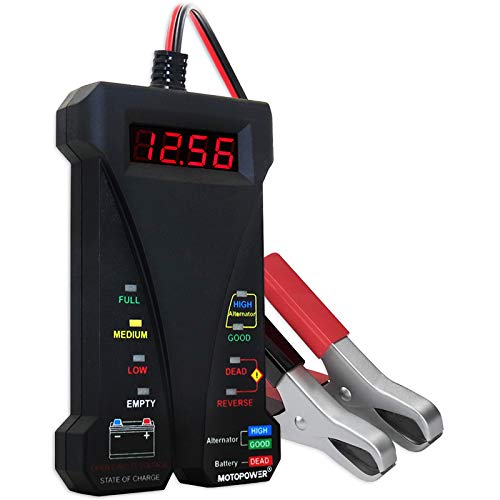
- 4-digit LCD reads voltage to 0.01V
- Tests battery and alternator status
- Lightweight, protected, and easy to carry
Best For: Routine 12V voltage and charging checks
Best Heavy-Duty Load Tester

- Tests both 6V and 12V batteries
- Handles up to 1,000 CCA
- Rugged steel case with portable handle
Best For: Mixed-voltage vehicles and rugged garage use
Best Compact 12V Tester

- Tests battery voltage and alternator output
- Clear LED status indicators
- Reverse-connection and over-voltage protection
Best For: Simple 12V battery and charging-system checks
Best Data-Rich Analyzer
BR502 6V/12V/24V Battery Tester

- Supports 6V, 12V, and 24V batteries
- Measures SOH, SOC, CCA, resistance, and voltage
- Provides results in about two seconds
Best For: Detailed diagnostics across many battery types and vehicles
Best Versatile 12V Monitor

- Checks 12V batteries and alternators
- LCD voltage plus LED status feedback
- 4–30V DC range with reverse protection
Best For: Routine 12V checks across cars, RVs, boats, and powersports vehicles
Compact Load Testing

- Tests 12V batteries from 100–2000 CCA
- Checks load, cranking, and charging systems
- Compact body with storage bag and two-year warranty
Best For: DIY owners needing portable 12V battery checks
Multi-Voltage Diagnostics

- Tests 6V, 12V, and 24V batteries up to 3000 CCA
- Analyzes SOH, SOC, voltage, resistance, cranking, and charging
- Protective housing supports use in busy engine bays
Best For: Multi-vehicle users needing broad voltage coverage
12V Battery Monitoring

- Reports SOH, SOC, voltage, current, and CCA
- Supports common 12V flooded, AGM, GEL, and EFB batteries
- Powered by the vehicle battery with four protective safeguards
Best For: 12V vehicle owners wanting detailed battery readings
Best Overall Value – KONNWEI KW208
For shoppers comparing compact car battery testers, the KONNWEI KW208 stands out as a feature-rich 12V option that fits easily in a glove box or garage. It tests 100-2000 CCA batteries, including flooded, AGM, and gel types, and also evaluates cranking and charging systems.
Best For: Drivers and DIY users who want broad battery compatibility, CCA readings, and alternator and starter testing in one compact device.
Pros:
- Tests 12V batteries from 100-2000 CCA, including AGM and gel batteries.
- Reports voltage, internal resistance, CCA, AH capacity, health, and charge status.
- Compact 230-gram design with plug-and-play operation and eight language options.
Cons:
- Designed for 12V systems rather than 6V batteries.
- Its extensive readouts may be more than casual users need.
The KW208 is a strong all-around pick when you want more than a basic voltage reading. Its wide testing range and system diagnostics make it especially useful for preventative checks before a battery or charging problem leaves you stranded.
Best for Broad Vehicle Use – TOPDON BT100
The TOPDON BT100 is one of the most versatile compact car battery testers for 12V lead-acid batteries. Its battery, cranking, and charging tests cover vehicles ranging from cars and motorcycles to trucks, boats, ATVs, and golf carts.
Best For: Home garages, auto shops, and vehicle owners who need a simple tester that works across many types of 12V equipment.
Pros:
- Supports 100-2000 CCA flooded, AGM, EFB, and gel batteries.
- Provides state-of-health, state-of-charge, voltage, current, and rating information.
- Compact body, color LED indicators, polarity protection, and spark-proof copper clamps.
Cons:
- Only supports 12V batteries.
- Testing requires the unit to be properly connected before it powers on.
The BT100 combines broad compatibility with straightforward menu-based operation. Its visual indicators and safety features make it approachable for DIY users, while the charging and cranking tests add useful diagnostic coverage.
Best for Simple Voltage Checks – MOTOPOWER MP0514A
If you want compact car battery testers focused on quick readings, the MOTOPOWER MP0514A offers a straightforward plug-and-test design. Its 4-digit LCD displays voltage to 0.01 volts, while colored LEDs help indicate battery and alternator status.
Best For: Car owners who want an easy-to-carry 12V battery and charging-system checker with clear visual feedback.
Pros:
- Reads voltage across a 4-20V DC range and displays results on a 4-digit LCD.
- Checks both battery condition and alternator output.
- Includes reverse-connection and over-voltage protection in a lightweight 150-gram housing.
Cons:
- Its supplied features focus on voltage and status indication rather than CCA or internal-resistance testing.
- Designed for vehicles with 12V batteries.
The MP0514A is a practical choice for routine checks and emergency troubleshooting. It is smaller and simpler than advanced battery analyzers, making it convenient to keep in a vehicle or toolbox.
Best Heavy-Duty Load Tester – QWORK 24338
The QWORK 24338 brings a more traditional load-tester design to compact car battery testers. It checks both 6V and 12V batteries, supports loads up to 1,000 CCA, and adds alternator testing for cars, trucks, RVs, golf carts, and other equipment.
Best For: Users who need a rugged, portable tester for mixed 6V and 12V vehicle or recreational-equipment batteries.
Pros:
- Tests both 6V and 12V batteries.
- Supports batteries up to 1,000 CCA and includes alternator testing.
- Shock-resistant steel case, copper-plated clamps, and built-in handle support frequent handling.
Cons:
- Its 1,000 CCA maximum is lower than some competing testers.
- The supplied notes do not specify warranty details.
The QWORK is a sensible option when durability and voltage flexibility matter more than advanced digital analytics. Its steel case and handle suit garage, RV, golf-cart, and ATV use, while the 6V capability broadens its applications.
Best Compact 12V Tester – 12V Car Battery Tester
For drivers seeking compact car battery testers for routine checks, this 12V model combines a clear LED readout with simple battery and alternator status indicators. It reports real-time voltage and uses FULL, HIGH, LOW, and EMPTY indicators to make basic diagnostics easy to interpret.
Best For: 12V vehicle owners who want a straightforward tester for batteries and alternator charging systems.
Pros:
- Tests 12V batteries and evaluates alternator output.
- LED display is designed for easy reading, including at night.
- Reverse-connection and over-voltage protection help guard against wiring errors.
- Works with cars, trucks, motorcycles, boats, golf carts, and lawnmowers.
Cons:
- Limited to 12V systems.
- Provides indicator-based status readings rather than the broader battery data offered by advanced analyzers.
This is a practical choice when quick voltage and charging checks matter more than detailed battery-health measurements. Its compact 4.53-by-2.75-inch design and 81-gram weight also make it convenient to keep in a vehicle or toolbox.
Best Data-Rich Analyzer – BR502 6V/12V/24V Battery Tester
Among compact car battery testers, the BR502 stands out for covering 6V, 12V, and 24V batteries while providing more detailed diagnostic information. Its 1.8-inch screen reports state of health, state of charge, CCA, internal resistance, voltage, and a Good, Normal, or Poor assessment.
Best For: Drivers, mechanics, and marine users who need broader battery compatibility and detailed diagnostic readings.
Pros:
- Supports 6V, 12V, and 24V batteries rated from 100 to 2000 CCA.
- Tests flooded, AGM flat plate, AGM spiral, and gel batteries.
- Displays SOH, SOC, CCA, internal resistance, voltage, and replacement or charging guidance.
- Delivers stated results within two seconds and can test batteries in or out of the vehicle.
Cons:
- The broader feature set may be more than needed for simple voltage checks.
- The screen is compact at 1.8 inches.
Choose the BR502 when a basic voltmeter is not enough. Its wide voltage range and battery-type support make it the most versatile option here, while polarity protection adds reassurance for beginners.
Best Versatile 12V Monitor – ANENG BT172 Battery Tester
The ANENG BT172 is one of the more compact car battery testers for quick 12V battery and alternator checks. It shows live voltage on an LCD, uses LEDs to indicate battery or alternator status, and measures across a 4–30V DC test range with approximately 0.01V accuracy.
Best For: Owners of cars, RVs, motorcycles, boats, and other 12V vehicles who want a compact tester with both LCD and LED feedback.
Pros:
- Tests 12V batteries and analyzes alternator charging performance.
- Offers approximately 0.01V accuracy and a 4–30V DC test range.
- LCD voltage readings are supplemented by LED status indicators.
- Includes reverse-connection protection and displays LO or HI when voltage is outside the range.
Cons:
- Designed for 12V batteries rather than 6V or 24V systems.
- Its supplied functions focus on voltage and status checks rather than CCA or internal-resistance testing.
The BT172 is a sensible middle ground for routine maintenance: more informative than a basic voltage-only display, but simpler than a full battery analyzer. The included clamps, adapter cable, and manual make it ready for common vehicle checks.
Compact Load Testing – MOTOPOWER MP0515A
The MOTOPOWER MP0515A is a straightforward choice among compact car battery testers for checking 12V batteries. It supports 100–2000 CCA testing and combines battery-load, cranking, and charging-system checks in a small 5.91-by-0.91-by-3.35-inch body.
Best For: DIY vehicle owners who want a compact 12V tester with a storage bag and simple automotive diagnostic coverage.
Pros:
- Tests 12V batteries across a 100–2000 CCA range.
- Checks battery load, cranking performance, and the charging system.
- Compact 340-gram design includes a storage bag and two-year manufacturer warranty.
Cons:
- Designed for 12V systems rather than 6V or 24V applications.
- The supplied details do not specify compatibility with battery chemistries beyond automotive 12V batteries.
Choose the MP0515A if portability and core 12V testing matter most. Its narrow body and included storage bag make it convenient to keep in a garage or vehicle toolkit.
Multi-Voltage Diagnostics – VDIAGTOOL BT500
The VDIAGTOOL BT500 stands out among compact car battery testers for its broad 6V, 12V, and 24V coverage. It supports 5–3000 CCA testing, reports voltage, resistance, SOH, and SOC, and also analyzes cranking and charging systems.
Best For: Owners, technicians, and DIYers working across cars, trucks, motorcycles, ATVs, SUVs, boats, and other compatible vehicles.
Pros:
- Supports 6V, 12V, and 24V batteries with a 5–3000 CCA range.
- Works with flooded, AGM flat-plate, AGM spiral, GEL, and EFB batteries.
- Provides battery and alternator diagnostics with reverse-polarity and short-circuit protection.
- Uses a shock-resistant, anti-slip housing and supports 12 languages.
Cons:
- Not intended for lithium, deep-cycle, or golf-cart batteries.
- Correct battery type, standard, and CCA settings are required for accurate results.
The BT500 is the most versatile option here when voltage range and vehicle compatibility are priorities. Its wider diagnostic scope is useful for users who maintain more than one type of vehicle.
12V Battery Monitoring – ANCEL BA101
The ANCEL BA101 is a practical pick among compact car battery testers for 12V vehicles. It measures SOH, SOC, voltage, current, and CCA while checking cranking and charging systems, and it works with several common battery standards and chemistries.
Best For: Drivers and DIY mechanics testing 12V batteries in cars, trucks, boats, RVs, ATVs, lawnmowers, golf carts, and motorbikes over 30Ah.
Pros:
- Measures SOH, SOC, voltage, current, and CCA, plus cranking and charging performance.
- Compatible with flooded, AGM, GEL, and EFB 12V batteries over 30Ah.
- Powered directly by the vehicle battery, so no charging or internal batteries are needed.
- Includes reverse-polarity, short-circuit, overcurrent, and overvoltage protection.
Cons:
- Limited to 12V batteries; it does not test 6V or 24V systems.
- Not suitable for lithium batteries or motorcycles below 30Ah.
- Its 9.5-by-7-by-2-inch dimensions are less compact than some dedicated handheld testers.
The BA101 makes sense for users who want detailed 12V battery information and broad compatibility with conventional battery types. Consider another model if you need lithium, 6V, 24V, or smaller motorcycle-battery support.
How We Picked These Compact Car Battery Testers
We focused on testers designed for practical automotive diagnostics, including battery health checks, starting or cranking tests, alternator output, and charging-system analysis. We also considered supported voltage ranges, stated CCA coverage, display readability, operating simplicity, portability, and whether the tool uses an electronic test method or a traditional load test.
Because specifications vary by model and seller, verify the tester’s supported battery type and testing range before purchase. A device rated for 12V automotive batteries may not be suitable for 6V, 24V, AGM, GEL, or deep-cycle batteries unless those applications are explicitly listed.
Quick Comparison
| Best For | Look For |
|---|---|
| Routine home checks | Simple digital readings and clear status indicators |
| Battery and alternator diagnosis | Dedicated cranking and charging-system tests |
| High-current traditional testing | 100A load capability and appropriate cooling guidance |
| Multiple vehicle types | 6V, 12V, and 24V compatibility with a broad CCA range |
Key Buying Factors for Compact Car Battery Testers
Voltage and Battery Compatibility
Most passenger cars use 12V batteries, but trucks, RVs, golf carts, motorcycles, and commercial equipment may use different systems. Choose a tester that matches both the battery voltage and chemistry. Multi-voltage models offer flexibility, but only when their instructions support your specific battery.
Testing Functions
Voltage measurement shows the battery’s present electrical state, but it does not tell the whole story. For more useful diagnosis, look for conductance or internal-resistance testing, rated CCA measurement, load testing, and separate alternator, cranking, or charging checks. A tester with several functions can help distinguish a failing battery from a starter or alternator problem.
CCA Range and Accuracy
Match the tester’s CCA range to the rating printed on your battery. A broad range is useful for vehicles with different battery sizes, while a clearly labeled result is easier to interpret than raw voltage alone. Electronic testers are generally convenient for quick checks; load testers may provide a more direct stress test but require careful operation.
Portability and Usability
Compact dimensions, strong insulated leads, reverse-polarity protection, a readable LCD, and straightforward controls matter when testing in a driveway or roadside situation. LED indicators can speed up basic checks, while a backlit display is valuable in low light. Look for robust cable connections and instructions that explain test timing.
Who Should Buy Which Compact Car Battery Testers?
Choose a basic 12V digital analyzer if you want occasional home checks before a long trip. Pick a model with alternator and cranking tests if you are troubleshooting repeated starting problems. A traditional 100A load tester suits experienced users who want a physical load test and can follow the required safety and cooldown procedures. For mixed fleets, RVs, or unusual applications, select a multi-voltage tester with a suitably wide CCA range.
