

10 Best Compact Quiet Garage Air Compressors for 2026: Low-Noise Picks for Home Projects

A good garage compressor should deliver useful air power without dominating the workspace with noise or taking up more room than necessary. This roundup compares 10 compact quiet garage air compressors across small portable models, wall-mounted designs, and larger tanks for demanding DIY work.
We focused on practical differences that matter in a home garage: sound levels, tank capacity, pressure, airflow, portability, maintenance, and the kinds of tools each compressor can realistically support.
Best 10 Compact Quiet Garage Air Compressors Picks for 2026
Quiet Job-Site Choice
Makita MAC210Q 2-Gallon Quiet Compressor

- 60 dB operation for quieter indoor work
- Oil-free pump needs minimal maintenance
- Lightweight 44-pound roll-cage design
Best For: Indoor garage projects and light pneumatic tasks
Space-Saving Garage Pick
CRAFTSMAN Wall-Mount 0.5-Gallon Compressor

- Wall-mount design saves garage floor space
- Retractable 30-foot hose improves reach
- Includes an eight-piece accessory kit
Best For: Tire inflation and organized home garage setups
High-Capacity Quiet Workhorse
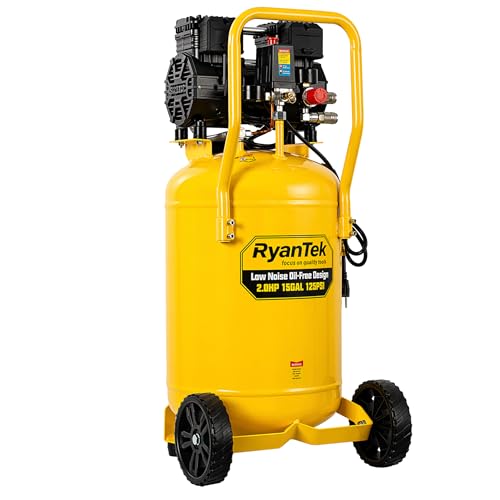
- 15-gallon tank reduces frequent cycling
- 4.5 CFM at 90 PSI supports demanding tools
- 66 dB oil-free twin-cylinder operation
Best For: Workshops needing capacity for tools, painting, and repair
Accessory-Ready Pancake Pick
ECOMAX 6-Gallon 150 PSI Compressor

- Six-gallon portable pancake-tank design
- 150 PSI maximum pressure
- Includes a 25-foot hose and 10-piece accessory kit
Best For: General garage inflation and light pneumatic tasks
Best Overall
DEWALT DWFP55130 Quiet Trim Compressor

- 3.0 SCFM at 90 PSI with 200 PSI maximum pressure
- Compact 2.5-gallon tank and flexible storage orientation
- Oil-free, 71.5 dBA operation with dual couplers
Best For: Trim carpentry and compact garage storage
Best Larger-Tank Value
5-Gallon Quiet Oil-Free Compressor

- 5-gallon tank with 2.8 CFM at 90 PSI
- 68 dB stated operation with induction motor
- Includes wheels, 25-foot hose, and 13-piece kit
Best For: Versatile garage pneumatic-tool use
Best All-Around Pick
MZB 2.4-Gallon Ultra Quiet Compressor

- 5.65 CFM airflow at up to 115 PSI
- 70 dB oil-free operation
- Compact steel tank for varied garage tasks
Best For: Versatile auto repair, painting, carpentry, and nailing
Best Heavy-Duty Pick
FORNAX 1.3-Gallon Silent Compressor
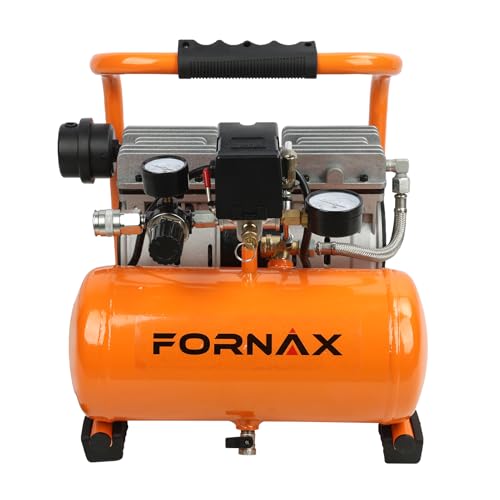
- 65 dB operating noise
- Lightweight, portable hot-dog design
- 125 PSI maximum with 1.7 CFM at 90 PSI
Best For: Quiet inflation, airbrushing, trim work, and light pneumatic tools
Best for Larger Air Reserves
VEVOR 13-Gallon Quiet Compressor

- 13-gallon tank for extended work
- 4.6 CFM at 90 PSI and 125 PSI max
- 66 dB oil-free operation with wheels
Best For: Larger garage projects, spray painting, auto repair, and woodworking
Quiet Job-Site Choice – Makita MAC210Q 2-Gallon Quiet Compressor
Makita MAC210Q Quiet Series, 1 HP, 2 Gallon, Oil-Free, Electric Air Compressor
Check Price On AmazonFor shoppers comparing compact quiet garage air compressors, the Makita MAC210Q stands out with a 60 dB operating level, a compact 2-gallon tank, and a lightweight design. Its oil-free pump keeps routine maintenance simple, while the roll cage adds protection for transport and storage.
Best For: Indoor garage work, light pneumatic tasks, tire inflation, and users who prioritize lower operating noise and portability.
Pros:
- Quiet 60 dB operation is well suited to indoor use.
- Oil-free dual-piston pump requires minimal maintenance.
- Lightweight 44-pound design and roll-cage construction improve portability and protection.
- 135 PSI maximum pressure supports a range of light-duty applications.
Cons:
- The 2-gallon tank is smaller than those on larger workshop compressors.
- Its 1.6 CFM airflow is better suited to lighter tasks than sustained high-demand tool use.
The MAC210Q is a practical pick when quiet operation and easy movement matter more than extended runtime. It offers a good balance for garages, indoor projects, and occasional pneumatic work.
Space-Saving Garage Pick – CRAFTSMAN Wall-Mount 0.5-Gallon Compressor
The CRAFTSMAN wall-mount model is a compact quiet garage air compressor designed to save floor space. It weighs 20.9 pounds, includes a retractable 30-foot hose, and combines a 0.5-gallon tank with 125 PSI maximum pressure for inflation and other light garage jobs.
Best For: Garage tire inflation, home workshops, and users who want a wall-mounted setup with included accessories and a long reach hose.
Pros:
- Wall-mount design preserves valuable garage floor space.
- Retractable 30-foot hose provides useful reach around a vehicle or work area.
- Includes an eight-piece accessory kit for inflation and pneumatic tasks.
- Oil-free motor is easier to maintain and is rated for cold-weather operation.
Cons:
- The 0.5-gallon tank limits stored air for longer continuous tool use.
- Its 65 dB noise rating is quiet-oriented but not the lowest among the listed options.
This CRAFTSMAN is especially appealing when organization and convenience are priorities. The small tank favors quick tasks, while the wall-mount format and included hose make it a tidy choice for routine garage use.
High-Capacity Quiet Workhorse – 15-Gallon 2 HP Air Compressor
For buyers who need more capacity than a small portable unit, this 15-gallon model offers a relatively quiet 66 dB operation with a vertical, space-conscious design. Its 2 HP twin-cylinder pump delivers 4.5 CFM at 90 PSI, helping support longer work sessions and demanding garage applications.
Best For: Home workshops, nail guns, spray painting, auto repair, woodworking, and users who need reduced cycling from a larger tank.
Pros:
- Large 15-gallon tank helps reduce frequent motor cycling.
- Delivers 4.5 CFM at 90 PSI for more demanding pneumatic work.
- 66 dB oil-free operation provides a quieter, cleaner-air alternative.
- Vertical footprint, wheels, and handle support workshop mobility and storage.
Cons:
- At 68.3 pounds, it is less convenient to carry than compact pancake or small-tank models.
- The larger tank requires more dedicated garage space despite its vertical layout.
This compressor is the strongest capacity-focused option in the group. It is a sensible choice when sustained airflow and fewer recovery cycles matter more than minimum size or weight.
Accessory-Ready Pancake Pick – ECOMAX 6-Gallon 150 PSI Compressor
ECOMAX Air Compressor 6 Gallon 150 PSI Pancake Portable Oil-free Tank with 10 PCS Accessories Kit
Check Price On AmazonThe ECOMAX 6-gallon pancake compressor is a portable option for garage users who value included accessories and a high 150 PSI maximum. At 34.17 pounds, it is easier to move than a large tank compressor, though its 75 dB noise rating makes it less focused on quiet operation than the other models here.
Best For: Inflation, blow cleaning, brad and stapler use, light spraying, and buyers who want a portable compressor with a broad accessory kit.
Pros:
- Six-gallon tank offers more reserve air than the smallest compact models.
- 150 PSI maximum pressure provides useful operating headroom.
- Includes a 25-foot hose, blow gun, tire gauge, couplers, nozzle, and other accessories.
- Flip-up handle, dual gauges, dual quick couplers, and oil-free operation improve convenience.
Cons:
- Its 75 dB noise rating is relatively high for a quiet-compressor roundup.
- The supplied airflow specification is listed as 3 cubic inches per minute, so buyers should verify performance requirements for specific tools.
The ECOMAX is a practical all-in-one package for general garage chores and inflation. Choose it for portability, accessories, and tank capacity rather than for the quietest possible operation.
Best Overall – DEWALT DWFP55130 Quiet Trim Compressor
The DEWALT DWFP55130 is a practical choice for compact quiet garage air compressors when you need dependable nail-gun performance without taking up much space. Its 2.5-gallon tank, 200 PSI maximum pressure, and 71.5 dBA operation suit trim work, light pneumatic tasks, and portable storage.
Best For: Trim carpentry, supporting two nailers, and garages where vertical or horizontal storage matters.
Pros:
- Delivers 3.0 SCFM at 90 PSI with a 2.5-gallon tank for nailer work and quick recovery.
- Compact 36-pound design can be stored or operated vertically or horizontally.
- Oil-free pump, low 12-amp draw, dual quick couplers, and protective roll cage add convenience.
Cons:
- At 71.5 dBA, it is quieter than many compressors but not the quietest option in this group.
- The 2.5-gallon tank is more suited to trim and intermittent tasks than extended air-tool use.
Choose this DEWALT when portability, flexible storage, and nailer support are more important than maximum tank capacity or the lowest possible noise rating.
Quietest Compact Pick – 1-Gallon Ultra-Quiet Compressor
For shoppers comparing compact quiet garage air compressors, this 1-gallon model emphasizes low noise, fast filling, and easy portability. Its stated 60 dB operation and 23.7-pound weight make it convenient for indoor projects, tire inflation, nailing, and occasional cleaning.
Best For: Quiet indoor use, quick fastening tasks, tire inflation, and small garage or workshop projects.
Pros:
- Operates at a notably quiet 60 dB and weighs 23.7 pounds for easy movement.
- Reaches full pressure in 13 seconds and recovers to 120 PSI in 4 seconds, according to the supplied specifications.
- Oil-free design, quick connectors, low-voltage start, and multiple protection features simplify use.
Cons:
- The 1-gallon tank provides less stored air than larger garage compressors.
- The manufacturer recommends plugging directly into a wall outlet rather than using an extension cord or power strip.
- Its 120 PSI maximum pressure is lower than the DEWALT option in this roundup.
This is the strongest fit when minimizing noise and moving the compressor easily are priorities, though heavier or continuous pneumatic-tool work may call for a larger tank.
Best Larger-Tank Value – 5-Gallon Quiet Oil-Free Compressor
This 5-gallon model is a useful option among compact quiet garage air compressors when you want more stored air for pneumatic tools without moving to a louder compressor. It runs at a stated 68 dB and includes wheels, a hose, and accessories for garage, woodworking, nailing, and inflation tasks.
Best For: Garage users who need a larger tank for nailers, blow cleaning, inflation, and varied pneumatic tools.
Pros:
- Five-gallon tank and 2.8 CFM at 90 PSI support a broad range of listed air tools.
- Induction motor is specified at 68 dB for smoother, quieter operation.
- Includes wheels, a 25-foot hose, and a 13-piece accessory kit.
- Oil-free design reduces routine maintenance and is designed for reliable cold-weather starting.
Cons:
- Its 5-gallon tank and wheels make it less compact for tight storage than the 1-gallon model.
- The listed specifications show a 120 PSI maximum pressure, below the DEWALT’s 200 PSI rating.
- The supplied notes give both 68 dB and 70 dB noise figures, so actual operating noise may vary.
Consider this compressor when tank capacity and included equipment matter more than the smallest footprint. It offers a useful middle ground between portability and longer pneumatic-tool sessions.
Best All-Around Pick – MZB 2.4-Gallon Ultra Quiet Compressor
For shoppers comparing compact quiet garage air compressors, the MZB combines a 2.4-gallon steel tank with a 1.2HP oil-free motor and 5.65 CFM airflow. Its 70 dB operating level, 110V power, and portable design suit a range of garage and workshop tasks.
Best For: Auto repair, carpentry, spray painting, tire inflation, and pneumatic nailing where a versatile portable compressor is useful.
Pros:
- Fills its tank in approximately 28–32 seconds.
- Delivers up to 5.65 CFM at 115 PSI.
- Oil-free operation reduces contamination and routine maintenance.
- Compact 19-by-8-by-19-inch design is easier to carry and store.
Cons:
- Its 70 dB rating is quiet relative to many compressors but not silent.
- The 2.4-gallon tank is smaller than models intended for extended, continuous tool use.
The MZB is a strong general-purpose choice when you want high stated airflow in a compact format. It is particularly appealing for users who need one oil-free compressor for varied garage, painting, and woodworking jobs.
Best Heavy-Duty Pick – FORNAX 1.3-Gallon Silent Compressor
The FORNAX is a practical contender among compact quiet garage air compressors, with a 65 dB noise rating and a low-speed 1HP oil-free motor. Its portable hot-dog format is designed for inflation, trim work, airbrushing, and lighter pneumatic-tool jobs.
Best For: Home garages, indoor workshops, tire and bike inflation, airbrushing, stapling, and other tasks where reduced operating noise matters.
Pros:
- 65 dB operation is the quietest stated rating in this group.
- Oil-free 1HP motor runs at a relatively low 1,450 RPM.
- Portable design weighs approximately 31.75 pounds.
- Reaches up to 125 PSI and provides 1.7 CFM at 90 PSI.
Cons:
- The 1.3-gallon tank offers less stored air than larger garage compressors.
- Its 1.7 CFM at 90 PSI is better suited to lighter-duty tools than high-demand continuous applications.
- The supplied information does not specify the tank refill time.
Choose the FORNAX when noise, portability, and everyday convenience take priority over tank capacity and airflow. It is a sensible fit for intermittent garage work and indoor use, especially with inflators and small nailers.
Best for Larger Air Reserves – VEVOR 13-Gallon Quiet Compressor
The VEVOR provides a larger-capacity alternative for buyers seeking compact quiet garage air compressors with more stored air. Its 13-gallon tank, 2HP oil-free motor, 4.6 CFM output at 90 PSI, and 66 dB rating support longer or more demanding garage tasks.
Best For: Auto repairs, woodworking, spray painting, inflation, and users who need a larger tank for repeated work between compressor cycles.
Pros:
- Large 13-gallon tank supplies a substantial air reserve.
- Builds pressure in under three minutes according to the supplied notes.
- Provides 4.6 CFM at 90 PSI and reaches 125 PSI maximum.
- Oil-free 66 dB operation and 7-inch rubber wheels improve convenience.
Cons:
- At 71 pounds and 33.3 inches tall, it is less compact and portable than the smaller models.
- The larger tank requires more floor space for storage.
- Its wheel-based design is easier to move than carry, rather than ideal for frequent lifting.
The VEVOR is the better match when tank capacity and sustained garage utility matter more than minimum footprint. Although it is the largest option here, its 66 dB operation and wheels make the extra capacity more manageable for stationary workshop use.
How We Picked These Compact Quiet Garage Air Compressors
We evaluated the selected models by comparing their advertised noise ratings, tank sizes, maximum pressure, airflow at 90 PSI, power design, portability, and included accessories. We also considered how each format fits common garage tasks, including tire inflation, brad and finish nailing, stapling, light cleaning, and intermittent pneumatic-tool use.
Because manufacturer specifications can vary by testing method, treat decibel figures as useful comparisons rather than absolute guarantees. Actual noise depends on distance, flooring, walls, and whether the compressor is cycling under load.
Quick Comparison
| Best For | Recommended Format | What to Prioritize |
|---|---|---|
| Tire inflation and occasional repairs | 1- to 2.4-gallon portable unit | Low noise, fast fill, easy storage |
| Trim, brad, and finish nailers | 2- to 6-gallon oil-free compressor | Regulated pressure and adequate recovery |
| Longer pneumatic-tool sessions | 13- to 15-gallon tank | Higher CFM at 90 PSI and stronger duty cycle |
| Limited floor space | Wall-mounted or compact vertical model | Mounting hardware, hose reach, and accessibility |
Key Buying Factors for Compact Quiet Garage Air Compressors
Noise and Placement
Look for a published rating around 60 to 70 dB when quiet operation is a priority. Oil-free models generally reduce maintenance, while rubber feet, vibration isolation, and placement away from walls can further reduce rattling. A wall-mounted unit saves floor space but should be installed on a properly supported surface.
Tank Size and Airflow
A larger tank provides a longer reserve before the motor restarts, but it also adds weight and takes more space. Tank capacity alone does not determine tool performance. Check CFM at 90 PSI when available: nailers and inflators need relatively little, while grinders, sanders, and spray equipment require substantially more continuous airflow.
Pressure, Duty Cycle, and Power
Higher maximum PSI can be useful for storage capacity and specialized tools, but it does not automatically mean faster operation. Confirm that the compressor’s voltage matches your outlet and that its duty cycle suits your work pattern. Most compact garage models are best for intermittent use rather than continuous-duty tools.
Portability and Accessories
Handles, wheels, hose length, quick-connect fittings, and included inflator accessories can make a modest compressor much more convenient. For tire work, an accurate gauge and sufficiently long hose may matter more than maximum PSI.
Who Should Buy Which Compact Quiet Garage Air Compressors?
Choose a 1-gallon or similarly compact model if storage space is extremely limited and your main jobs are topping off tires or running a small nailer occasionally. A 2- to 6-gallon compressor is the most versatile choice for trim work, DIY repairs, inflation, and general home maintenance. Select a 13- or 15-gallon model when you need more reserve capacity and better recovery for repeated tool use, provided you have room for the larger footprint.
For the quietest practical setup, compare decibel ratings first, then match CFM and tank capacity to your tools. Buying the smallest compressor that meets your actual airflow needs usually delivers the best balance of noise, storage, cost, and usability.
