

10 Best Compact Wheel Balancer Machines for Garages and Tire Shops in 2026

The best compact wheel balancer machines help garages and tire technicians improve ride quality without giving up valuable floor space. This roundup compares portable, automatic, manual, and combination systems across different budgets and workloads.
Use the product details below to compare rim capacity, measurement features, motor power, accuracy, portability, and overall shop fit before choosing a machine.
Best 10 Compact Wheel Balancer Machines Picks for 2026
Best Professional Pick
MutsMover Automatic Wheel Balancer

- Automatic A/D measurement and smart balancing modes
- Laser guide, LED light, and electronic brake
- 10-26-inch rim range with 40mm spindle
Best For: Professional shops needing efficient, versatile operation
Best Portable Option
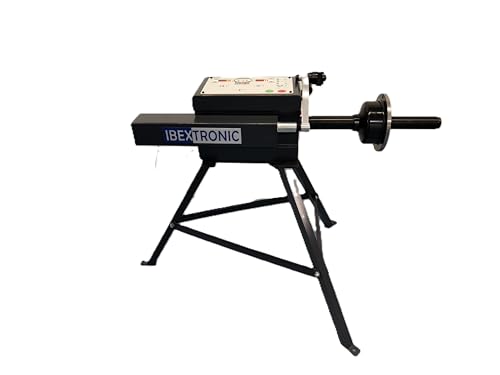
- Portable 44-pound main unit
- USB Type-C DC 5V/1A power
- Supports aluminum-rim ALU2/ALU3 modes
Best For: Home shops, garages, and mobile setups
Best Heavy-Duty Capacity

- Supports wheels up to 143 pounds
- Automatic ruler enters A/D measurements
- Handles 8-24-inch diameters and 1.5-20-inch widths
Best For: Busy repair shops handling varied or heavier wheels
Best Versatile Manual Choice

- 1-gram balancing accuracy
- Self-calibration and ALU support
- Handles standard, motorcycle, and racing tires
Best For: Workshops servicing specialty and varied wheel types
Best Value for Rim Coverage

- Pure-copper motor for heat management
- Extended shaft for wider wheels
- Multiple rim-specific balance modes
Best For: Home garages and service shops handling wider or custom rims
Best All-in-One Setup
WEIZE Tire Changer and Balancer Combo
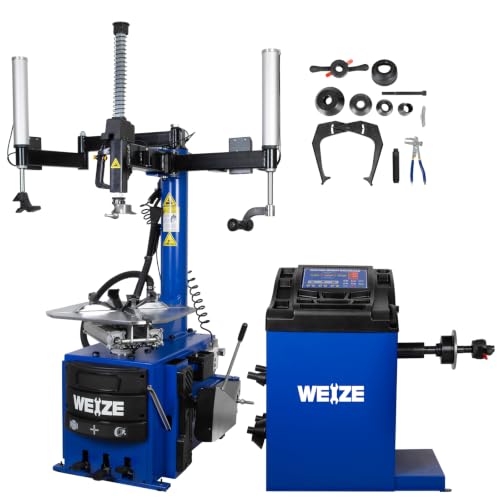
- Combines changing and balancing functions
- Dual assist arms aid difficult tire mounting
- Built-in bead blaster seats tough beads
Best For: Professional shops needing an integrated tire-service station
Best for Precision Controls
KATRAX KT-B700 Professional Balancer

- Auto-detects common rim types
- Stated ±1g balancing accuracy
- Includes a 12-month full warranty
Best For: Garages and tire shops prioritizing automated, precise balancing
Best Compact Manual Balancer
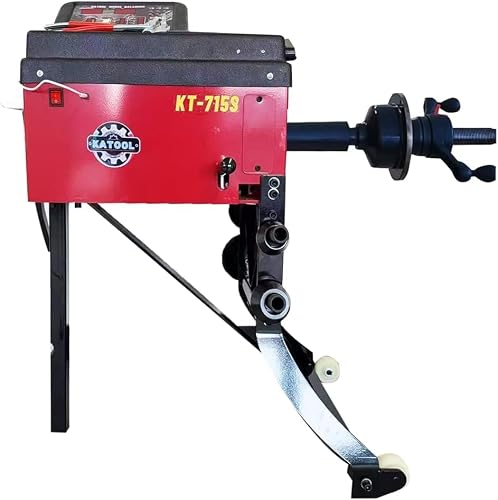
- 10- to 24-inch rim compatibility
- 15-second measurement cycles
- Portable 35-pound design
Best For: Home garages and smaller shops needing a movable balancer
Best Heavy-Duty Combo

- Tire changer and balancer in one setup
- Balances rims up to 28 inches
- Includes assist arm and bead blaster
Best For: Professional shops with dedicated installation space
Best Shop and DIY Combo

- Balances 10- to 28-inch rims
- Dynamic, static, and four ALU modes
- 2.0HP changer with 10 Bar force
Best For: Mid-volume shops and serious DIY garages
Best Professional Pick – MutsMover Automatic Wheel Balancer
For shops looking for compact wheel balancer machines with professional automation, this MutsMover model combines automatic rim measurement, laser guidance, and a heavy-duty spindle in a 110V design. Its 10-26-inch rim range makes it suitable for varied workshop workloads.
Best For: Professional auto shops that need fast, repeatable wheel balancing across a broad range of wheels.
Pros:
- Automatically measures rim A/D values and includes a sonic tire-width sensor.
- Laser guidance, LED lighting, electronic brake, and a large five-window display support accurate operation.
- Handles 10-26-inch rims with a thickened, lengthened 40mm spindle.
- Includes smart balancing modes, auto-calibration, energy-saving mode, and a 12-month warranty.
Cons:
- Its professional steel construction and feature set may be more than occasional users need.
- The supplied notes do not specify the machine’s overall shipping weight or dimensions.
This is the most automation-focused option in the group. Choose it when workflow speed, broad wheel compatibility, and shop-oriented controls matter more than having the lightest machine.
Best Portable Option – I40 PRO Mini Wheel Balancer
If portability is your priority, this I40 PRO is one of the more compact wheel balancer machines to consider for a home shop, garage, workbench, or mobile setup. It uses a USB Type-C DC 5V/1A connection and weighs 44 pounds for the main unit.
Best For: Home mechanics, small garages, and mobile users who need a lighter, easily installed balancer.
Pros:
- Portable design with a 44-pound/20 kg main unit.
- USB Type-C power input using DC 5V/1A.
- Supports ALU2 and ALU3 non-standard modes for aluminum rims.
- Offers stated balancing accuracy of ±0.04 oz (1 g) and supports wheels up to 22 inches.
Cons:
- Hand-spin operation requires turning the wheel two to three circles.
- Its 22-inch maximum wheel diameter is narrower than some full-size alternatives.
- The supplied information lists both 44-pound main-unit weight and 74.8-pound item weight, so buyers should verify the relevant shipping configuration.
The I40 PRO stands out for installation flexibility and low-voltage portability. It is a practical fit for lighter-duty work, but users wanting automated operation or a larger capacity may prefer a shop-size model.
Best Heavy-Duty Capacity – KATOOL KT-B750 Wheel Balancer
The KATOOL KT-B750 is a strong choice among compact wheel balancer machines for workshops that regularly handle heavier wheels. It supports wheels up to 143 pounds, accepts 110V power, and uses an automatic measurement ruler to enter key rim dimensions quickly.
Best For: Repair shops balancing a wide mix of passenger, specialty, and heavier wheels.
Pros:
- Handles wheel weights up to 143 pounds.
- Automatic ruler inputs “A” and “D” values for faster setup.
- Supports rim widths from 1.5 to 20 inches.
- Accommodates rim diameters from 8 to 24 inches and uses standard 110V power.
Cons:
- At 278 pounds, it is less convenient to move than the portable mini model.
- The supplied notes do not list a stated balancing-accuracy figure.
- Its substantial size and capacity may be unnecessary for occasional home use.
With its high weight capacity and broad width and diameter ranges, the KT-B750 is geared toward demanding service environments. It makes the most sense when versatility and stability outweigh portability.
Best Versatile Manual Choice – Motool KT-710G Wheel Balancer
Motool Technology Professional Auto Wheel Balancer Portable Car Tire Balancer for Tire Workshops
Check Price On AmazonThis Motool KT-710G offers a straightforward manual approach for buyers comparing compact wheel balancer machines. It provides 1-gram balancing accuracy, covers 10-24-inch rims, and includes self-calibration plus ALU functionality for specialty and unusually shaped rims.
Best For: Tire workshops and experienced users balancing standard, motorcycle, racing, or specialty-rim tires.
Pros:
- Rated balancing accuracy is 1 gram.
- Self-calibration adjusts across a wide range.
- ALU function supports rims with various special shapes.
- Can balance ordinary tires as well as motorcycle and racing tires.
Cons:
- The supplied notes identify it as a manual balancer, so it may require more hands-on setup than automatic models.
- Its 10-24-inch rim range is smaller than the 10-26-inch range of the MutsMover model.
- The notes do not provide a machine weight or overall dimensions.
The KT-710G is appealing when adaptability matters more than extensive automation. Its self-calibration and ALU support make it a flexible choice for workshops that service specialty wheels.
Best Value for Rim Coverage – KATOOL KT-B700 Wheel Balancer
KATOOL Wheel Balancer KT-B700 Machines HomeGarageEquipment Service Shop Tools Repair
Check Price On AmazonFor garages comparing compact wheel balancer machines, the KATOOL KT-B700 focuses on dependable operation and broader wheel fitment. Its pure-copper motor, stable circuit board, extended shaft, and rim-specific balance modes make it a practical choice for regular service work.
Best For: Home garages and service shops that need a durable balancer with compatibility for wider wheels and custom rims.
Pros:
- Pure-copper motor supports heat dissipation and long operating life.
- Extended shaft accommodates wider wheels and custom rims.
- Multiple rim-specific modes support precise balancing across wheel types.
- Stable circuit board promotes consistent power delivery.
Cons:
- At 278 pounds, it is not especially easy to reposition.
- Its 30 x 35 x 40-inch dimensions require dedicated floor space.
The KT-B700 is a solid fit when wheel compatibility and service durability matter more than portability. Its larger footprint is the main trade-off for the extended shaft and shop-oriented construction.
Best All-in-One Setup – WEIZE Tire Changer and Balancer Combo
The WEIZE combo stands apart from standalone compact wheel balancer machines by combining tire changing, bead seating, inflation, and balancing in one heavy-duty unit. It covers a wide range of rims and tires while adding dual assist arms for more controlled mounting.
Best For: Professional shops that want one integrated machine for tire changing and wheel balancing, including work with run-flat and low-profile tires.
Pros:
- Handles external 10–22-inch and internal 12–24-inch rim clamping ranges.
- Dual assist arms help manage run-flat and low-profile tire mounting.
- Integrated 8–10 bar air bead blaster supports difficult bead seating.
- 250W balancer measures rim data for wheels from 10–28 inches and operates below 70 dB.
Cons:
- At 795 pounds, it is substantially less portable than a standalone balancer.
- The large combination design requires significant shop space.
This is the most capable option for shops seeking a complete tire-service station rather than a compact balancing-only machine. Its weight and footprint make it better suited to a permanent professional installation.
Best for Precision Controls – KATRAX KT-B700 Professional Balancer
For buyers prioritizing precise operation in compact wheel balancer machines, the KATRAX KT-B700 offers automatic rim detection and stated accuracy of ±1 gram. Its 0.25KW pure-copper motor, vibration-dampening base, and reinforced frame are designed for repeated garage or tire-shop use.
Best For: Garages and tire shops that want automatic rim-mode selection, wide wheel compatibility, and a 12-month full warranty.
Pros:
- Auto-detects alloy, steel, and chrome rims and adjusts balance modes.
- Provides stated balancing accuracy of ±1 gram.
- Extended shaft supports wider wheels, including truck, SUV, and custom rims.
- Reinforced frame and vibration-dampening base suit shop environments.
Cons:
- The 39 x 31 x 26-inch package dimensions still require dedicated workspace.
- Its professional construction may be more machine than occasional users need.
The KATRAX model is a strong choice when automated rim recognition and fine balance accuracy are central requirements. The included 12-month full warranty adds useful coverage for professional users.
Best Compact Manual Balancer – KATOOL KT-715S
The KATOOL KT-715S is a practical choice among compact wheel balancer machines for home garages and smaller shops. Its 10- to 24-inch rim range, 65kg capacity, 15-second cycle time, and transport wheels support flexible day-to-day tire service without taking up excessive space.
Best For: Home garages and shops that need a movable, space-conscious manual balancer.
Pros:
- Handles 10- to 24-inch rims and 1.5- to 20-inch wheel widths.
- Measures in approximately 15 seconds per cycle.
- Offers electronic control, push-button calibration, and a 65kg wheel capacity.
- Compact 35-pound design includes integrated transport wheels.
Cons:
- Manual operation may be less convenient than a fully automated setup.
- Its 65kg capacity may not suit especially heavy wheels.
With useful coverage, quick cycles, and a portable footprint, the KT-715S is a strong fit when shop space and mobility matter. It is best suited to buyers who want electronic assistance in a compact manual format.
Best Heavy-Duty Combo – KATOOL KT835 and KT-B760
The KATOOL KT835 and KT-B760 combo combines tire changing and balancing in one professional-oriented setup. It is less compact than standalone compact wheel balancer machines, but its 14- to 24-inch inside-clamp range, 28-inch balancer rim capacity, alloy-steel jaws, and bead-blast assist target demanding workshop use.
Best For: Professional automotive workshops that need an integrated tire-changing and balancing workflow.
Pros:
- Combines a tire changer with a wheel balancer.
- Tire changer supports 14- to 24-inch inside clamping.
- Wheel balancer accommodates rims up to 28 inches.
- Includes a double-side assist arm and bead-blast seater.
Cons:
- At 661 pounds, it is difficult to move or reposition.
- Its 46 x 34 x 33-inch package requires substantial shop space.
- Designed for 110V power rather than a compact portable setup.
This combo makes sense when workflow efficiency and broad wheel coverage outweigh portability. Buyers should plan for dedicated floor space and a stable installation area.
Best Shop and DIY Combo – BILT Hard 2.0HP Combo
The BILT Hard tire changer and wheel balancer combo offers broad compatibility for shops and serious DIY garages. Although it is not a standalone compact wheel balancer machine, the 110V system pairs a 2.0HP tire changer with a 250W balancer supporting 10- to 28-inch rims and both dynamic and static balancing.
Best For: Mid-volume shops and serious DIY users seeking one setup for tire changing and balancing.
Pros:
- Wheel balancer supports 10- to 28-inch rims and 1.5- to 18-inch widths.
- Performs both dynamic and static balancing with four ALU modes.
- 2.0HP tire changer provides 10 Bar of bead-breaking force.
- Both machines use standard 110V/60Hz power.
Cons:
- A two-machine combo requires more space than a standalone balancer.
- Manual A and D value input requires hands-on measurement setup.
- The supplied product dimensions are listed as 1 x 1 x 1 inches, so actual space requirements should be confirmed.
This package is appealing for buyers who want a complete tire-service workflow rather than a single balancing unit. Its broad rim coverage and ALU modes add flexibility, while the 110V operation suits many garage environments.
How We Picked These Compact Wheel Balancer Machines
We selected machines representing the main use cases in this category: occasional home-garage work, mobile tire service, routine automotive repair, and higher-volume shop use. We compared stated rim ranges, measurement systems, balancing accuracy, motor specifications, portability, included safety features, and whether each unit works independently or as part of a tire-changing setup.
Because specifications and included accessories can vary by seller, confirm the current listing before purchase. Pay particular attention to voltage, shipping requirements, wheel guard availability, spindle dimensions, and calibration or installation needs.
Quick Comparison
| Best For | What to Prioritize | Recommended Type |
|---|---|---|
| Home garage | Simple controls, compact footprint, reasonable price | Manual or entry-level automatic balancer |
| Mobile service | Low weight, compact storage, easy power requirements | Portable mini or lightweight machine |
| General repair shop | Automatic measurements, wheel protection, repeatability | Automatic balancer with guard |
| Busy tire shop | Speed, durability, accuracy, and workflow efficiency | Professional automatic unit or changer-and-balancer combo |
Key Buying Factors for Compact Wheel Balancer Machines
Rim and Wheel Capacity
Check both the minimum and maximum rim sizes, along with the supported wheel width and weight. A machine that handles common passenger-car wheels may not accommodate larger truck, SUV, or specialty rims.
Measurement and Balancing Accuracy
Automatic A/D measurement, electronic rulers, laser guides, and digital readouts can reduce setup time and improve consistency. Look for clearly stated accuracy, such as ±1 gram, but remember that correct mounting and calibration are equally important.
Motor, Power, and Operating Environment
Compare motor wattage or horsepower with your expected workload. Confirm whether the unit requires 110V or another supply, and allow adequate clearance for the wheel guard and operator access. USB-powered portable models are convenient, but they are generally intended for lighter-duty work.
Safety and Convenience Features
A wheel guard, electronic brake, LED lighting, automatic stop, and laser positioning can make operation faster and safer. A heavier base may improve stability, while a lightweight frame is preferable when the machine must be moved frequently.
Who Should Buy Which Compact Wheel Balancer Machines?
Choose a manual balancer if you work on a small number of wheels and value low cost, simplicity, and minimal maintenance. Select a portable mini model for occasional use or mobile applications where storage and transport matter more than throughput.
For most home garages and independent repair shops, an automatic machine with an integrated measurement ruler offers the best balance of convenience and repeatability. Professional tire shops should consider a durable automatic unit with a guard, brake, laser or LED guidance, and a motor suited to continuous use.
If you also need tire-mounting capability, a changer-and-balancer combo can save space and coordinate the workflow, but verify the included accessories, air requirements, rim range, and installation instructions before ordering. Regardless of type, plan for proper leveling, calibration, and regular cleaning to maintain accurate results.
