

10 Best Digital Battery Load Testers for Fast, Accurate Vehicle Diagnostics in 2026

A reliable battery tester can help you identify weak starting power before a vehicle leaves you stranded. The best digital battery load testers provide fast readings for voltage, cranking performance, battery condition, and charging-system output.
We compare 10 automotive testers ranging from compact 12V analyzers to versatile 6V, 12V, and 24V models. Use the guide below to match testing range, accuracy, display features, and battery compatibility to your vehicle or workshop.
Best 10 Digital Battery Load Testers Picks for 2026
Best Value
KONNWEI KW208 12V Battery Tester

- Tests 12V batteries from 100-2000 CCA
- Includes cranking, charging, alternator, and starter tests
- Compact design with updated alloy clips
Best For: Budget-minded DIY vehicle owners
Best 12V/24V Coverage

- Supports 12V and 24V batteries
- Performs battery, cranking, and charging tests
- Color LCD with memory function and rugged housing
Best For: Mixed-voltage vehicles and demanding DIY diagnostics
Best Manual Load Testing

- Provides 100A 12V and 50A 6V load tests
- Checks battery, starter consumption, and charging system
- Portable housing with insulated handle and copper clips
Best For: Simple garage testing of 6V and 12V batteries
Best Compact Choice
TOPDON BT100 12V Battery Tester

- Tests 100-2000 CCA 12V lead-acid batteries
- Includes health, cranking, and charging tests
- Compact body with protected copper clamps
Best For: Portable checks in cars, garages, and powersports vehicles
Best Digital Analyzer
FOXWELL BT705 12V/24V Battery Tester
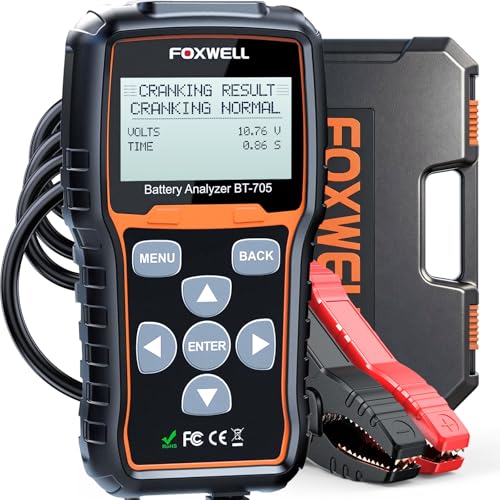
- Measures CCA, voltage, resistance, and battery health
- Tests 12V and 24V systems up to 2000 CCA
- Includes guided results, long cable, and hard case
Best For: Professional and DIY battery, cranking, and charging-system checks
Best Simple Load Check
NEIKO 40510A 100A Battery Tester

- Tests 6V and 12V automotive batteries
- Applies 100A or 50A loads by battery voltage
- Uses a protected analog meter and portable handle
Best For: Basic home-garage and shop battery load testing
Best Portable Analog Tester
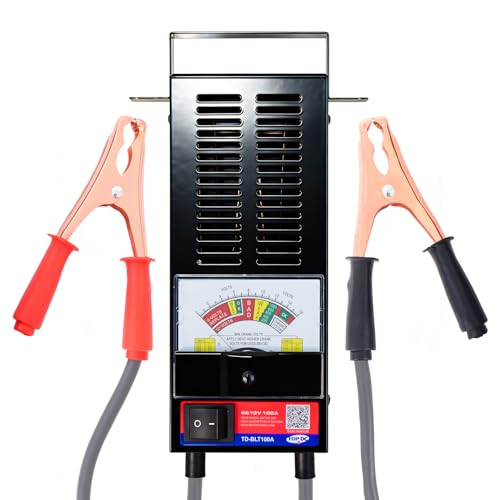
- Tests 6V and 12V batteries from 100–1000 CCA
- Checks battery, cranking, and charging performance
- Portable housing has cooling holes and color-coded clips
Best For: Portable testing for cars, powersports vehicles, boats, and RVs
Versatile 6V–24V Diagnostics

- Tests 6V, 12V, and 24V lead-acid batteries
- Checks battery, cranking, and charging systems
- Covers 5–3000 CCA with safety protection
Best For: Multi-vehicle owners and automotive DIYers
Simple Rapid Testing
BR502 Digital Battery Analyzer

- Supports 6V, 12V, and 24V batteries
- Provides CCA, voltage, resistance, SOC, and SOH data
- Shows a result in about two seconds
Best For: Beginners and routine battery checks
Lead-Acid and Lithium Support

- Tests 12V and 24V lead-acid or lithium batteries
- Analyzes battery, cranking, and charging systems
- Adds QR reports and a color TFT display
Best For: Mixed-battery vehicle owners and detailed diagnostics
Best Value – KONNWEI KW208 12V Battery Tester
The KONNWEI KW208 is a compact choice among digital battery load testers for checking 12V automotive batteries. It measures battery condition, voltage, internal resistance, CCA, and amp-hour capacity, while also testing cranking and charging systems.
Best For: Budget-conscious DIYers who need broad 12V vehicle coverage and alternator and starter testing in a glove-box-friendly tool.
Pros:
- Supports 12V batteries from 100-2000 CCA, including flooded, AGM, and gel types.
- Tests battery health, charge status, cranking, charging, alternator, and starter conditions.
- Works in and out of the vehicle, including with dead batteries, and supports eight languages.
- Updated galvanized alloy clips are designed for durability, contact, and safer connections.
Cons:
- Designed for 12V systems rather than 24V applications.
- The product’s accuracy claims are manufacturer-provided rather than independently verified here.
The KW208 packs extensive diagnostic coverage into a small, low-cost tester. It is a practical pick when you want more than a basic voltage reading without moving up to a professional shop tool.
Best 12V/24V Coverage – TOPDON BT200 Battery Tester
The TOPDON BT200 stands out among digital battery load testers because it handles both 12V and 24V batteries. Its conductance-based testing covers battery health, cranking, and charging systems, with a color display intended to remain readable in sunlight.
Best For: DIYers, mechanics, and owners of mixed vehicle types—including trucks, RVs, boats, and golf carts—who need 12V and 24V support.
Pros:
- Supports 12V and 24V batteries rated from 100-2000 CCA.
- Compatible with flooded, AGM, gel, and deep-cycle battery types.
- Provides battery, cranking, and charging system tests in one device.
- Includes a memory function, rugged housing, copper clamps, and a sunlight-readable color LCD.
Cons:
- Its listed operating range is -4°F to 140°F, so use outside that range is not specified.
- It is larger and heavier than some compact 12V-only testers.
The BT200 is the most versatile option in this group for voltage-system coverage. Its display and temperature-range features also make it appealing for outdoor, seasonal, and fleet-related checks.
Best Manual Load Testing – 6V/12V Battery Load Tester
This manual-style tester is a straightforward option among digital battery load testers for checking 6V and 12V batteries. Its fixed load simulates starter-motor demand, while the voltmeter helps determine battery condition and charging-system performance.
Best For: Home garages and DIY users who want a simple, portable load test for cars, motorcycles, RVs, boats, and other 6V or 12V equipment.
Pros:
- Supports 6V and 12V batteries, with a 100A load for 12V and 50A load for 6V.
- Can help assess battery condition, starter-motor consumption, and charging systems.
- Copper clips have red and black insulated grips for easier terminal identification.
- Ventilated housing and an insulated carry handle support portable operation.
Cons:
- The supplied notes specify voltage accuracy of ±0.2V rather than advanced battery analytics.
- The load test should be held for no more than 10 seconds.
- Although the title references 16V and 24V, the supplied compatibility details specify 6V and 12V use.
This tester favors a traditional load-test approach over detailed electronic reporting. It makes sense for buyers who want a simple tool for checking starting-battery performance without extra diagnostic features.
Best Compact Choice – TOPDON BT100 12V Battery Tester
The TOPDON BT100 is a compact 12V option among digital battery load testers. It reports state of health, state of charge, voltage, current, and rating, while its three testing functions cover battery health, cranking, and charging systems.
Best For: Car, truck, motorcycle, boat, and powersports owners who want a small tester that can stay in a glove box or center console.
Pros:
- Works with 100-2000 CCA flooded, AGM, EFB, and gel lead-acid batteries.
- Performs battery health, cranking, and charging-system tests.
- Compact design and passive operation mean it does not need to be charged separately.
- Copper clamps include reverse-polarity prevention and spark-proof features.
Cons:
- It is intended for 12V batteries only.
- The three-color LED interface may provide less information at a glance than a larger color screen.
The BT100 is a sensible everyday tester when portability matters most. It offers the core battery and vehicle-system checks without taking much room, making it well suited to occasional roadside or garage use.
Best Digital Analyzer – FOXWELL BT705 12V/24V Battery Tester
The FOXWELL BT705 is a versatile choice among digital battery load testers for checking battery health, cranking performance, and charging output. Its guided 2.8-inch display reports CCA, voltage, internal resistance, and state of health, while the 5.9-foot cable makes solo testing easier.
Best For: DIY users, repair shops, and fleet operators testing 12V and 24V lead-acid batteries from 100–2000 CCA.
Pros:
- Tests battery health, cranking performance, and alternator output.
- Supports Flooded, AGM, GEL, and EFB batteries across 12V and 24V systems.
- Guided results summarize conditions as GOOD, RECHARGE, or REPLACE.
- Includes a hard case and a long 5.9-foot test cable.
Cons:
- Its broader professional feature set may be more than casual users need.
- It is designed for lead-acid battery systems rather than a universal battery range.
The BT705 is the most capable option here for users who want digital readings and system-level diagnostics instead of a simple load-only check. The 24V support and included case also make it practical for commercial vehicles and repeated use.
Best Simple Load Check – NEIKO 40510A 100A Battery Tester
NEIKO 40510A Car Battery Tester | 100 AMP 6 and 12 Volt Automotive Load Checker | CCA Analyzer
Check Price On AmazonThe NEIKO 40510A is a straightforward choice among digital battery load testers for applying a controlled load to 6V and 12V automotive batteries. Its 100-amp load, analog voltage meter, and portable design keep basic battery checks easy to perform at home or in a shop.
Best For: DIY vehicle owners and mechanics who need a portable load checker for cars, trucks, motorcycles, boats, RVs, and similar vehicles.
Pros:
- Supports both 6V and 12V automotive batteries.
- Applies a 100-amp load to 12V batteries and a 50-amp load to 6V batteries.
- Protected analog meter is designed for easy reading.
- Features copper clamps, insulated grips, an external handle, and anti-sparking switchgear.
Cons:
- The analog display is less detailed than a digital diagnostic readout.
- The load should be held for no more than 10 seconds.
- It does not provide the broader battery and alternator reporting of the FOXWELL tester.
The NEIKO 40510A favors simple, hands-on load testing over extensive digital analysis. It is a practical fit when the main goal is checking battery voltage behavior under load without extra menus or system diagnostics.
Best Portable Analog Tester – TOPDC 100A 6V/12V Load Tester
The TOPDC TD-BLT100A is a compact load tester for shoppers comparing digital battery load testers with simpler analog tools. It checks 6V and 12V batteries, measures 100–1000 CCA, and combines battery, starting, and charging-system checks in a portable housing.
Best For: Vehicle owners testing cars, motorcycles, ATVs, boats, and RVs where portability and a clear analog dial matter.
Pros:
- Works with 6V and 12V batteries across several vehicle types.
- Provides 50-amp 6V and 100-amp 12V load testing.
- Checks voltage, cranking power, and charging-system performance.
- Includes heavy-duty color-coded clips, rubber grips, cooling holes, and a shock-resistant meter.
Cons:
- The analog dial does not offer the detailed digital readouts of the FOXWELL BT705.
- Its listed CCA range ends at 1000, below the FOXWELL’s 2000-CCA range.
- The maximum operating voltage is listed as 13.8V.
The TOPDC is a useful middle ground for basic multi-vehicle testing. Its cooling-focused enclosure and carrying grips support portable use, while the 6V/12V compatibility covers more than standard car-battery checks.
Versatile 6V–24V Diagnostics – VDIAGTOOL BT500
The VDIAGTOOL BT500 is a versatile choice among digital battery load testers, supporting 6V, 12V, and 24V batteries across cars, trucks, motorcycles, SUVs, ATVs, and boats. It measures voltage, resistance, state of health, and state of charge, while also checking cranking and charging systems.
Best For: Drivers, DIYers, and mechanics who need one tester for multiple vehicle types and battery voltages.
Pros:
- Supports 6V, 12V, and 24V lead-acid battery types, including AGM, GEL, EFB, and flooded batteries.
- Tests battery health, charge, cranking performance, and alternator charging.
- Includes reverse-polarity and short-circuit protection, a shock-resistant housing, and a multilingual interface.
- Offers a broad 5–3000 CCA testing range.
Cons:
- Not designed for lithium, deep-cycle, or golf-cart batteries.
- Requires selecting the correct battery type, standard, and CCA value for accurate results.
The BT500 stands out for its wide voltage and CCA range, making it a practical general-purpose diagnostic tool. Its alternator and starter testing adds useful troubleshooting capability beyond a basic battery checker.
Simple Rapid Testing – BR502 Digital Battery Analyzer
The BR502 is a straightforward option among digital battery load testers for checking 6V, 12V, and 24V batteries. It reports voltage, internal resistance, state of charge, state of health, and CCA, then displays a Good, Normal, or Poor result on its compact screen.
Best For: Beginners and vehicle owners who want quick battery condition checks without a complicated setup.
Pros:
- Works with 6V, 12V, and 24V flooded, AGM, and gel batteries from 100–2000 CCA.
- Displays test results in about two seconds on a 1.8-inch HD screen.
- Can test batteries installed in a vehicle, removed from a vehicle, or discharged.
- Reverse-connection protection helps prevent damage from incorrectly attached clips.
Cons:
- The 100–2000 CCA range is narrower than some competing testers.
- The supplied notes do not list alternator or charging-system testing.
The BR502 focuses on essential battery analysis and ease of use. Its quick readout and simple connection process make it a sensible pick for routine checks, especially when you do not need broader charging-system diagnostics.
Lead-Acid and Lithium Support – ANCEL BT410
The ANCEL BT410 expands the flexibility of digital battery load testers with support for both lead-acid and lithium-ion batteries in 12V and 24V systems. It also evaluates battery health, cranking voltage, alternator performance, and ripple voltage, with QR reports for sharing test data.
Best For: Owners of cars, trucks, RVs, motorcycles, and boats who need battery and charging-system diagnostics across lead-acid and lithium platforms.
Pros:
- Supports 12V and 24V lead-acid and lithium-ion batteries.
- Reports SOC, SOH, voltage, internal resistance, cranking voltage, and charging performance.
- Generates shareable QR reports and provides clear battery recommendations.
- Uses a 2.4-inch color TFT display, long 31.5-inch cables, and short-circuit and reverse-polarity protection.
Cons:
- It does not support 6V systems.
- The 100–2000 CCA range may not cover very high-CCA applications.
The BT410 is the most broadly compatible choice here for users who work with both lithium and lead-acid batteries. Its report-sharing feature and charging-system analysis add value for maintenance records and more involved troubleshooting.
How We Picked the Best Digital Battery Load Testers
We focused on testers that provide useful, actionable results rather than voltage readings alone. Our selection considers supported battery voltages, CCA testing ranges, starter and alternator checks, display readability, connection quality, operating simplicity, and compatibility with common lead-acid automotive batteries. Models with broader vehicle coverage or support for lithium batteries are also useful for owners with mixed fleets.
A good tester should make it easy to determine whether a battery needs charging, replacing, or further diagnosis. We also favored products with clearly labeled clamps, straightforward controls, and results that can be read quickly in a driveway or professional service bay.
Quick Comparison
| What to Compare | Why It Matters |
|---|---|
| Voltage coverage | Confirms whether the tester suits 6V, 12V, or 24V systems. |
| CCA range | Determines whether it can evaluate your battery’s rated starting capacity. |
| Test functions | Battery, cranking, charging, and alternator tests provide a fuller diagnosis. |
| Battery chemistry | Some models support lead-acid types; others also handle lithium batteries. |
| Display and controls | Clear digital results reduce guesswork during testing. |
Key Buying Factors for Digital Battery Load Testers
Voltage and CCA Range
Choose a tester that matches the electrical system you plan to inspect. Most passenger cars use 12V batteries, while motorcycles, older equipment, commercial vehicles, and some recreational vehicles may require 6V or 24V support. The CCA range should also cover the rating printed on your battery label; a tester that tops out below that rating may not provide a meaningful assessment.
Testing Functions
Basic models may check battery voltage and approximate condition, while more capable Digital Battery Load Testers evaluate starting voltage, alternator output, and charging performance. These extra tests can help separate a failing battery from a starter or charging-system problem.
Battery Type and Connection Design
Verify compatibility with flooded, AGM, GEL, or lithium batteries before buying. Insulated alligator clips and sufficiently long leads make testing safer and more convenient. Reverse-polarity and overload protection are valuable safeguards, particularly for occasional users.
Readability and Portability
A bright screen, simple menu, and clearly explained results matter when working outdoors or in low light. Compact testers are easy to keep in a glove box, whereas larger 100-amp load testers may be preferable for repeated workshop use.
Who Should Buy Which Digital Battery Load Testers?
For routine passenger-car checks, a compact 12V tester is usually the most practical choice. Buyers who work on cars, trucks, or equipment with multiple electrical systems should choose a 6V/12V/24V model with a wide CCA range. If you diagnose charging complaints, prioritize a tester with dedicated alternator and cranking tests. For mixed battery types, select a model that explicitly supports the chemistry you use, including lithium where required. Finally, choose a heavy-duty load tester if you want a traditional high-current check for frequent garage or shop work.
