

10 Best Digital Car Battery Analyzers for Accurate Testing in 2026

A reliable battery analyzer can help you identify a weak battery, charging fault, or starting-system problem before your vehicle leaves you stranded. The best models provide clear test results without requiring advanced diagnostic equipment.
We compared 10 digital car battery analyzers by supported voltage, CCA range, testing functions, display quality, reporting features, and overall practicality for drivers, DIY mechanics, and professional technicians.
Best 10 Digital Car Battery Analyzers Picks for 2026
Best Value 12V Analyzer

- Tests 12V batteries from 100–2000 CCA
- Checks cranking, charging, alternator, and starter systems
- Compact plug-and-play design with durable clips
Best For: DIY 12V vehicle maintenance
Most Versatile Battery Coverage
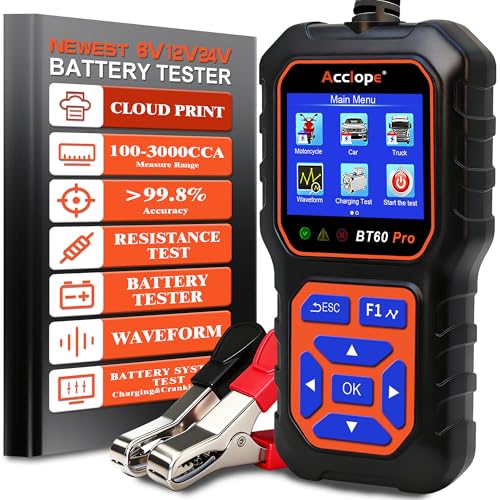
- Supports 6V, 12V, and 24V systems
- Provides QR-based cloud printing and sharing
- Includes dedicated 6V motorcycle testing mode
Best For: Mixed motorcycle, car, and truck diagnostics
Best for Printed Reports

- Tests 12V and 24V lead-acid batteries
- Built-in printer creates immediate paper reports
- 3.5-inch color screen with data playback
Best For: Shops and professionals needing test records
Best Simple 12V Tester

- Tests 100–2000 CCA 12V batteries
- Checks cranking and charging systems
- Includes storage bag and two-year warranty
Best For: Occasional home and roadside 12V checks
Versatile Voltage Pick
KINGBOLEN BM550 Battery Analyzer

- Tests 6V, 12V, and 24V batteries
- Measures SOH, SOC, CCA, voltage, and resistance
- Supports in-vehicle and out-of-vehicle testing
Best For: DIY users needing broad voltage coverage
Safety-Focused Choice

- Tests 12V battery, cranking, and charging systems
- Provides fast conductivity-based results
- Adds spark-free and reverse-polarity protection
Best For: Routine 12V testing at home or in a shop
All-in-One Diagnostic Pick

- Combines OBD2 and battery-system testing
- Reads codes and displays live engine data
- Tests battery health, cranking, and charging
Best For: Drivers wanting one tool for battery and engine diagnostics
Top Pick
TOPDON BC100 12V Battery Tester

- Tests 12V lead-acid batteries from 100–2,000 CCA
- Includes battery, cranking, and charging tests
- Stores previous results with Data Playback
Best For: DIYers wanting a compact 12V tester with result history
Most Versatile
VDIAGTOOL BT500 Multi-Voltage Tester

- Supports 6V, 12V, and 24V systems
- Tests up to 3,000 CCA
- Adds cranking and alternator diagnostics
Best For: Users testing vehicles with different battery voltages
Best Display

- Uses a readable 2.8-inch color screen
- Provides GOOD, RECHARGE, or REPLACE results
- Includes a 6.5-foot cable for solo testing
Best For: DIYers who want clear results and easier under-hood testing
Best Value 12V Analyzer – KONNWEI KW208
The KONNWEI KW208 is a compact, plug-and-play option for drivers who want one of the more affordable digital car battery analyzers. It tests 12V batteries from 100–2000 CCA, including flooded, AGM, and gel types, and can also evaluate cranking, charging, alternator, and starter performance.
Best For: Vehicle owners and DIY users who need broad 12V battery and starting-system checks in a small tester.
Pros:
- Tests battery voltage, internal resistance, CCA, AH capacity, health, and charge status.
- Works with in-vehicle, out-of-vehicle, and even dead-battery testing.
- Updated galvanized alloy clips are designed for stronger contact and durability.
- Supports up to eight languages and includes a compact glove-box-friendly design.
Cons:
- Limited to 12V batteries rather than 6V or 24V systems.
- Does not include report printing or QR-based result sharing.
The KW208 stands out when affordability, portability, and basic full-system testing matter more than shop-oriented reporting features. Its broad 12V compatibility makes it a practical everyday diagnostic tool.
Most Versatile Battery Coverage – ACCLOPE BT60 PRO
The ACCLOPE BT60 PRO is a versatile choice among digital car battery analyzers, supporting 6V, 12V, and 24V systems. It measures key battery health data on supported lead-acid batteries and adds QR-based cloud sharing for users who need to save, print, or send test results.
Best For: DIY users, garages, and service providers working across motorcycles, cars, and 24V trucks.
Pros:
- Supports 6V, 12V, and 24V lead-acid, AGM, GEL, EFB, and flooded batteries.
- Measures SOH, SOC, voltage, resistance, and CCA on supported batteries.
- QR cloud printing enables result saving, sharing, and printing without an app.
- Features a dedicated 6V motorcycle mode and a 3.2-inch HD screen.
Cons:
- Not compatible with 48V systems and is not an OBD2 code reader.
- LiFePO4 support is limited to voltage and health checks; precise CCA is not guaranteed.
- USB is not for charging, and the unit is powered by the clamps.
The BT60 PRO offers the broadest system-voltage coverage in this group and useful record-sharing features. It is especially compelling for mixed vehicle work, provided its lithium-battery limitations match your needs.
Best for Printed Reports – TOPDON BT600
The TOPDON BT600 is a shop-friendly option among digital car battery analyzers, combining 12V and 24V battery testing with a large color display and built-in thermal printer. It tests common lead-acid battery types and provides cranking and charging-system results for professional-style diagnostics.
Best For: Auto shops, battery dealers, and used-car professionals who need immediate paper records.
Pros:
- Tests 12V and 24V lead-acid batteries from 100–2000 CCA.
- Supports flooded, AGM flat, AGM spiral, GEL, and EFB batteries.
- Built-in printer produces reports immediately, while playback stores the last test.
- Large 3.5-inch color screen and navigation keys simplify operation.
Cons:
- Designed for 12V and 24V systems, not 6V batteries.
- Software updates through the mini-USB port are compatible with Windows systems only.
- At 1.29 kg, it is less lightweight than compact handheld testers.
The BT600 is a strong fit when clear on-screen readings and printed documentation are priorities. Its professional reporting features make it more suitable for service environments than casual glove-box use.
Best Simple 12V Tester – MOTOPOWER MP0515A
The MOTOPOWER MP0515A is a straightforward 12V option for shoppers seeking digital car battery analyzers without extra reporting features. It is rated for 100–2000 CCA batteries and is designed to test automotive batteries along with cranking and charging systems.
Best For: Car owners who want a basic 12V tester with a storage case for occasional checks.
Pros:
- Supports 100–2000 CCA 12V battery testing.
- Designed for automotive cranking and charging-system checks.
- Includes a storage bag and instruction manual.
- Comes with a two-year manufacturer warranty.
Cons:
- Only supports 12V car batteries according to the supplied details.
- Supplied notes do not list battery-health, internal-resistance, or AH-capacity readings.
- No printer, QR reporting, or multilingual feature is specified.
The MP0515A favors simple 12V diagnostics over advanced data presentation. Its included case and two-year warranty add practicality for occasional home or roadside use.
Versatile Voltage Pick – KINGBOLEN BM550 Battery Analyzer
For shoppers comparing digital car battery analyzers, the KINGBOLEN BM550 is a practical choice when you need broad voltage coverage. It tests 6V, 12V, and 24V batteries across 100–2,000 CCA and displays battery condition, charge, voltage, and internal resistance on its compact screen.
Best For: DIY users and garages testing cars, trucks, SUVs, ATVs, boats, and motorcycles with compatible lead-acid battery types.
Pros:
- Supports 6V, 12V, and 24V batteries from 100–2,000 CCA.
- Tests SOH, SOC, CCA, voltage, and internal resistance.
- Can test batteries in or out of the vehicle, including a dead battery.
- Includes reverse-connection protection.
Cons:
- Not suitable for deep-cycle batteries.
- Users must enter the battery’s corresponding CCA value.
- The screen may flicker if the clips are not clamped properly.
The BM550 stands out among digital car battery analyzers for its flexible 6V/12V/24V support and straightforward plug-and-play operation. It is a strong fit for general vehicle maintenance, provided your battery is within its supported types and CCA range.
Safety-Focused Choice – TOPDON BT50 Battery Tester
The TOPDON BT50 is one of the more user-friendly digital car battery analyzers for 12V lead-acid systems. Its conductivity testing provides quick readings on battery health, cranking ability, and charging-system performance, while the bright display and one-button operation simplify routine checks.
Best For: Home mechanics and technicians who want quick 12V battery and alternator checks with added safety features.
Pros:
- Analyzes 12V lead-acid batteries, cranking performance, and charging systems.
- Uses conductivity testing for fast results.
- Includes spark-free operation, reverse-polarity protection, and overheating safeguards.
- Offers six interface languages and historical test-result review.
Cons:
- Designed for 12V systems rather than 6V or 24V batteries.
- The supplied notes specify a minimum operating voltage of 8V.
- Its data review and diagnostic scope may be more than needed for simple voltage checks.
With its compact design, multilingual interface, and safety protections, the BT50 is a sensible option for repeated 12V testing. The 12-month warranty and lifetime technical support add reassurance for regular users.
All-in-One Diagnostic Pick – ANCEL AD410 PRO OBD2 Scanner
The ANCEL AD410 PRO combines digital car battery analyzers with an OBD2 code reader, making it useful when a starting problem may involve the battery, starter, alternator, or engine system. Along with battery health, cranking, and charging tests, it reads and clears engine codes and displays live vehicle data.
Best For: Vehicle owners who want battery testing and engine diagnostics in one plug-and-play tool.
Pros:
- Combines battery, cranking, charging, and OBD2 engine diagnostics.
- Reads more than 42,000 SAE diagnostic trouble codes.
- Provides live data, freeze-frame information, and I/M readiness testing.
- Uses a 2.4-inch screen, supports 10 languages, and includes lifetime updates.
Cons:
- Does not support ABS, SRS, or transmission systems.
- Not intended for EVs.
- Requires a compatible vehicle with a standard 16-pin OBD2 port for scanner functions.
The AD410 PRO is the broadest diagnostic option in this group because it goes beyond battery analysis. Choose it when you want to investigate check-engine faults and charging or starting issues without carrying separate tools.
Top Pick – TOPDON BC100 12V Battery Tester
The TOPDON BC100 is a practical choice among digital car battery analyzers for drivers who want more than a basic voltage reading. It tests 12V lead-acid batteries from 100 to 2,000 CCA and combines battery health, cranking, and charging-system checks in a compact, glove-box-friendly design.
Best For: Car owners, DIYers, and boat or lawnmower users who need broad 12V compatibility and stored test results.
Pros:
- Tests flooded, AGM, GEL, and EFB 12V lead-acid batteries.
- Checks battery health, engine cranking, and charging-system performance.
- Data Playback helps review earlier results and track battery condition.
- Long 31.5-inch cables, reverse-polarity protection, and a spark-free design improve usability.
Cons:
- Limited to 12V batteries.
- Designed for lead-acid batteries rather than lithium batteries.
Choose the BC100 if you want a straightforward 12V analyzer with useful diagnostic modes and result history. Its compact size and long leads make it especially convenient for routine checks in different vehicles.
Most Versatile – VDIAGTOOL BT500 Multi-Voltage Tester
The VDIAGTOOL BT500 stands out among digital car battery analyzers because it supports 6V, 12V, and 24V systems. Its 5-to-3,000 CCA range, battery-load testing, and alternator and starting-system checks make it suitable for a mix of personal vehicles and larger equipment.
Best For: Users who maintain cars, trucks, motorcycles, ATVs, or boats with different battery voltages.
Pros:
- Supports 6V, 12V, and 24V lead-acid batteries.
- Tests battery voltage, resistance, SOH, SOC, cranking, and charging systems.
- Offers a broad 5-to-3,000 CCA testing range.
- Includes reverse-polarity and short-circuit protection, an anti-slip grip, and 12-language support.
Cons:
- Not intended for lithium, deep-cycle, or golf-cart batteries.
- Correct battery type, standard, and CCA settings are required for accurate results.
The BT500 is the strongest fit when voltage flexibility matters. It offers more coverage than a typical 12V-only tester, though its battery-type limitations should be checked before purchase.
Best Display – FOXWELL BT301 12V Analyzer
The FOXWELL BT301 is a user-friendly option among digital car battery analyzers, pairing battery health, cranking, and charging tests with a 2.8-inch color screen. Its 6.5-foot cable also makes it easier to monitor prompts while starting the vehicle by yourself.
Best For: DIY vehicle owners who prioritize readable results and convenient one-person testing.
Pros:
- Displays SOH, SOC, CCA, voltage, internal resistance, and results such as GOOD, RECHARGE, or REPLACE.
- Tests 12V flooded, AGM, EFB, GEL, and other supported lead-acid batteries from 100 to 2,000 CCA.
- Long 6.5-foot cable helps with cranking and charging tests.
- Color screen, heavy-duty clamps, carrying bag, and no separate internal battery simplify use.
Cons:
- Supports 12V systems only.
- Not designed for lithium batteries.
The BT301 makes a good choice when clear on-screen guidance and cable reach are more important than multi-voltage support. Its result labels can also make battery-replacement decisions easier for less experienced users.
How We Picked the Best Digital Car Battery Analyzers
We focused on testers that provide useful results for real-world vehicle maintenance rather than simple voltage readings. The selected models cover common 12V automotive batteries, while several also support 6V or 24V systems. We considered battery-health testing, cold-cranking-amp measurement, cranking and alternator checks, operating range, screen readability, report features, and ease of use.
We also included both dedicated battery testers and combination tools. A dedicated analyzer is usually faster for routine checks, while a scanner-and-tester combination can be more useful if you also want basic engine diagnostics.
Quick Comparison
| What to Compare | Best For |
|---|---|
| 12V testing | Most cars, trucks, SUVs, and motorcycles |
| 6V/12V/24V support | Mixed fleets, commercial vehicles, and specialty equipment |
| High CCA range | Large batteries and heavy-duty applications |
| Printer or QR reports | Service records, customer documentation, or fleet maintenance |
| Cranking and charging tests | Diagnosing starting and alternator problems |
| OBD2 functionality | Users who want battery and basic engine diagnostics in one device |
Key Buying Factors for Digital Car Battery Analyzers
Voltage and Battery Compatibility
Confirm that the tester supports your battery type and voltage before buying. A 12V model is suitable for most passenger vehicles, but 6V/12V/24V compatibility is more versatile for garages, RVs, trucks, and equipment.
CCA Range and Test Accuracy
Choose a CCA range that covers the batteries you expect to test. A broader range is useful for heavy-duty batteries, but accurate readings and clear pass, recharge, or replace guidance matter more than maximum numbers alone.
Available Tests
Look for battery condition, starting or cranking, and alternator charging tests if you want to troubleshoot the complete starting system. Some analyzers also support tests for different battery technologies, so check compatibility with AGM, gel, or enhanced flooded batteries when relevant.
Display, Reports, and Ease of Use
A bright screen, straightforward menus, reverse-polarity protection, and readable results make frequent testing easier. Built-in printers, QR reports, or stored results are especially valuable for repair shops and fleet operators, while occasional home users may prefer a simpler, lower-cost design.
Who Should Buy Which Digital Car Battery Analyzers?
Home mechanics who mainly maintain one or two vehicles should prioritize a compact 12V tester with battery, cranking, and charging checks. Drivers with multiple vehicle types should choose a model supporting 6V, 12V, and 24V systems. Professional technicians and service writers may benefit from a printer or digital reporting feature. If you also need to investigate check-engine faults, an OBD2 combination tool can provide broader coverage than a dedicated battery analyzer.
