

10 Best Digital Car Battery Testers for Accurate Charging and Cranking Checks in 2026

A dependable battery tester can reveal weak starting performance before a vehicle leaves you stranded. The best digital car battery testers measure more than resting voltage, helping identify battery condition, cranking strength, and charging-system issues.
This roundup compares 10 practical options for home garages, technicians, and drivers who want faster, more informed battery diagnostics without relying on guesswork.
Best 10 Digital Car Battery Testers Picks for 2026
Best All-Around Diagnostics

- Measures SOH, SOC, voltage, current, CCA, cranking, and charging
- Supports common 12V flooded, AGM, GEL, and EFB batteries
- Built-in protection and no internal battery to recharge
Best For: DIY users wanting comprehensive 12V battery and alternator testing
Best Compact Load Tester

- Performs battery, cranking, and charging-system tests
- Supports 100–2,000 CCA 12V lead-acid batteries
- Compact design with color LED result indicators
Best For: Drivers and shops needing a portable core-diagnostics tester
Best Simple Voltage Checker
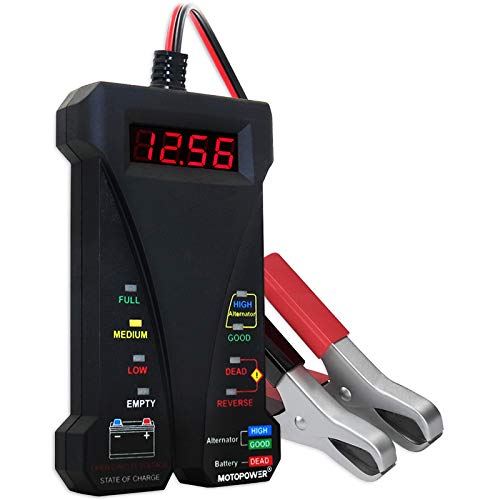
- Plug-and-test design for quick battery and alternator checks
- Four-digit LCD reads voltage to 0.01V
- Colored LEDs plus reverse-connection protection
Best For: Owners wanting an uncomplicated 12V voltage tester
Best for Test History

- Tests battery health, cranking, and charging systems
- Reviews historical results to monitor degradation
- Compact, spark-free design with multilingual operation
Best For: Users tracking 12V battery condition over repeated tests
Best Value

- Tests 12V batteries from 100–2000 CCA
- Includes battery, cranking, and charging tests
- Compact plug-and-play design
Best For: Budget-minded DIY vehicle owners
Best 12V/24V Coverage

- Works with 12V and 24V batteries
- Performs battery, cranking, and charging tests
- Color screen stays readable in sunlight
Best For: Multi-vehicle owners and professional garages
Best for Easy Readings

- Large 2.8-inch color screen
- 6.5-foot cable supports solo testing
- Tests battery, cranking, and charging systems
Best For: DIY users who want clear, convenient diagnostics
Reliable 12V Pick

- Tests 12V batteries from 100-2000 CCA
- Checks load, cranking, and charging systems
- Includes storage bag and 2-year warranty
Best For: DIY owners testing standard 12V vehicle batteries
Best Multi-Voltage Value
BR502 Digital Battery Analyzer

- Works with 6V, 12V, and 24V batteries
- Displays SOH, SOC, CCA, resistance, and voltage
- Delivers results in about two seconds
Best For: Multi-vehicle owners and beginners needing detailed battery data
Most Comprehensive Diagnostics

- Combines health, cranking, charging, and load tests
- Covers 30-2000 CCA and 12V/24V systems
- Stores test records and includes a bright color screen
Best For: Mechanics and DIY users wanting full starter and charging diagnostics
Best All-Around Diagnostics – ANCEL BA101
If you want one of the more capable digital car battery testers for routine vehicle checks, the ANCEL BA101 combines battery-health, starting, and charging-system testing in a compact handheld unit. It supports several 12V lead-acid battery types and provides readings for SOH, SOC, voltage, current, and CCA.
Best For: Drivers and DIY users who want broad 12V battery compatibility and detailed diagnostic readings.
Pros:
- Tests SOH, SOC, voltage, current, CCA, cranking, and charging systems.
- Supports flooded, AGM, GEL, and EFB 12V batteries rated from 100 to 2,000 CCA.
- Includes reverse-polarity, short-circuit, overcurrent, and overvoltage protection.
- Uses vehicle-battery power, so it does not require charging or internal batteries.
Cons:
- Not intended for lithium, 6V, 8V, or 24V batteries.
- Motorcycles below 30Ah are not supported.
The BA101 is a strong choice when you want more than a simple voltage reading. Entering the battery’s correct type, rating, and temperature is important for the clearest results.
Best Compact Load Tester – TOPDON BT100
The TOPDON BT100 is a compact option among digital car battery testers, offering battery-health, cranking, and charging-system tests for 12V lead-acid batteries. Its color LED indicators and menu-driven operation make the results accessible for regular garage or roadside checks.
Best For: DIY users, auto shops, and drivers who want a small tester that covers core 12V battery diagnostics.
Pros:
- Tests battery health, engine cranking performance, and charging operation.
- Works with 100–2,000 CCA flooded, AGM, EFB, and GEL batteries.
- Color LEDs and a menu system make results easier to interpret.
- Copper clamps include reverse-polarity prevention and spark-proof features.
Cons:
- Designed for 12V lead-acid batteries only.
- The vehicle ignition should be turned off during testing.
With its small size and vehicle-powered operation, the BT100 is easy to keep in a glove box or toolbox. It is a practical pick for checking whether a battery needs replacement or a jump-start.
Best Simple Voltage Checker – MOTOPOWER MP0514A
For straightforward voltage and alternator checks, the MOTOPOWER MP0514A keeps digital car battery testing simple. Its plug-and-test design, four-digit LCD, and colored LED indicators help identify battery or charging-system status without a complicated setup.
Best For: Car owners who primarily need quick 12V voltage and alternator-output checks.
Pros:
- Plug-and-test operation requires no complex setup.
- Four-digit display provides voltage readings to 0.01V accuracy.
- Eight colored LEDs offer an additional visual status indicator.
- Reverse-connection and over-voltage protection improve testing safety.
Cons:
- Its listed functions focus on voltage and charging-system analysis rather than CCA or SOH testing.
- It is intended for vehicles with 12V batteries.
The MP0514A is a sensible choice if you do not need a full load analyzer. Its compact, rubber-coated housing and 50cm cable make it convenient for emergency storage or toolbox use.
Best for Test History – TOPDON BT50
The TOPDON BT50 is one of the digital car battery testers suited to ongoing maintenance because it can review historical test results. It analyzes 12V lead-acid battery health, cranking capability, and charging performance, while its compact design and one-button operation keep testing convenient.
Best For: DIY enthusiasts and technicians who want quick testing plus a way to monitor battery-condition trends.
Pros:
- Analyzes battery health, cranking performance, and charging-system efficiency.
- Historical data review helps track changes over time.
- Conductivity testing and an upgraded algorithm are designed for quick results.
- Offers spark-free testing, reverse-polarity protection, and anti-overheating safeguards.
Cons:
- Designed for 12V lead-acid batteries.
- Its listed operating-temperature upper limit is 50°C.
The BT50 stands out when periodic records matter as much as a single reading. A bright LCD, six-language interface, and one-button operation make it approachable for both home and professional use.
Best Value – KONNWEI KW208
The KONNWEI KW208 is a practical choice among digital car battery testers for drivers who want broad 12V coverage without a complicated setup. It tests battery condition, cranking performance, charging systems, alternators, and starters, with support for several common lead-acid battery types.
Best For: Budget-conscious DIYers who need an easy-to-store tester for cars, trucks, motorcycles, boats, and other 12V equipment.
Pros:
- Tests 12V batteries from 100–2000 CCA, including flooded, AGM, and gel batteries.
- Checks battery health, voltage, internal resistance, CCA, AH capacity, cranking, and charging status.
- Plug-and-play operation works with batteries in or out of the vehicle, including dead batteries.
- Compact design, wrapped galvanized alloy clips, and support for eight languages.
Cons:
- Limited to 12V systems.
- The display and controls may be less suitable for users seeking advanced diagnostic features.
The KW208 stands out when affordability and basic system coverage matter most. Its compact size and straightforward connection make it a convenient tester to keep in a glove box or garage.
Best 12V/24V Coverage – TOPDON BT200 Battery Tester
The TOPDON BT200 is one of the more versatile digital car battery testers in this roundup because it supports both 12V and 24V systems. Its conductance testing, color display, and three-part diagnostic coverage make it useful for routine checks at home or in a professional garage.
Best For: DIYers, mechanics, and owners of cars, trucks, RVs, boats, motorcycles, and other vehicles using either 12V or 24V batteries.
Pros:
- Supports 12V and 24V batteries rated from 100–2000 CCA.
- Tests battery health, starting performance, and charging-system operation.
- Sunlight-readable 2.4-inch color LCD provides clear results and Good/Replace prompts.
- Includes memory for recalling the last test, rugged housing, copper clamps, and a wide operating temperature range.
Cons:
- Larger and heavier than some compact 12V-only testers.
- Its broad vehicle compatibility may be unnecessary for owners who only test one 12V car.
The BT200 is the strongest fit for users who need flexibility across different vehicles or equipment. Its 24V support and readable screen add useful convenience, while the included warranty and lifetime technical support provide extra reassurance.
Best for Easy Readings – FOXWELL BT301 Battery Tester
The FOXWELL BT301 is a user-friendly option among digital car battery testers, combining battery, cranking, and charging checks with a large 2.8-inch color screen. Its 6.5-foot cable is especially helpful when one person needs to operate the tester while starting the vehicle.
Best For: DIY car owners and home garages that want clear results and convenient testing from the driver’s seat or beside the vehicle.
Pros:
- Displays SOH, SOC, CCA, voltage, internal resistance, and clear condition results.
- Long 6.5-foot cable makes solo cranking and charging tests easier.
- Supports 100–2000 CCA 12V flooded, AGM, EFB, and gel lead-acid batteries.
- Requires no app or separate internal battery and includes a carrying bag.
Cons:
- Designed for 12V systems only.
- Not intended for lithium batteries.
The BT301 is a sensible pick when readability and hands-free convenience are priorities. Its long cable and straightforward condition prompts help reduce guesswork before deciding whether to recharge or replace a battery.
Reliable 12V Pick – MOTOPOWER MP0515A
The MOTOPOWER MP0515A is a practical choice among digital car battery testers for checking 12V automotive batteries. Its 100-2000 CCA range supports basic battery load, cranking, and charging-system checks, while the compact handheld design and included storage bag make it convenient for garage use.
Best For: DIY vehicle owners who need a straightforward 12V battery and charging-system tester.
Pros:
- Tests 12V batteries across a broad 100-2000 CCA range.
- Supports battery load, cranking, and charging-system testing.
- Includes a storage bag and a 2-year manufacturer warranty.
Cons:
- Designed for 12V systems rather than 6V or 24V batteries.
- The supplied specifications do not list advanced battery-health or data-logging features.
Choose this model if you want a focused 12V tester with familiar automotive diagnostic functions. It is less suitable if you need multi-voltage coverage or more detailed digital reporting.
Best Multi-Voltage Value – BR502 Digital Battery Analyzer
The BR502 stands out among digital car battery testers for its broad 6V, 12V, and 24V compatibility. It reports state of health, state of charge, CCA, internal resistance, and voltage on a 1.8-inch display, making it useful for checking batteries before they fail.
Best For: Owners and technicians working with cars, trucks, motorcycles, boats, and other 6V-24V applications.
Pros:
- Supports 6V, 12V, and 24V batteries from 100-2000 CCA.
- Tests SOH, SOC, CCA, internal resistance, and voltage.
- Provides results within two seconds and includes reverse-polarity protection.
Cons:
- The screen may flicker if the clips are not properly clamped.
- Its listed CCA range does not cover batteries below 100 CCA.
For broad vehicle compatibility and quick battery-health information, the BR502 is a versatile option. Its plug-and-play operation should also appeal to beginners who want more than a simple voltage reading.
Most Comprehensive Diagnostics – AUTOOL BT460 12V/24V Tester
The AUTOOL BT460 is a feature-rich option among digital car battery testers, combining battery-health, cranking, charging, and load tests. It covers 12V and 24V systems, supports 30-2000 CCA, and adds historical test-data storage for tracking battery condition over time.
Best For: DIY enthusiasts and professional mechanics diagnosing batteries and charging systems across multiple vehicle types.
Pros:
- Offers four diagnostic functions: health, cranking, charging, and load testing.
- Supports flooded, AGM, EFB, and gel lead-acid batteries from 30-2000 CCA.
- Features a bright color display, reverse-polarity protection, and test-record storage.
- Backed by a 3-year limited warranty and 24-hour customer-support response claim.
Cons:
- The supplied specifications focus on lead-acid battery types.
- Its broader feature set may be more than needed for simple voltage checks.
The BT460 is the strongest fit when you want one handheld tool for battery, starter, and alternator-related checks. Choose it over a basic tester if tracking results and supporting several vehicle categories are priorities.
How We Picked the Best Digital Car Battery Testers
We compared these testers by testing scope, supported voltage systems, rated CCA range, display readability, operating simplicity, and the usefulness of their diagnostic results. Models that test cranking and charging performance received particular attention because voltage alone does not provide a complete picture of battery health.
We also considered whether each unit is suited to occasional roadside checks, routine home maintenance, or more demanding workshop use. A wide CCA range, clear test prompts, reverse-polarity protection, and a durable cable design can make a meaningful difference in day-to-day use.
Quick Comparison
| What to Compare | Why It Matters |
|---|---|
| Voltage support | Most passenger cars use 12V systems, while trucks and some equipment may require 24V testing. |
| CCA range | The tester must match the cold-cranking rating printed on the battery label. |
| Test functions | Battery, cranking, alternator, and charging tests provide different diagnostic information. |
| Display and controls | A clear screen and simple menu make results easier to interpret in a garage or roadside setting. |
| Safety features | Reverse-polarity and overvoltage protection help reduce the risk of incorrect connections. |
Key Buying Factors for Digital Car Battery Testers
Voltage and Battery Compatibility
Choose a 12V model for most cars, SUVs, motorcycles, and light trucks. If you service commercial vehicles or equipment, select a tester with 24V support. Some models also accommodate 6V batteries, but verify the manufacturer’s stated applications before buying.
CCA Range and Testing Standard
Enter the battery’s correct rating and testing standard when prompted. A tester covering roughly 100 to 2,000 CCA handles many automotive batteries, while broader ranges may be useful for heavy-duty applications. Results are only meaningful when the tester is configured correctly.
Diagnostic Functions
Battery-health testing estimates available starting capacity, while cranking tests show how the battery performs during startup. Charging and alternator tests help determine whether the vehicle’s electrical system is replenishing the battery properly. Internal-resistance readings can add useful context but should not be treated as the only measure of battery condition.
Ease of Use and Construction
Look for readable LCD or color displays, long leads, strong clamps, and clearly labeled controls. A compact tester is convenient for glove-box storage, whereas a larger screen may be preferable for frequent professional use.
Who Should Buy Which Digital Car Battery Testers?
For basic home checks: Choose a straightforward 12V tester with battery, cranking, and charging-system functions. It should be simple enough to use without specialized training.
For broad vehicle coverage: A 12V/24V model is the better choice for households or garages that handle cars, trucks, and commercial vehicles.
For frequent diagnostics: Prioritize a wide CCA range, a durable housing, clear test results, and a larger display. These features reduce repeated testing and make workshop workflows more efficient.
For occasional roadside use: Select a compact, easy-to-store unit with simple prompts and built-in polarity protection. Keep in mind that these testers diagnose electrical performance; they do not replace a professional load test or a complete vehicle inspection when results are uncertain.
