

10 Best Garage Exhaust Fans for DIY Mechanics in 2026: Top Picks for Safer, Cooler Workspaces

Working on cars in a closed garage can quickly create problems with heat, fumes, dust, and stale air. The right exhaust fan helps move contaminated air outdoors while making the workspace more comfortable.
These 10 options cover compact wall-mounted models, portable blowers, high-CFM industrial fans, and whole-garage ventilation systems. Use the guide below to match airflow, controls, installation, and safety features to your projects.
Best 10 Garage Exhaust Fans for DIY Mechanics Picks for 2026
Best Wall-Mount Pick
iLiving 12-Inch Variable-Speed Exhaust Fan

- 960 CFM with coverage up to 1,400 square feet
- Variable speed and 32–130°F thermostat control
- UL/cUL-listed galvanized steel wall-mount design
Best For: Permanent garage wall ventilation with adjustable control
Best Portable Blower
12-Inch 3500 CFM Ducted Air Mover

- Up to 3,500 CFM from a 550-watt motor
- Includes a 40-foot flexible PVC duct
- Portable frame with IP44 and thermal overload protection
Best For: Directed ventilation in garages and confined spaces
Best Smart Wall Fan
VEVOR 14-Inch 2000 CFM Exhaust Fan

- 2,000 CFM airflow for garages and workshops
- Temperature and humidity triggers with up to 10 speeds
- Automatic shutter, remote, timer, and alarm functions
Best For: Automated ventilation in larger garages and workshops
Best Whole-Garage Solution
QuietCool GA PRO-2.0 Garage Fan

- Moves up to 1,834 CFM through the garage attic
- Uses as little as 133 watts on a two-speed motor
- Includes wireless control, thermostat, and fire damper
Best For: Whole-garage cooling where an attic is available
Best Overall
Amico 12-Inch Smart Shutter Exhaust Fan

- 1,282 CFM airflow for garages up to 1,600 square feet
- Thermostat, eight speeds, and power-off memory
- Plug-and-play design with automatic weather-resistant shutters
Best For: DIY mechanics wanting adjustable, automatic garage ventilation
Maximum Airflow
16-Inch Explosion-Proof Industrial Exhaust Fan

- 300W pure copper motor rated at 2,800 RPM
- Durable iron-and-copper construction with mesh guard
- Wall-mount design with pre-drilled installation holes
Best For: Large shops prioritizing high-volume industrial ventilation
Balanced Ventilation
VEVOR 16-Inch Shutter Exhaust Fan

- High-volume airflow for garages and workshops
- Steel housing with automatic rain-blocking shutters
- Prewired cord, but controller and power plug are separate
Best For: DIY mechanics wanting strong airflow and protected outdoor-facing ventilation
Best Compact Airflow
8-Inch Heavy-Duty Metal Wall Exhaust Fan

- 576 CFM airflow for clearing garage odors and stale air
- Metal wall-mount construction with backdraft damper
- Designed for standard 8-inch wall openings
Best For: Smaller garages and compact work areas
Best High-Capacity Pick
HG Power 10-Inch Garage Exhaust Fan

- 988 CFM airflow for larger garages and workshops
- Metal housing with reverse-airflow damper
- Includes 8-foot cord and built-in switch
Best For: Large garages, shops, sheds, and high-volume exhaust
Best Adjustable Ventilation
8-Inch 700 CFM Fan with Speed Controller
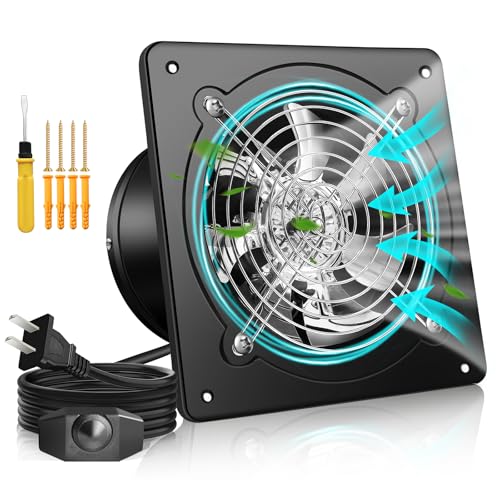
- 700 CFM airflow with adjustable speed control
- Brushless motor uses 80 watts and is designed for quiet operation
- Includes damper, mesh protection, and 8.2-foot cord
Best For: Garages where airflow needs change between tasks
Best Wall-Mount Pick – iLiving 12-Inch Variable-Speed Exhaust Fan
For DIY mechanics comparing garage exhaust fans for DIY mechanics, the iLiving 12-inch model offers a practical wall-mounted setup with adjustable airflow and temperature control. Its 960 CFM rating is suited to garages and workshops up to 1,400 square feet.
Best For: Permanent wall-mounted garage ventilation with adjustable speed and thermostat control.
Pros:
- Moves up to 960 CFM and is rated for coverage up to 1,400 square feet.
- Includes variable-speed and temperature controls with a 32–130°F range.
- Galvanized steel housing, aluminum shutters and blades, and a UL/cUL listing support workshop use.
Cons:
- Its 65 dB noise rating may be noticeable in a working garage.
- Wall installation is less flexible than a portable blower.
- At 12 inches, it provides less airflow than the larger 14-inch model in this roundup.
This is a sensible choice when you want a dedicated exhaust point rather than a temporary fan. The included controller adds useful adjustment for changing garage temperatures and ventilation needs.
Best Portable Blower – 12-Inch 3500 CFM Ducted Air Mover
This portable blower stands out among garage exhaust fans for DIY mechanics when you need to direct air through a confined space. It combines a 3,500 CFM motor with a 40-foot flexible duct for garage, crawl-space, basement, and paint-booth ventilation.
Best For: Temporary or directed ventilation where a long duct run is useful.
Pros:
- Produces up to 3,500 CFM from a 550-watt motor running at 3,500 RPM.
- Included 40-foot foldable PVC duct supports intake or exhaust applications.
- Portable floor-mounted design includes a carry handle and non-slip feet.
- IP44 protection and thermal overload protection add useful safeguards in damp work areas.
Cons:
- It requires floor space instead of providing a permanent wall installation.
- At 17.9 pounds, it is less convenient to relocate than a smaller fan.
- The high-output blower may be more ventilation than a small garage needs.
Choose this model when flexibility and airflow matter more than a clean, fixed installation. The duct makes it especially useful for routing fumes, dust, odors, or moisture away from a specific work area.
Best Smart Wall Fan – VEVOR 14-Inch 2000 CFM Exhaust Fan
For DIY mechanics who want automated garage ventilation, this VEVOR wall-mounted fan pairs 2,000 CFM airflow with temperature and humidity programming. Its automatic shutter closes when the fan is off, helping limit exposure to rain and small debris.
Best For: Larger garages, workshops, and sheds needing sensor-based ventilation control.
Pros:
- Delivers up to 2,000 CFM for expelling heat, odors, dirt, and stale air.
- Temperature and humidity triggers provide automatic adjustment across up to 10 speeds.
- All-metal construction and automatic shutters suit demanding garage or outdoor-adjacent installations.
- Includes a sensor cable, remote, timer, and alarm functions.
Cons:
- The listed 68 dB noise level may be noticeable during operation.
- Wall mounting requires planning and a suitable opening.
- Its control system may be more elaborate than needed for basic on/off ventilation.
This model is a strong fit when garage conditions change throughout the day and you prefer the fan to respond automatically. It offers more programming flexibility than a basic shutter exhaust fan, though installation and setup may take more attention.
Best Whole-Garage Solution – QuietCool GA PRO-2.0 Garage Fan
The QuietCool GA PRO-2.0 takes a different approach to garage exhaust fans for DIY mechanics: it pulls cooler air into the garage while moving hot air into the attic and out through attic vents. Its ceiling-mounted design is intended for garages with an attic above.
Best For: Whole-garage cooling and ventilation in attached or detached garages with attic access.
Pros:
- Provides up to 1,834 CFM on high and 1,396 CFM on low.
- Two-speed motor uses as little as 133 watts.
- Plug-and-play installation includes a 20-foot power cord, thermostat, grille, and wireless RF control.
- Integrated two-hour-rated fire damper and a 15-year warranty add useful value.
Cons:
- It requires an attic above the garage for installation.
- Ceiling installation is more involved than placing a portable fan or mounting a wall unit.
- It is designed for whole-garage airflow rather than targeted fume extraction at a vehicle or workbench.
This is the most specialized option here, but it can be appealing when the goal is broad garage cooling rather than spot exhaust. Confirm that your garage has the required attic space and suitable venting before choosing it.
Best Overall – Amico 12-Inch Smart Shutter Exhaust Fan
For DIY mechanics who want adaptable garage exhaust fans for DIY mechanics projects, the Amico combines strong airflow with thermostat control and eight speed settings. Its 1,282 CFM rating, automatic louvers, and plug-and-play design make it a practical choice for refreshing a standard two-car garage.
Best For: DIY mechanics needing automatic temperature control, adjustable airflow, and straightforward wall or window installation.
Pros:
- Delivers 1,282 CFM and is designed for spaces up to 1,600 square feet.
- Thermostat probe and eight speeds allow flexible, mostly hands-off operation.
- Brushless 25W DC motor operates at a stated 50 dB and is designed for lower energy use.
- Automatic gravity shutters help block drafts, rain, and insects when switched off.
Cons:
- The 12-inch size provides less airflow than the larger industrial models here.
- Wall installation may still require cutting an opening and securing the unit properly.
Overall, this is the most feature-rich option for a home garage: it offers useful automation without requiring a complicated control setup. Confirm the opening dimensions and ventilation path before installation.
Maximum Airflow – 16-Inch Explosion-Proof Industrial Exhaust Fan
When a busy shop needs rapid air exchange, this industrial fan stands out among garage exhaust fans for DIY mechanics with its 300W copper motor and high rotational speed. Its metal construction and wall-mount format suit demanding ventilation jobs, though the single-speed design is more utilitarian than adjustable.
Best For: Large or heavily used garage shops that prioritize high-volume ventilation over quiet operation and speed control.
Pros:
- Uses a 300W pure copper motor rated at 2,800 RPM.
- Supplied notes specify an air volume of 8,000 cubic feet per hour.
- Iron-and-copper construction with a protective mesh guard is built for durability.
- Pre-drilled holes and an integrated structure simplify wall mounting.
Cons:
- Its listed 85 dB noise level may be intrusive in a home garage.
- Only one power level is listed, so airflow cannot be finely adjusted.
- Installation requires connecting the wiring, and mounting screws are not included.
This model is best viewed as a powerful shop ventilator rather than a quiet, comfort-focused garage fan. Before buying, verify the electrical setup, mounting surface, and the manufacturer’s intended meaning of the explosion-proof designation for your application.
Balanced Ventilation – VEVOR 16-Inch Shutter Exhaust Fan
The VEVOR 16-inch model offers a middle ground for shoppers comparing garage exhaust fans for DIY mechanics. It provides strong 2,438 CFM ventilation, a steel housing, and automatic shutters that close when the fan is off. Its prewired cord helps with setup, but speed control and a power plug are not included according to the supplied notes.
Best For: DIY mechanics seeking high airflow and rain protection for a garage, workshop, shed, or utility space.
Pros:
- Rated to move 2,438 CFM for quickly removing heat, odors, dirt, and stale air.
- Steel housing is designed to resist deformation in damp conditions.
- Automatic shutters open during operation and close to help block rain and debris.
- Prewired cord supports a quicker installation than a fully unwired unit.
Cons:
- Speed controller and power plug must be purchased separately and wired before use.
- The supplied specifications list one speed and approximately 65 dB of noise.
- Airflow figures vary across the supplied listing details, so confirm the current specification before purchase.
This is a practical choice when a larger shutter fan and substantial airflow matter more than quiet operation or built-in controls. Plan for the missing controller and plug when budgeting and preparing the installation.
Best Compact Airflow – 8-Inch Heavy-Duty Metal Wall Exhaust Fan
For DIY mechanics who need garage exhaust fans for DIY mechanics projects, this 8-inch wall-mounted model offers a compact way to clear odors, smoke, moisture, and stale air. Its 576 CFM airflow and metal construction suit smaller garages, basements, and utility areas.
Best For: Smaller garages and work areas with a standard 8-inch wall opening.
Pros:
- 576 CFM airflow from a high-power motor and seven blades
- Durable, corrosion-resistant metal construction
- Built-in backdraft damper helps limit drafts, dust, and outdoor air
- Wall-mount design supports relatively straightforward installation
Cons:
- Single speed and push-button control offer limited adjustment
- The damper must be installed with left-right opening orientation
- Best suited to spaces compatible with an 8-inch opening
This is a practical pick when space and opening size matter more than maximum extraction. Verify the wall opening and install the damper in the specified orientation before use.
Best High-Capacity Pick – HG Power 10-Inch Garage Exhaust Fan
DIY mechanics looking for garage exhaust fans for DIY mechanics work may appreciate this 10-inch HG Power model when stronger extraction is the priority. It provides 988 CFM airflow, uses a durable metal housing, and includes a plug-in cord and switch for a simpler setup.
Best For: Larger garages, workshops, sheds, and other spaces needing high-volume exhaust.
Pros:
- 988 CFM airflow for removing smoke, odors, steam, and pollutants
- Metal construction and metal blades are suited to regular use
- Eight-foot power cord and included switch support plug-and-play installation
- Backdraft damper helps prevent reverse airflow
Cons:
- One-speed operation does not provide airflow fine-tuning
- Listed noise level is 60 dB
- The larger 10-inch format requires more wall space
Choose this model if your garage or shop needs more extraction than a compact 8-inch fan can provide. Its corded design is convenient, but confirm that the wall location and available power arrangement suit the installation.
Best Adjustable Ventilation – 8-Inch 700 CFM Fan with Speed Controller
This 8-inch wall-mount fan stands out among garage exhaust fans for DIY mechanics because its speed controller lets you adjust airflow instead of relying on a fixed setting. It delivers 700 CFM, includes a damper and mesh protection, and uses a brushless motor designed for efficient operation.
Best For: DIY mechanics who want adjustable ventilation for changing garage tasks.
Pros:
- 700 CFM airflow with adjustable speed control
- Brushless, double-ball-bearing motor and 80-watt power use
- Metal construction with corrosion and moisture resistance
- Extended 8.2-foot cord, damper, and detachable design for cleaning
Cons:
- Its actual diameter is 7.5 inches, so opening and duct measurements still matter
- Indoor use is the stated usage category
- Installation requires fitting the included hardware and tools
This is the most flexible option of the three for mechanics who vary fan output between light circulation and faster air removal. Its adjustable control and cleaning-oriented design add convenience for a frequently used work area.
How We Picked the Best Garage Exhaust Fans for DIY Mechanics
We compared the selected fans by airflow, fan size, motor design, installation style, control options, portability, and stated safety features. CFM is important, but it is only useful when considered alongside duct length, wall openings, louvers, filters, and other airflow restrictions.
We also looked for practical features for home garages, including thermostats, variable-speed controls, automatic shutters, dampers, wireless controls, flexible ducting, and metal housings. Always verify the manufacturer’s specifications and local electrical requirements before installation.
Quick Comparison
| Fan type | Best suited for | Main advantage |
|---|---|---|
| 8- to 10-inch wall fan | Small garages and targeted ventilation | Compact installation and lower energy use |
| 12- to 14-inch shutter fan | Typical one- or two-car garages | Balanced airflow and straightforward wall mounting |
| 16-inch industrial fan | Large spaces and heavy-duty ventilation | High airflow for heat, dust, or fumes |
| Portable blower with duct | Temporary or directed exhaust | Flexible placement and focused extraction |
| Whole-garage fan | Frequent workspace-wide ventilation | Broad air exchange with convenient controls |
Key Buying Factors for Garage Exhaust Fans for DIY Mechanics
Airflow and Garage Size
Choose airflow based on the room’s volume and how aggressively you need to exchange air. Higher-CFM fans can clear heat and fumes faster, but they may require larger openings and a reliable make-up-air path through a door, window, or vent.
Fumes, Sparks, and Motor Safety
Standard exhaust fans are not automatically safe for flammable vapors. If you work with fuel, solvents, paint, or other combustible materials, look for equipment specifically rated for the hazard and follow ventilation, storage, and electrical-safety rules. Never rely on an ordinary fan to make unsafe conditions safe.
Controls, Noise, and Weather Protection
Thermostats and variable-speed controls make it easier to balance ventilation and noise. Automatic shutters or dampers can reduce drafts when the fan is off. For an exterior wall installation, confirm that the housing, louvers, and electrical components are appropriate for the location and protected from weather.
Installation and Air Path
Measure the wall opening, available clearance, power supply, and duct route before buying. A fan’s published CFM can drop substantially through long or narrow ducting, bends, screens, and restrictive vents. Secure every connection and direct exhaust away from doors, windows, and neighboring properties.
Who Should Buy Which Garage Exhaust Fans for DIY Mechanics?
Choose an 8- or 10-inch model for a compact garage, bench area, or modest targeted exhaust job. A 12- to 14-inch shutter fan is a practical middle ground for many DIY mechanics who want wall-mounted ventilation without an oversized installation.
Pick a 16-inch industrial fan when rapid air movement matters more than compactness or quiet operation. A portable blower is better for temporary jobs, flexible duct runs, or extracting air from a specific vehicle area. For frequent whole-garage use, a dedicated whole-house or garage ventilation system can provide more controlled, convenient air exchange.
