

10 Best Heavy-Duty Automotive Paint Thickness Gauges for Accurate Inspections in 2026

Choosing the right paint thickness gauge can make vehicle inspections faster, more consistent, and easier to document. The models in this roundup cover basic magnetic checks, high-resolution digital measurements, ferrous and nonferrous metals, and app-connected workflows.
Whether you buy used cars, repair bodywork, manage a detailing shop, or inspect industrial coatings, focus on measurement range, accuracy, substrate compatibility, calibration, and everyday durability—not just the smallest displayed increment.
Best 10 Heavy-Duty Automotive Paint Thickness Gauges Picks for 2026
Best Factory-Calibrated Pick
CM-224 Auto Paint Thickness Gauge

- Factory calibrated for immediate use
- Detects steel, aluminum, and galvanized steel
- 0.1 μm resolution with continuous mode
Best For: Used-car inspections and metal-panel checks
Best Smart Inspection Tool
CM-226Pro Bluetooth Paint Gauge

- Bluetooth app support for iOS and Android
- Car Mode organizes panel readings
- 3000 μm range with rechargeable battery
Best For: Professional inspections and stored vehicle reports
Best Simple Value Option
RDINSCOS ET330 Coating Thickness Meter

- Simple digital spot and continuous measurement
- Automatic Fe, NF, and Zn detection
- 0–1500 μm range with 0.1 μm resolution
Best For: Basic used-car and coating inspections
Best Workshop Workflow
CM-224Pro Automotive Paint Gauge
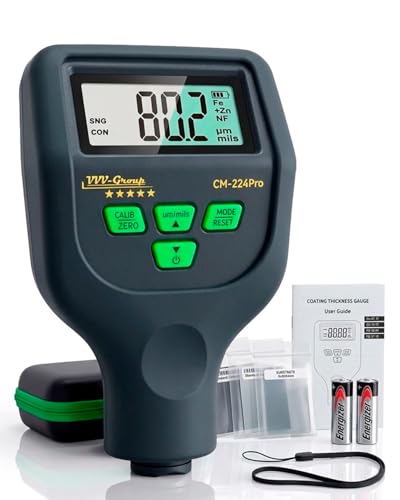
- 0.1 μm resolution for panel comparisons
- Automatic Fe, NFe, and zinc detection
- Backlit display with protective carrying case
Best For: Dealership and body-shop inspection routines
Best All-Around Metal Panel Gauge
POROMETISTO 0-2000μm Paint Thickness Meter

- Automatic Fe/NFe detection for steel and aluminum
- Continuous scanning with average, max, and min readings
- Stores 30 sets and exports via USB-C
Best For: Metal-panel inspections by buyers, dealers, detailers, and body shops
Best for Used-Car Inspection
Digital Automotive Paint Depth Micron Gauge

- Detects metal substrates, body filler, and metallic coatings
- Stores data for 19 panels and up to 999 vehicles
- Includes thickness alarms and voice readouts
Best For: Vehicle inspections, used-car evaluations, and safe polishing
Best for Field Reporting
CM-208FN Industrial Paint Thickness Meter

- Automatic Fe/NFe detection with 0.1μm resolution
- Shows average, minimum, maximum, and reading count
- Exports measurement data by USB
Best For: Mobile inspections, detailing, maintenance, and PC-based reporting
Quick Steel-Panel Check
Magnetic Paint Thickness Gauge Pen

- Battery-free magnetic operation
- Color-coded comparison bands
- Compact 4.1-inch pen design
Best For: Simple checks on steel or iron car panels
Versatile Digital Inspection
Auto-Detect Coating Thickness Meter

- Automatic Fe/NFe recognition
- 0–2000 μm range with 1 μm resolution
- Backlit display and calibration films included
Best For: Mixed-metal automotive and workshop inspections
Professional Continuous Measurement
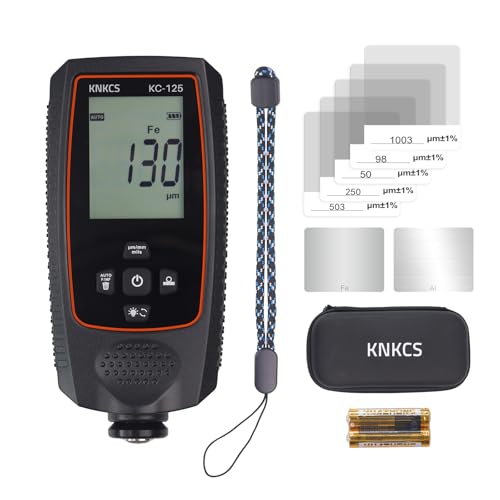
- 0–2500 μm measurement range
- 0.1 μm stated resolution
- Continuous measurement and rotating screen
Best For: Auto body shops and detailed vehicle inspections
Best Factory-Calibrated Pick – CM-224 Auto Paint Thickness Gauge
The CM-224 Auto is a practical choice among heavy-duty automotive paint thickness gauges for buyers who want accurate readings without a lengthy setup. It measures coatings up to 1500 μm, automatically recognizes steel, aluminum, and galvanized steel, and includes a backlit display for quick panel checks.
Best For: Used-car buyers, vehicle appraisers, body shops, and detailing professionals who inspect metal vehicle panels.
Pros:
- Factory calibrated and ready to use after installing the included AAA batteries.
- Automatically detects Fe, NFe, and Fe+Zn substrates.
- Offers 0.1 μm resolution, single-point mode, and continuous scanning.
- Supports optional zero and multi-point calibration with factory reset.
Cons:
- Designed for metal surfaces only; it is not suitable for plastic, carbon fiber, or composite parts.
- Uses replaceable AAA batteries rather than a rechargeable battery.
For straightforward automotive inspections, the CM-224 Auto combines broad metal-substrate compatibility with easy operation. Its factory calibration makes it especially convenient for occasional users, while continuous mode and advanced calibration provide added flexibility for professional checks.
Best Smart Inspection Tool – CM-226Pro Bluetooth Paint Gauge
The CM-226Pro stands out among heavy-duty automotive paint thickness gauges for its Bluetooth app support and vehicle-focused workflow. It measures up to 3000 μm, stores inspection data, and helps organize readings by panels such as the hood, doors, fenders, roof, and trunk.
Best For: Dealerships, mobile inspectors, detailing shops, body repair checks, and buyers who want smartphone-supported vehicle inspections.
Pros:
- Connects to iOS and Android devices through Bluetooth.
- Dedicated Car Mode organizes measurements by vehicle body panel.
- Measures up to 118 mils with 0.1 μm resolution.
- Includes a rechargeable 600mAh battery, backlit display, voice prompts, and data features.
Cons:
- App connectivity may be unnecessary for users who only need basic spot readings.
- Its broader feature set may require more setup than a simple standalone gauge.
This is the most feature-rich option in the group for structured inspections and record keeping. The combination of Car Mode, statistics, storage, and rechargeable operation makes it well suited to repeated professional use, while automatic substrate recognition keeps measurements accessible to beginners.
Best Simple Value Option – RDINSCOS ET330 Coating Thickness Meter
RDINSCOS Car Coating Thickness Meter | For Used Car Buyers, Check Original Coating, Auto Paint Meter
Check Price On AmazonThe RDINSCOS ET330 is a straightforward option for shoppers comparing heavy-duty automotive paint thickness gauges without needing advanced connectivity. It provides non-destructive readings from 0 to 1500 μm, automatically identifies ferrous and non-ferrous substrates, and supports both spot checks and continuous scanning.
Best For: Used-car inspections, vehicle maintenance, and basic paint-coating checks where simple digital operation is preferred.
Pros:
- Simple power-on-and-measure operation with a clear digital display.
- Automatically detects Fe, NF, and Zn substrates.
- Provides 0.1 μm resolution with stated accuracy of ±(3%+2 μm).
- Supports both μm and mil units, plus spot and continuous modes.
Cons:
- Does not list app connectivity, data storage, or a rechargeable battery.
- Its 1500 μm range is narrower than the CM-226Pro’s stated range.
The ET330 focuses on the essentials: automatic substrate detection, flexible measurement modes, and uncomplicated operation. It is a sensible fit for occasional inspections and routine vehicle checks when advanced reporting features are not a priority.
Best Workshop Workflow – CM-224Pro Automotive Paint Gauge
The CM-224Pro is built for repeatable panel-to-panel comparisons, making it a strong contender among heavy-duty automotive paint thickness gauges for dealership and workshop routines. It measures up to 1500 μm, automatically recognizes steel, aluminum, and zinc surfaces, and uses a backlit multi-unit display.
Best For: Dealership inspectors, body shops, and professionals comparing coating consistency across doors, hoods, roofs, and other metal panels.
Pros:
- Provides 0.01 mil (0.1 μm) resolution across a 0–59.1 mil range.
- Automatically detects Fe, NFe, and zinc substrates.
- Designed for stable probe contact and efficient panel-to-panel scanning.
- Includes a backlit display, protective housing, and carrying case.
Cons:
- The supplied notes do not indicate Bluetooth, app support, or data storage.
- Its stated operating range is intended for workshop and controlled professional environments.
For professionals who mainly need consistent comparative readings rather than connected reporting, the CM-224Pro offers a focused workflow. Its automatic substrate recognition and portable protective design support regular inspection rounds across multiple vehicle panels.
Best All-Around Metal Panel Gauge – POROMETISTO 0-2000μm Paint Thickness Meter
For shoppers comparing heavy-duty automotive paint thickness gauges, the POROMETISTO is a versatile choice for checking steel, iron, aluminum, and copper body panels. Its automatic Fe/NFe detection, fine 0.1μm resolution below 100μm, and continuous scanning mode make it practical for spotting uneven clear coat, repairs, and repainting.
Best For: Used-car buyers, dealers, detailers, body shops, coating applicators, and QC users inspecting metal panels.
Pros:
- Measures both ferrous and non-ferrous metal panels without manual mode switching.
- Continuous mode refreshes readings every 0.3 seconds and shows recent average, maximum, and minimum values.
- Stores 30 measurement sets and supports USB-C transfer to a Windows PC.
- Includes calibration foils, a bare substrate, batteries, and a two-year repair-or-replace warranty.
Cons:
- Does not measure plastic, fiberglass, carbon fiber, wood, or drywall.
- Requires calibration and careful probe placement for reliable results.
- Curves under 5mm, weld seams, rust, and dirt can affect readings.
The POROMETISTO balances useful inspection features with a straightforward one-button interface. It is especially appealing if you want stored readings and PC export, provided your inspections focus on metal body panels.
Best for Used-Car Inspection – Digital Automotive Paint Depth Micron Gauge
Among heavy-duty automotive paint thickness gauges, this digital gauge stands out for inspection-oriented data handling and material identification. It measures up to 3000μm, detects ferrous and non-ferrous substrates automatically, and can identify body filler and non-magnetic metallic coatings.
Best For: Used-car buyers, vehicle inspectors, and paint-correction users who need panel-by-panel records and thickness alerts.
Pros:
- Measures from 0 to 118 mils in about 0.5 seconds with stated accuracy of ±(3% + 1μm).
- Car Mode stores readings for 19 body panels and supports up to 999 vehicles.
- Customizable alarms can flag coatings that are too thin or too thick before polishing.
- Offers a rotatable backlit display, voice measurement announcements, and USB-C rechargeable power.
Cons:
- Its one-year manufacturer warranty is shorter than some competing options.
- Advanced features may be more than casual users need.
- Although calibration supports curved surfaces, correct calibration remains important for accuracy.
This model is a strong fit when inspection workflow matters as much as the reading itself. Its vehicle and panel storage, alerts, and filler detection support more systematic evaluations than a basic spot-check meter.
Best for Field Reporting – CM-208FN Industrial Paint Thickness Meter
The CM-208FN is a practical option for buyers seeking heavy-duty automotive paint thickness gauges with inspection statistics and computer reporting. Its integrated ruby-tip probe, automatic Fe/NFe identification, and broad 0-2000μm range support repeatable checks on steel and aluminum vehicle panels.
Best For: Car buyers, detailers, inspectors, technicians, and mobile users who need measurement summaries and USB data export.
Pros:
- Provides resolution down to 0.1μm, with automatic detection of steel and aluminum substrates.
- Displays average, minimum, maximum, and reading count for evaluating coating uniformity.
- Integrated probe enables quick one-handed measurements on flat and moderately curved surfaces.
- Designed for field use across an operating range of -4°F to 122°F.
Cons:
- Measures coatings only on metal bases and is not suitable for plastic, composite, or carbon-fiber parts.
- The supplied notes do not specify a warranty or included calibration accessories.
- USB export requires connection to a PC for documentation and analysis.
The CM-208FN favors straightforward, repeatable field measurements over vehicle-specific record keeping. Choose it if statistical summaries, USB reporting, and a compact integrated probe are more important than filler detection or multi-vehicle storage.
Quick Steel-Panel Check – Magnetic Paint Thickness Gauge Pen
For a simple first pass with heavy-duty automotive paint thickness gauges, this magnetic pen offers a battery-free way to compare coating bands on clean, flat steel or iron panels. Its color-coded mechanical scale makes it useful during a used-car walk-around, while keeping expectations realistic: differences are clues for further inspection, not proof of accident history.
Best For: Used-car shoppers who want a compact, no-battery check for ferromagnetic body panels.
Pros:
- No batteries, charging, or pre-use manual calibration required.
- Color bands make panel-to-panel comparisons quick to interpret.
- Pen-sized design fits easily in a glove box or tool kit.
Cons:
- Works only on magnetic steel or iron panels.
- Does not provide a numerical thickness reading.
- Clean, flat panels are needed for useful comparisons.
This is a convenient screening tool rather than a full diagnostic instrument. Choose it for portability and simplicity, but use a digital meter when you need measurements across mixed metal substrates or more precise documentation.
Versatile Digital Inspection – Auto-Detect Coating Thickness Meter
This digital option brings useful versatility to heavy-duty automotive paint thickness gauges by automatically recognizing ferrous and non-ferrous substrates. With a 0–2000 μm range, selectable units, calibration films, and a backlit display, it suits used-car checks as well as workshop and field coating inspections.
Best For: Buyers and technicians measuring coatings on steel, aluminum, copper, chrome, and anodized surfaces.
Pros:
- Automatically detects Fe and NFe substrates without manual switching.
- Measures from 0–2000 μm with 1 μm resolution and stated accuracy of ±(3%+1 μm).
- Includes seven calibration films, a wrist lanyard, and a backlit LCD.
- Supports μm, mm, and mil measurement units.
Cons:
- Zero calibration is required before first use for accurate readings.
- Two AAA batteries are required and are not included.
- Automatic shutoff occurs after five minutes of inactivity.
Its automatic substrate recognition and broad material compatibility make it a practical middle ground for automotive inspections. The included calibration accessories add flexibility, but remember to calibrate as directed before relying on readings.
Professional Continuous Measurement – KC-125 Paint Thickness Gauge
For more demanding heavy-duty automotive paint thickness gauges work, the KNKCS KC-125 combines a 0–2500 μm range with continuous measurement and a rotating screen. Its stated 0.1 μm resolution and recognition features for iron powder filler and iron-zinc-coated substrates make it geared toward detailed automotive and industrial evaluations.
Best For: Auto body shops, professional inspectors, and serious used-car evaluations requiring repeated readings.
Pros:
- Wide 0–2500 μm measurement range.
- Stated accuracy of ±(3%+1 μm) and 0.1 μm resolution.
- Continuous measurement supports efficient repeated inspections.
- Includes a rotating screen and recognition for iron powder filler and iron-zinc-coated substrates.
Cons:
- The supplied notes do not specify battery type or included calibration accessories.
- Its professional-oriented feature set may be more than casual buyers need.
- High resolution does not eliminate the need to follow proper measurement practices.
The KC-125 is the strongest fit here for users who value range, repeat readings, and specialized substrate recognition. Its five-year maintenance program and lifetime technical support may also appeal to professionals planning regular use.
How We Picked These Heavy-Duty Automotive Paint Thickness Gauges
We compared the selected gauges by measurement range, resolution, support for steel and aluminum panels, automatic substrate detection, calibration features, display clarity, portability, and inspection workflow. We also considered whether each design suits occasional used-car checks or repeated professional use. A fine resolution can help identify small coating differences, but it does not automatically mean the instrument is more accurate, so both specifications matter.
Quick Comparison
For straightforward steel-panel checks, a magnetic pen or basic Fe/NFe meter may be sufficient. Digital models with automatic detection are more versatile for mixed-material vehicles, while Bluetooth-enabled gauges are better for users who want to record, organize, or share readings through a phone. Models with ranges reaching about 2,000 μm are useful when inspecting thick filler, protective coatings, or industrial finishes rather than factory automotive paint alone.
Key Buying Factors
Substrate Compatibility
Confirm that the gauge measures both ferrous and nonferrous metals if you inspect modern vehicles. Steel doors, aluminum hoods, and zinc-coated panels can produce different readings. Fe/NFe or Fe/Al/Fe+Zn detection reduces the risk of interpreting the wrong substrate.
Range, Resolution, and Accuracy
Automotive paint is relatively thin, so a resolution of 0.1 μm or a comparable mil increment can make changes easier to spot. For broad applications, choose a gauge with a higher upper range. Always compare stated accuracy and repeatability, and calibrate when the instructions require it.
Calibration and Usability
Zeroing, reference plates, and calibration foils help maintain dependable results. A large backlit display, quick measurement response, audible alerts, and simple controls are valuable when working outdoors or checking many panels in succession.
Connectivity and Build
Bluetooth and companion apps can simplify reports and data logging, but they add setup and battery considerations. For field work, prioritize a protective case, replaceable batteries or reliable charging, a stable probe, and a housing that can tolerate regular handling.
Who Should Buy Which Heavy-Duty Automotive Paint Thickness Gauges?
Used-car buyers usually benefit from a compact, easy-to-operate digital gauge with automatic Fe/NFe detection. Detailers and body shops should consider a higher-resolution model with calibration tools and a broad range for repeated panel checks. Inspectors who work across steel, aluminum, and zinc-coated surfaces should choose a multimetal model with automatic substrate recognition. Dealerships, fleet managers, and mobile inspection services may prefer Bluetooth connectivity for storing readings and producing consistent documentation.
Before buying, decide whether you need spot checks or recorded inspection histories, identify the metals you will measure most often, and check the included calibration accessories. The best Heavy-Duty Automotive Paint Thickness Gauges are the ones that match your materials, workload, and reporting needs while remaining simple enough to use consistently.
