

10 Best Heavy-Duty GPS Handheld Navigators for Reliable Backcountry Navigation in 2026

When cell service disappears, a dependable handheld GPS navigator can make route-finding, waypoint marking, and returning safely much easier. The best heavy-duty models balance rugged construction with accurate positioning, readable displays, long battery life, and straightforward controls.
This roundup compares 10 options ranging from compact eTrex units to feature-rich Montana and marine-focused GPSMAP models, helping you match navigation features to your terrain, trip length, and budget.
Best 10 Heavy-Duty GPS Handheld Navigators Picks for 2026
Best Large-Screen Navigator

- 5-inch glove-friendly touchscreen
- MIL-STD 810 and IPX7-rated construction
- Up to 432 hours in expedition mode
Best For: Hikers and overland travelers who want a large display and extensive mapping
Best for Challenging Terrain
- Multi-band and expanded GNSS support
- Button-operated 2.6-inch color display
- Compass, altimeter, and TopoActive maps
Best For: Outdoor users navigating forests, steep terrain, or urban canyons
Best Value Compact Navigator

- Lightweight 4.96-ounce design
- Up to 25 hours on two AA batteries
- TopoActive maps with routable trails
Best For: Hikers and cyclists who want a compact, battery-friendly navigator
Best Basic Multi-Band Navigator

- Multi-band and expanded GNSS support
- Sunlight-readable 2.6-inch display
- Routable maps and public land boundaries
Best For: Hikers and hunters who want accurate positioning with physical controls
Top Premium Pick

- 5-inch rugged touchscreen with camera
- inReach messaging and SOS support
- Up to 432 hours in expedition mode
Best For: Remote adventures requiring navigation and satellite communication
Best Marine Option
- Floating IPX6 water-resistant design
- Preloaded BlueChart g3 coastal charts
- Stores 10,000 waypoints and 250 routes
Best For: Boating, fishing, and coastal navigation
Best Long-Battery Value
NiesahYan Rugged GPS Navigator

- Up to 36 hours of battery life
- Sunlight-readable button-operated display
- USA Topo maps and multi-GNSS support
Best For: Hikers and campers wanting simple controls and extended runtime
Best Long-Battery Pick

- Up to 1,800 hours in expedition mode
- Multi-GNSS support for challenging environments
- IPX7 water resistance and sunlight-readable display
Best For: Extended trips, hiking, and geocaching
Best Mapping Value

- Preloaded routable TopoActive maps
- 8 GB storage plus microSD expansion
- Sunlight-readable color display
Best For: Hiking and cycling with downloadable maps
Best Simple Navigator

- Worldwide basemap and GLONASS support
- IPX7 waterproof construction
- Up to 20 hours on two AA batteries
Best For: Basic navigation, running, and geocaching
Best Large-Screen Navigator – Garmin Montana 710
For buyers who want a highly capable option among heavy-duty GPS handheld navigators, the Garmin Montana 710 combines a large, glove-friendly touchscreen with extensive mapping and rugged construction. Its 5-inch display, 32 GB of storage, and flexible power options suit demanding outdoor trips.
Best For: Hikers, campers, and overland travelers who prioritize screen size, mapping flexibility, and durable construction.
Pros:
- Large 5-inch touchscreen is designed for viewing and use with gloves.
- MIL-STD 810-rated construction and IPX7 water resistance support tough conditions.
- Includes TopoActive maps, satellite imagery support, and 32 GB of storage.
- Battery lasts up to 24 hours in GPS mode or up to 432 hours in expedition mode.
Cons:
- Additional maps, premium Outdoor Maps+ content, and mounting options are sold separately.
- AA batteries are not included.
The Montana 710 is the most feature-rich and screen-focused choice in this lineup. It is especially appealing when easy map viewing and extended expedition operation matter more than compact size.
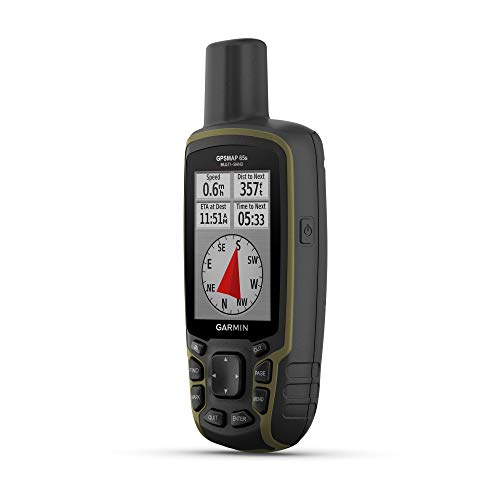
Best for Challenging Terrain – Garmin GPSMAP 65s
The Garmin GPSMAP 65s is a practical pick among heavy-duty GPS handheld navigators for locations where satellite reception can be difficult. Multi-band technology and expanded GNSS support are designed for steep terrain, dense forests, and urban canyons, while button controls remain useful in wet or gloved conditions.
Best For: Hikers, hunters, and geocachers who need improved positioning in challenging environments and prefer physical buttons.
Pros:
- Multi-band technology and expanded GNSS support target difficult reception conditions.
- 2.6-inch sunlight-readable color display is easy to view outdoors.
- Includes routable TopoActive mapping and U.S. federal public land maps.
- Built-in 3-axis compass and barometric altimeter add navigation data.
Cons:
- Battery life is rated at up to 16 hours, shorter than some models in this roundup.
- Requires a compatible smartphone for Garmin Explore features.
Choose the GPSMAP 65s when positioning reliability and tactile operation are more important than a large screen. Its ABC sensors and multi-band support make it a strong tool for technical outdoor navigation.
Best Value Compact Navigator – Garmin eTrex 32x
The Garmin eTrex 32x offers a compact, straightforward approach to heavy-duty GPS handheld navigators. It provides a sunlight-readable color display, routable TopoActive maps, GPS and GLONASS support, and useful ABC sensors in a lightweight body powered by two AA batteries.
Best For: Hikers, cyclists, and outdoor users seeking a compact navigator with long battery life and core mapping features.
Pros:
- Compact design weighs just 4.96 ounces.
- Battery life reaches up to 25 hours with two AA batteries.
- Preloaded TopoActive maps include routable roads and trails.
- Includes a 3-axis compass, barometric altimeter, 8 GB of memory, and a microSD slot.
Cons:
- Its 2.2-inch display is smaller than the screens on the other listed models.
- Satellite support is limited to GPS and GLONASS rather than expanded multi-band GNSS.
The eTrex 32x is a sensible choice when portability, replaceable batteries, and essential navigation tools take priority. It delivers useful trail features without the larger size of touchscreen models.
Best Basic Multi-Band Navigator – Garmin GPSMAP 65
The Garmin GPSMAP 65 is a button-operated option for shoppers comparing heavy-duty GPS handheld navigators with expanded satellite support. Its multi-band technology, sunlight-readable display, routable TopoActive maps, and public land boundaries provide a capable foundation for hiking, hunting, and outdoor travel.
Best For: Outdoor users who want multi-band positioning and physical controls without the additional sensor package listed for the GPSMAP 65s.
Pros:
- Multi-band technology and expanded GNSS support help in forests, steep country, and urban canyons.
- 2.6-inch sunlight-readable color display supports outdoor viewing.
- Includes routable TopoActive maps and U.S. federal public land maps.
- Compatible with Garmin Explore for managing tracks, routes, and waypoints.
Cons:
- Battery life is rated at up to 16 hours.
- It does not list the 3-axis compass and barometric altimeter included with the GPSMAP 65s.
- A compatible smartphone is required for Garmin Explore features.
The GPSMAP 65 is a focused choice for buyers who value reception technology and button control. Consider the 65s instead if an altimeter and compass are important to your navigation setup.
Top Premium Pick – Garmin Montana 760i
The Garmin Montana 760i is a feature-rich choice among heavy-duty GPS handheld navigators, combining a large glove-friendly screen with rugged construction, detailed maps, and satellite communication for trips beyond cell coverage. Its capabilities suit demanding outdoor use, though inReach features require an active subscription.
Best For: Backcountry travelers, ATV and dirt-bike riders, hikers, and campers who want navigation plus emergency communication.
Pros:
- Rugged 5-inch touchscreen is rated to MIL-STD 810 and IPX7 for water resistance.
- inReach supports two-way messaging, location tracking, and interactive SOS with a subscription.
- Includes TopoActive and City Navigator maps, satellite imagery support, and 32 GB of storage.
- Battery lasts up to 24 hours in GPS mode or 432 hours in expedition mode.
Cons:
- Satellite communication features require a separate active subscription.
- Additional mounts and some premium mapping content are sold separately.
- The larger feature set may be more than casual hikers need.
Choose this model if you need a versatile navigator that can handle rough conditions while providing communication and mapping flexibility. It is especially compelling for remote adventures where cell service is unreliable.
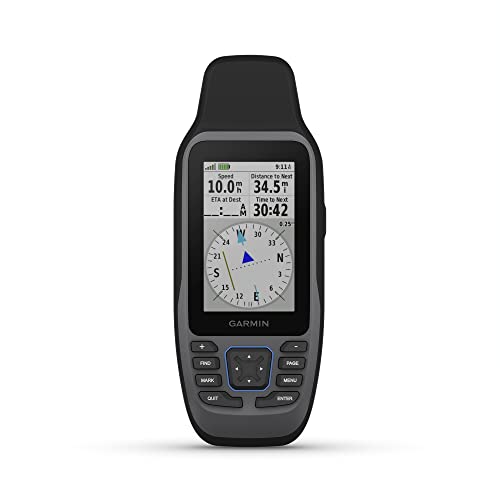
Best Marine Option – Garmin GPSMAP 79sc
The Garmin GPSMAP 79sc is a practical marine-focused entry among heavy-duty GPS handheld navigators. Its floating, water-resistant design, preloaded BlueChart g3 coastal charts, and electronic compass make it particularly suitable for boating and fishing.
Best For: Boaters and anglers who need a rugged handheld GPS that floats and includes coastal chart coverage.
Pros:
- Designed to float and rated IPX6 for water resistance at the unit level.
- Preloaded BlueChart g3 coastal charts support marine navigation.
- Tracks up to 10,000 waypoints, 250 routes, and 300 fit activities.
- Includes a 3-axis compass and barometric altimeter.
Cons:
- Battery life is limited to up to 20 hours in GPS mode.
- Its mapping focus is better suited to coastal use than general trail navigation.
- USB is the listed connectivity option, with no stated Wi-Fi or Bluetooth support.
For water-based navigation, the floating housing and BlueChart coverage are the main reasons to choose the GPSMAP 79sc. It offers useful tracking capacity without adding unnecessary general-purpose features.
Best Long-Battery Value – NiesahYan Rugged GPS Navigator
This compact NiesahYan model offers a straightforward option for shoppers seeking heavy-duty GPS handheld navigators without a touchscreen. It combines physical buttons, a sunlight-readable 3.2-inch display, USA Topo maps, multi-GNSS support, and a claimed 36-hour rechargeable battery.
Best For: Hikers and campers who prefer button controls, compact size, and extended battery life.
Pros:
- Sunlight-readable 3.2-inch screen and physical buttons suit changing outdoor conditions.
- Supports GPS, Galileo, BeiDou, and QZSS for multi-GNSS positioning.
- Includes a 3-axis compass, barometric altimeter, and preloaded USA Topo maps.
- Rechargeable battery provides up to 36 hours and charges through USB-C.
Cons:
- Its 3.2-inch non-touchscreen display is smaller than the Montana 760i’s screen.
- IP66 water resistance is specified rather than a fully waterproof rating.
- The supplied notes do not mention satellite messaging or SOS functionality.
This is a sensible pick for route finding and waypoint return when long battery life and simple controls matter most. Its compact design and USA Topo maps make it a practical hiking companion, while advanced communication features are absent.
Best Long-Battery Pick – Garmin eTrex SE
The Garmin eTrex SE is a strong choice among heavy-duty GPS handheld navigators when long battery life and modern satellite support matter. Its sunlight-readable 2.2-inch display, multi-GNSS reception, digital compass, and IPX7 water resistance suit extended hiking and camping trips.
Best For: Extended outdoor trips, geocaching, hiking, and users who want wireless phone connectivity.
Pros:
- Up to 168 hours in standard mode or 1,800 hours in expedition mode
- Supports GPS, GLONASS, Galileo, BeiDou, and QZSS
- Sunlight-readable display and digital compass work well outdoors
- Bluetooth pairing enables app-based planning, updates, and geocaching features
Cons:
- Two field-replaceable AA batteries are required but not included
- Small 2.16-inch screen may feel limited for detailed map viewing
The eTrex SE stands out for exceptional endurance and broad satellite-system support. It is a practical pick when dependable tracking and low-maintenance field use take priority over a large touchscreen.
Best Mapping Value – Garmin eTrex 22x
The Garmin eTrex 22x is a practical option for shoppers seeking heavy-duty GPS handheld navigators with preloaded outdoor maps and expandable storage. Its color screen, TopoActive maps, GPS/GLONASS support, and rugged handheld format cover common hiking and cycling needs.
Best For: Hiking, cycling, and outdoor users who want routable trails and extra map storage.
Pros:
- Preloaded TopoActive maps include routable roads and trails
- 8 GB of internal storage plus a microSD card slot
- Sunlight-readable 2.2-inch color display
- GPS and GLONASS support improves tracking in challenging environments
Cons:
- Battery life is rated at up to 25 hours with two AA batteries
- Uses a non-touchscreen interface with button controls
The eTrex 22x offers a balanced feature set for traditional navigation. Its built-in maps and expandable memory make it more versatile than basic basemap-only models, though its battery endurance is more modest than the eTrex SE.
Best Simple Navigator – Garmin eTrex 10
The Garmin eTrex 10 is a straightforward choice among heavy-duty GPS handheld navigators for buyers who prefer a rugged, uncomplicated device. It combines a worldwide basemap, WAAS-enabled GPS with HotFix and GLONASS support, IPX7 waterproofing, and paperless geocaching.
Best For: Basic hiking, running, geocaching, and users who value simple button-based navigation.
Pros:
- Rugged, IPX7-waterproof design for rain and splashes
- Worldwide basemap with GPS, HotFix, and GLONASS support
- Supports paperless geocaching and waypoint tracking
- Runs for up to 20 hours on two AA batteries
Cons:
- Monochrome 128 x 160 display is less detailed than color models
- Limited 6 MB memory restricts onboard storage
- Uses wired USB connectivity rather than Bluetooth
The eTrex 10 focuses on dependable fundamentals rather than advanced mapping. Choose it for basic coordinates, tracks, and waypoints in wet conditions, but consider a higher model if color maps or substantial storage are important.
How We Picked These Heavy-Duty GPS Handheld Navigators
We focused on models suited to demanding outdoor use, prioritizing durable construction, water resistance, satellite positioning support, battery practicality, screen visibility, and ease of operation. The selection includes button-operated units for dependable use in poor weather, touchscreen navigators for larger maps, marine GPS devices, and compact models for hiking or emergency backup.
We also considered navigation features such as electronic compasses, barometric altimeters, multi-band positioning, preloaded mapping, wireless connectivity, and satellite communication. Not every feature is necessary for every user, so the goal is to show meaningful differences rather than identify one universal winner.
Quick Comparison
- Best for large-screen navigation: Garmin Montana 710 and Montana 760i.
- Best for high-accuracy positioning: Garmin GPSMAP 65 and GPSMAP 65s with multi-band technology.
- Best for marine use: Garmin GPSMAP 79sc, which is designed to float and includes coastal charts.
- Best compact hiking options: Garmin eTrex 22x, eTrex 32x, and eTrex SE.
- Best basic budget choice: Garmin eTrex 10 for simple worldwide GPS navigation.
Key Buying Factors for Heavy-Duty GPS Handheld Navigators
Ruggedness and Weather Protection
Look for a water-resistant enclosure, impact-tolerant design, and controls that remain usable with wet hands or gloves. A floating design is especially valuable for kayaking, boating, and fishing.
Positioning Accuracy
Multi-band GNSS can improve location reliability near trees, cliffs, and buildings, while an electronic compass helps maintain orientation when stationary. A barometric altimeter can add useful elevation and weather-trend information.
Display and Controls
Touchscreens provide larger, map-friendly interfaces, but physical buttons are often preferable in cold, wet, or gloved conditions. Check screen size, sunlight readability, and whether maps are easy to interpret at your preferred zoom level.
Maps, Battery, and Connectivity
Confirm which maps are included and whether additional regional, topographic, or marine charts are supported. Also check battery type, expected runtime, charging options, and wireless features. Satellite messaging or SOS capability, available on select models, can be valuable far beyond cellular coverage.
Who Should Buy Which Heavy-Duty GPS Handheld Navigators?
Choose a Montana model if you want a large display, extensive mapping, and a more capable touchscreen experience. Select the Montana 760i when an integrated camera and inReach satellite communication are priorities. The GPSMAP 65 or 65s is a strong fit for hikers and field users who value accurate positioning and button-based control; the 65s adds navigation sensors.
For boaters, the GPSMAP 79sc is the most specialized choice. Pick an eTrex model for lightweight hiking, geocaching, hunting, or backup navigation. The eTrex 32x adds more orientation-focused capability, while the eTrex 10 is best for users who need basic coordinates and routes at the lowest complexity. The eTrex SE suits buyers seeking a compact, modern handheld with updated connectivity and navigation features.
