

10 Best Injector Cleaning Machines for Professional Mechanics in 2026: Workshop-Ready Picks

Choosing among injector cleaning machines for professional mechanics means looking beyond ultrasonic cleaning alone. A dependable shop machine should match your injector types, support accurate testing, and make repeated service work efficient.
This roundup compares 10 options across cylinder capacity, test functions, heating, adapters, pulse controls, and vehicle-system compatibility so you can select equipment that fits your workflow and budget.
Best 10 Injector Cleaning Machines for Professional Mechanics Picks for 2026
Best Multi-Voltage Pick
AUTOOL CT500 GDI/EFI Injector Cleaner

- Cleans and tests up to six injectors
- Includes 12 diagnostic test functions
- Supports 12V, 70V, and 120V outputs
Best For: Professional shops handling varied injector types
Best Heated-Cleaning Value

- Uses heated ultrasonic cleaning
- Handles four injectors simultaneously
- Offers nine cleaning and testing functions
Best For: Smaller automotive and motorcycle service shops
Best Portable Diagnostic Kit
Universal Dual-Channel Injector Tester

- Tests two injectors at once
- Offers eight pulse modes and two drive voltages
- Includes eight cleaning adapter sizes
Best For: Mobile technicians with existing shop equipment
Best Visual Testing System
FOXWELL JT410 Injector Cleaner

- Shows spray and flow through four cylinders
- Adds heated 38 kHz ultrasonic cleaning
- Includes seal, resistance, and RPM simulation tests
Best For: Shops needing detailed conventional-injector diagnosis
Versatile Shop Choice
AUTOOL CT-200 Injector Cleaner

- Six-injector petrol testing capacity
- Digital monitoring and automatic pressure control
- Supports sprayability and reverse-flush tests
Best For: Petrol-focused shops needing versatile bench testing
Diagnostic Workstation

- Tests four gasoline injectors at once
- 10 diagnostic functions with visible spray analysis
- Heated ultrasonic and pulse-driven cleaning
Best For: Shops needing detailed gasoline-injector diagnostics
GDI-Ready Professional Pick
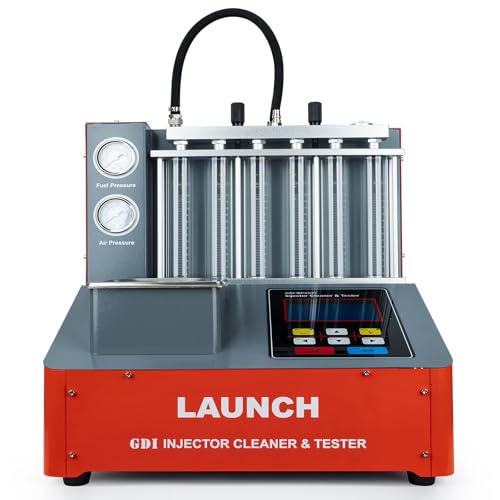
- Supports GDI, EFI, and SFI injectors
- Automatic liquid discharge improves workflow
- Offers ultrasonic and on-vehicle cleaning
Best For: Mixed gasoline-system repair shops
High-Capacity Diagnostic Bench
GarveeTech 6-Cylinder Injector Cleaner

- Cleans and tests up to six EFI injectors
- Supports flow, resistance, pulse, and RPM testing
- Adjustable 0–10 bar microcomputer pressure control
Best For: Busy professional shops needing high-capacity EFI injector testing
Portable Multi-Mode Value
4-Cylinder Heated Injector Cleaner Kit

- 28 kHz, 70 W ultrasonic cleaning with 45°C heating
- Nine test modes and three cleaning functions
- Compact 12-pound design with broad adapter coverage
Best For: Smaller shops and mobile technicians needing versatile testing
Adjustable Shop Testing
4-Cylinder Heated Injector Tester
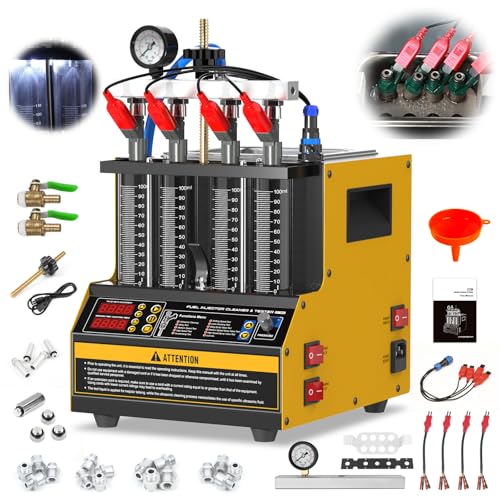
- Nine modes and four injector test functions
- Adjustable pressure up to 140 psi and speed to 7,500 RPM
- Four backlit cylinders with a 1,600 ml cleaning tank
Best For: Shops servicing 12V-and-below gasoline car and motorcycle injectors
Best Multi-Voltage Pick – AUTOOL CT500 GDI/EFI Injector Cleaner
For professional mechanics comparing injector cleaning machines for professional mechanics, the AUTOOL CT500 stands out when broad injector coverage and high testing capacity matter. It combines ultrasonic, reverse-flushing, and no-disassembly cleaning with 12 testing functions, while supporting GDI, EFI, and FSI applications.
Best For: Shops servicing varied direct-injection and standard injector systems.
Pros:
- Tests and cleans up to six injectors simultaneously.
- Offers 12 diagnostic tests covering spray, leakage, flow, and pulse performance.
- Includes 12V, 70V, and 120V output options for different injector types.
- Large 67.63-ounce ultrasonic tank and accessory storage drawer improve shop usability.
Cons:
- Reverse-flushing and no-disassembly cleaning require specific setup or additional C100 parts.
- The ultrasonic cleaning function supports only 12V injectors; 70V and 120V injectors are not supported for that function.
- Its 41.4-pound size is less convenient for mobile work.
The CT500 is a strong choice for a busy workshop that needs multiple testing modes and wider voltage compatibility. Confirm the required cleaning method and injector voltage before purchase.
Best Heated-Cleaning Value – LUTIFIX CT160 Injector Tester
The LUTIFIX CT160 is a practical option for mechanics who want injector cleaning machines for professional mechanics without moving to a larger six-cylinder platform. Its heated ultrasonic tank, automated cycles, and adjustable pressure system support routine automotive and motorcycle injector service.
Best For: Small shops and technicians needing four-injector cleaning and testing.
Pros:
- Heated cleaning fluid and ultrasonic technology target stubborn carbon deposits.
- Tests and cleans up to four injectors at once in a 2-liter tank.
- Provides nine functions for checking atomization, leakage, clogging, spray pattern, and balance.
- Supports 110V/220V operation and includes five adapter sizes.
Cons:
- Its four-injector capacity is lower than larger professional machines.
- The supplied notes do not specify compatibility with diesel injectors.
- Cleaning fluid is required for operation, even though the system supports recycling.
With a compact 16.87-pound design and useful heated cleaning features, the CT160 balances shop capability and portability. It is especially appealing when four-at-a-time service is sufficient.
Best Portable Diagnostic Kit – Universal Dual-Channel Injector Tester
For mechanics who need a compact diagnostic tool rather than a full benchtop machine, this universal kit is a flexible entry in injector cleaning machines for professional mechanics. It uses pulse testing, cleaning adapters, and dual output channels to evaluate petrol-vehicle injectors individually or in pairs.
Best For: Mobile technicians and shops that already have a fuel-pressure tester and cleaning supplies.
Pros:
- Tests two injectors simultaneously through dual output terminals.
- Provides eight pulse modes with 5V and 12V drive levels.
- Includes eight adapter sizes, including specialized BMW and Audi/VW options.
- Reverse-polarity and short-circuit protection add operational safeguards.
Cons:
- Cleaning fluid and the 12V power source are not included.
- It does not provide an integrated ultrasonic tank or fluid-heating system.
- It is intended for gasoline vehicles and is not suitable for diesel mechanical injectors.
This kit is best viewed as a portable pulse tester and adapter-based cleaner, not a complete shop cleaning station. It makes sense for technicians who value portability and already own supporting diagnostic equipment.
Best Visual Testing System – FOXWELL JT410 Injector Cleaner
The FOXWELL JT410 is designed for service bays that need clear visual inspection alongside cleaning. Among injector cleaning machines for professional mechanics, it combines heated 38 kHz ultrasonic cleaning with four transparent graduated cylinders, resistance checks, seal testing, and adjustable driving simulations.
Best For: Shops prioritizing visual flow comparison and detailed fault diagnosis.
Pros:
- Four 140 mL cylinders allow side-by-side spray and flow observation.
- Heated 45°C ultrasonic cleaning operates in a 2-liter tank.
- Supports resistance checks, seal testing up to 7 bar, and RPM simulations from 100 to 9,900.
- Automatically returns test and cleaning fluid for reuse.
Cons:
- The testing function is not compatible with diesel injectors or GDI injectors.
- Although cleaning supports all injector types, testing compatibility is more limited.
- Its 25.4-pound weight is less portable than a handheld pulse tester.
The JT410 offers a well-rounded workflow for diagnosing conventional automotive and motorcycle injectors, especially when technicians want to compare spray patterns directly. Verify injector type carefully because its cleaning and testing compatibility differ.
Versatile Shop Choice – AUTOOL CT-200 Injector Cleaner
For mechanics comparing injector cleaning machines for professional mechanics, the AUTOOL CT-200 offers automated cleaning and testing for petrol systems with up to six cylinders. Its digital display and microcomputer-controlled pressure system help you monitor test values while checking injector performance.
Best For: Professional shops servicing petrol cars and motorcycles that need six-injector capacity, adjustable pressure control, and reverse-flush capability.
Pros:
- Tests and cleans up to six petrol injectors.
- Digital display provides real-time monitoring of dynamic values.
- Supports uniformity, sprayability, and reverse-flush testing.
- Includes vehicle-cleaning adaptors and automatic draining for selected tests.
Cons:
- Designed for petrol injection systems rather than a stated diesel testing workflow.
- At 26.6 pounds, it requires dedicated bench space.
The CT-200 is a practical option when a shop wants automated pressure control, multiple test functions, and broad adaptor support in one bench-top unit. Its three-year warranty and lifelong maintenance promise add useful after-sales reassurance.
Diagnostic Workstation – V308 Pulse Injector Tester
The V308 stands out among injector cleaning machines for professional mechanics by combining heated ultrasonic cleaning with detailed gasoline-injector diagnostics. Four injectors can be tested at once, while transparent tubes, adjustable simulated engine conditions, and multiple test modes make flow and spray issues easier to identify.
Best For: Busy repair shops that want four-at-once testing, visible spray-pattern analysis, and programmable simulation of idle through high-speed conditions.
Pros:
- Tests four injectors simultaneously across 10 functions.
- Uses transparent graduated tubes and an analog pressure gauge for visual inspection.
- Offers ultrasonic cleaning with heat plus pulse-driven internal cleaning.
- Supports a broad range of low-pressure gasoline injector sizes.
Cons:
- Testing functions are limited to gasoline injectors, although ultrasonic cleaning supports almost all gasoline and diesel injectors.
- Pulse parameters are fixed; only cleaning time is adjustable.
With its combination of cleaning and simulation-based testing, the V308 is suited to technicians who want to diagnose flow, leakage, atomization, and speed-related behavior without repeatedly running the vehicle engine. Its three-year warranty and 24/7 customer support are additional positives.
GDI-Ready Professional Pick – LAUNCH X-431 CNC-801A
For professional mechanics looking for injector cleaning machines for professional mechanics, the LAUNCH X-431 CNC-801A supports GDI, EFI, SFI, and other injector types. It combines simulated engine-condition testing, ultrasonic cleaning, microcomputer pressure control, and on-vehicle fuel-supply-system cleaning.
Best For: Automotive workshops handling varied gasoline injection systems, including GDI, EFI, and SFI, that value automatic liquid discharge and on-vehicle cleaning options.
Pros:
- Supports GDI, EFI, SFI, and other gasoline injector applications.
- Automatically discharges test liquid at a preset level.
- Provides ultrasonic cleaning through pulse-signal operation and adjustable pressure control.
- Can clean the fuel supply system, combustion chamber, and nozzle without disassembly.
Cons:
- Cleaning liquid is not included.
- Backed by a one-year warranty, shorter than some alternatives in this group.
- The supplied version is specified for 110V operation.
The CNC-801A is a strong fit for shops that need broad gasoline-system coverage and workflow-oriented features. Automatic discharge can reduce manual handling, while the included detachable joints support servicing different vehicle applications.
High-Capacity Diagnostic Bench – GarveeTech 6-Cylinder Injector Cleaner
For professional mechanics seeking injector cleaning machines for professional mechanics, the GarveeTech 6-Cylinder model combines ultrasonic cleaning with flow, resistance, pulse, and RPM testing. Its six-injector capacity and adjustable 0–10 bar pressure control suit busy diagnostic and maintenance work.
Best For: Professional shops that need simultaneous testing and cleaning of up to six traditional EFI injectors.
Pros:
- Cleans injector surfaces and internal components with ultrasonic technology.
- Tests flow, resistance, pulse injection, and simulated RPM performance.
- Handles up to six injectors at once for improved shop throughput.
- Offers adjustable 0–10 bar pressure with microcomputer control.
Cons:
- At 39.7 pounds, it is less portable than compact alternatives.
- Its listed compatibility focuses on traditional EFI injectors.
Choose this unit when capacity and broad diagnostic control matter more than portability. It is a substantial bench-style option for recurring injector service in an automotive or motorcycle workshop.
Portable Multi-Mode Value – 4-Cylinder Heated Injector Cleaner Kit
This compact option gives mechanics a broad set of cleaning and diagnostic functions in one machine. It pairs 28 kHz, 70 W ultrasonic cleaning with heating, four-cylinder testing, adjustable parameters, and adapters for many 5V and 12V gasoline injectors.
Best For: Mobile technicians and smaller shops that want versatile injector testing in a lightweight 12-pound machine.
Pros:
- Uses heated ultrasonic cleaning with a 2,000 ml tank.
- Provides nine test modes plus ultrasonic, reverse-flush, and on-vehicle cleaning functions.
- Tests four injectors simultaneously with backlit 100 ml cylinders.
- Includes multiple adapters and supports adjustable pressure, time, and pulse width.
Cons:
- It is limited to four simultaneous injector tests.
- The notes require special test fluid or medical alcohol in the test cylinders and prohibit cleaning fluid, gasoline, diesel, and mineral oil.
Its combination of portability, heating, and test flexibility makes it a practical all-around choice. Pay close attention to the fluid requirements to avoid damaging the machine.
Adjustable Shop Testing – 4-Cylinder Heated Injector Tester
Designed for mechanics who need repeatable injector diagnostics, this 110V machine combines heated ultrasonic cleaning with four test functions and nine simulated operating modes. Its adjustable pressure, pulse width, test time, and speed settings provide useful control for car and motorcycle injector service.
Best For: Shops servicing mostly 12V-and-below gasoline injectors that want adjustable testing and clear visual monitoring.
Pros:
- Heats cleaning fluid to 45°C and supports no-disassembly cleaning.
- Offers uniformity, atomization, tightness, and injection-volume testing.
- Adjusts test pressure up to 140 psi, pulse width, time, and simulated speed up to 7,500 RPM.
- Includes four backlit cylinders and a 1,600 ml cleaning tank.
Cons:
- Its 110V specification may not suit every workshop setup.
- The listed compatibility is primarily for 12V-and-below gasoline injectors.
- Testing and cleaning fluids must be kept separate to protect seals and the pump.
This model is a strong fit when parameter control and observation are priorities. Its compact 12-pound format also makes storage and occasional relocation easier than with heavier bench machines.
How We Picked These Injector Cleaning Machines for Professional Mechanics
We focused on machines designed for repeatable injector service rather than basic consumer flush kits. The selection covers four- and six-cylinder equipment, ultrasonic cleaning systems, heated tanks, pulse testing, flow testing, resistance checks, and compatibility with common gasoline injection formats such as EFI, GDI, FSI, and SFI.
We also considered practical workshop details: adapter variety, control flexibility, tank capacity, voltage, included accessories, and whether the machine can support side-by-side comparison of injector performance. Product names and specifications should still be verified against the current listing before purchase, particularly for voltage, cylinder count, and included adapters.
Quick Comparison
| Feature | Why It Matters | What to Look For |
|---|---|---|
| Injector capacity | Determines how many injectors can be serviced together. | Four-cylinder units for routine work; six-cylinder models for higher throughput. |
| Cleaning method | Ultrasonic action helps remove deposits from injector components. | Adjustable cleaning cycles, heating, and a tank sized for your workload. |
| Testing functions | Reveals electrical and spray-performance problems. | Pulse, RPM, resistance, leak, flow, and comparison modes. |
| Compatibility | Adapters and controls must suit the injectors you service. | EFI, GDI, FSI, SFI support and a broad adapter set. |
| Power requirements | Incorrect voltage can prevent safe operation. | Check 110V or 12V input and any 70V or 120V test settings. |
Key Buying Factors for Professional Mechanics
Test Coverage and Repeatability
Cleaning is only half the job. Look for selectable pulse modes, adjustable frequency or RPM controls, resistance testing, and flow or leak checks. These features help you document whether an injector improved and identify units that should be replaced instead of reused.
Capacity, Tank Design, and Heating
A larger tank and six-cylinder capacity can improve productivity in a busy workshop, while a compact four-cylinder machine may be easier to store and sufficient for smaller service operations. Heated cleaning can help loosen stubborn deposits, but confirm temperature controls and follow the manufacturer’s fluid guidance.
Adapters and Injector Coverage
Adapter count is useful only when the fittings match the injectors you actually encounter. Before buying, compare the included connectors with your common petrol, motorcycle, direct-injection, and port-injection applications. GDI and other high-pressure systems may require specific adapters and procedures.
Controls, Safety, and Serviceability
Prioritize clear controls, readable displays, secure injector fixtures, fluid-resistant construction, and accessible replacement parts. A machine that is simple to set up and clean between jobs can save more time than one with extra modes that are rarely used.
Who Should Buy Which Injector Cleaning Machines for Professional Mechanics?
Choose a four-cylinder heated ultrasonic unit if you run a smaller repair shop, service motorcycles, or mainly handle ordinary EFI jobs. A six-cylinder machine is a better fit for professional shops that want to process complete engine sets efficiently. Select a model with broad adapters and GDI, FSI, or SFI support when your customer vehicles use varied injection systems.
For diagnostic-focused workshops, prioritize machines with flow, leak, resistance, and multi-pulse testing. If cleaning is the main requirement, a straightforward ultrasonic unit with reliable heating and a suitable tank may offer better value. Always match the machine’s electrical requirements, injector fixtures, and approved cleaning fluid to your workspace before ordering.
