

10 Best Portable Automotive Thermal Imagers for Smarter Vehicle Diagnostics in 2026

Portable automotive thermal imagers make it easier to spot abnormal heat before a small vehicle problem becomes an expensive repair. They can reveal hot connectors, cooling-system issues, battery temperature differences, brake drag, and HVAC faults that are difficult to confirm by touch.
This roundup compares 10 compact thermal cameras, including phone-connected modules, standalone handhelds, and models with added electrical testing features. Use the guide below to match resolution, temperature range, compatibility, and diagnostic tools to your work.
Best 10 Portable Automotive Thermal Imagers Picks for 2026
Best Android Detail Camera

- Enhanced 512x384 imaging with TISR
- -4°F to 1022°F measurement range
- One-ounce phone-powered design
Best For: Android-based automotive troubleshooting and tight-space inspections
Best AI-Assisted Inspection Camera

- AI highlights suspected problem areas
- Five preset inspection modes
- Up to 11 hours of continuous use
Best For: Guided electrical, HVAC, motor, and automotive inspections
Best Standalone Professional Camera
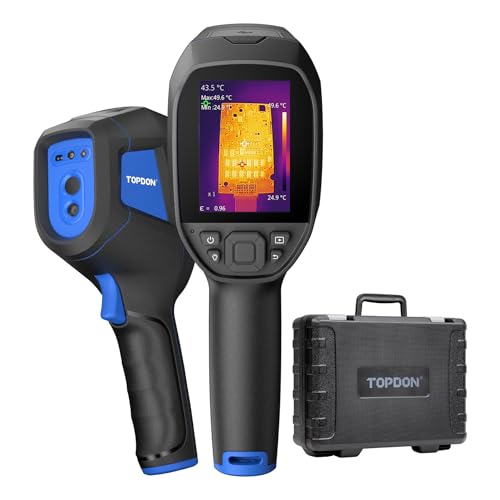
- 3.5-inch display with laser targeting
- 64GB internal storage
- Wi-Fi and USB reporting workflow
Best For: Professional inspections needing onboard viewing and documentation
Best USB-C Cross-Platform Module

- Supports USB-C iOS, Android, and Windows
- Enhanced 384x384 imaging with 25Hz refresh
- One-ounce, battery-free plug-in design
Best For: USB-C device users performing automotive and general inspections
Best Overall

- Detailed 320 × 240 display with TISR enhancement
- Temperature alerts and -10°C to 500°C range
- 8-hour battery, IP54 protection, and Windows reporting
Best For: Automotive maintenance and versatile field inspections
Most Portable

- Ultra-compact USB-C smartphone-connected design
- 192 × 192 resolution and 50° field of view
- -20°C to 400°C range with ±2% accuracy
Best For: Quick automotive checks in tight spaces
Best High-Temperature Range

- Measures up to 1022°F for demanding inspections
- 240 × 240 IRS resolution with <40mK sensitivity
- Adjustable emissivity, LED light, and USB export
Best For: Hot automotive and mechanical component diagnostics
Wide-Range Field Scanner

- -4°F to 1832°F measurement range
- Hot/cold spot tracking and alarms
- Rechargeable handheld design
Best For: Automotive and general field inspections
Electrical Diagnostic Combo
FIXCHIGO 2-in-1 Thermal Multimeter

- 240×240 thermal imaging resolution
- 10,000-count multimeter built in
- Touchscreen and USB-C charging
Best For: Combined thermal and electrical diagnostics
Pocket Phone Attachment
Android Type-C 128×96 Thermal Imager

- 13g plug-and-play Android design
- 128×96 IR resolution with 9Hz imaging
- Point, line, and area measurements
Best For: Android-based quick automotive inspections
Best Android Detail Camera – TOPDON TC001
The TOPDON TC001 is a compact choice among portable automotive thermal imagers for Android users who want detailed heat readings without carrying a standalone camera. It connects to compatible Android phones and tablets, using the mobile device for power and display.
Best For: Android-based automotive troubleshooting, component checks, and tight-space inspections.
Pros:
- Enhanced 512×384 imaging with TISR technology on supported Android devices.
- Measures from -4°F to 1022°F and supports point, line, and surface readings.
- Very compact, weighs about one ounce, and includes a 19.7-inch cable.
- Offers nine color palettes plus image fusion and enhancement features.
Cons:
- Requires a compatible Android device with OTG support.
- Not compatible with iPhone 15 according to the supplied notes.
- Enhanced resolution depends on phone compatibility.
The TC001 is particularly appealing when portability and phone-based operation matter most. Verify Android compatibility before buying, especially if you want the higher TISR resolution.
Best AI-Assisted Inspection Camera – GT16S Thermal Camera
The GT16S stands out among portable automotive thermal imagers for guided inspections. Its AI scene detection, preset modes, and real-time alerts help identify suspected issues while monitoring electrical, HVAC, motor, and other automotive-related components.
Best For: Users who want automated issue highlighting, flexible measurement modes, and extended field operation.
Pros:
- AI flags suspected problem areas in moisture, insulation, and floor-heating modes.
- Five preset inspection modes simplify setup for electrical and other applications.
- 25Hz refresh rate, thermometer mode, and hot, cold, and center-spot tracking.
- Up to 11 hours of continuous use with a temperature range to 1202°F.
Cons:
- Weighs 15.5 ounces, making it heavier than phone-connected modules.
- Its native sensor is 128×128, with enhancement producing a 240×240 display image.
- AI scene detection is centered on the listed preset inspection scenarios.
Choose the GT16S if guided workflows and long battery life are more valuable than the smallest possible form factor. Its alarms and adjustable emissivity also suit repeated diagnostic work.
Best Standalone Professional Camera – TOPDON TC005
The TOPDON TC005 is a standalone option among portable automotive thermal imagers, pairing a 3.5-inch display with laser targeting and substantial internal storage. It is designed for users who need to review findings on-site and organize inspection data for reporting.
Best For: Professional automotive and field inspections requiring onboard viewing, storage, and reporting tools.
Pros:
- 3.5-inch screen makes thermal findings easier to view in the field.
- Laser distance measurement up to 4 meters supports repeatable targeting.
- 64GB internal storage accommodates extensive image capture and documentation.
- Includes Wi-Fi app and USB PC software connections for analysis and reports.
Cons:
- At 1.04 pounds, it is considerably heavier than plug-in smartphone modules.
- Battery life is up to eight hours, with a stated two-hour recharge time.
- Its larger standalone design may be less convenient for ultra-tight spaces.
The TC005 makes the most sense when documentation and standalone operation are priorities. Its rugged housing, LED light, laser targeting, and storage capacity add practical value for demanding field use.
Best USB-C Cross-Platform Module – AMPBANK M192
The AMPBANK M192 is a lightweight option among portable automotive thermal imagers for USB-C phones, tablets, and compatible Windows devices. It combines plug-in convenience with enhanced imaging, temperature alarms, and a cable for reaching awkward inspection points.
Best For: USB-C iPhone, Android, and Windows users handling automotive, HVAC, electrical, or DIY inspections.
Pros:
- Works with USB-C iOS, Android, and Windows smart devices without a separate battery.
- Enhanced imaging reaches 384×384, with 25Hz refresh and 40mK sensitivity.
- Measures from -4°F to 842°F and includes adjustable emissivity and alarms.
- Weighs about 1.05 ounces and includes an extension cable and carrying case.
Cons:
- Requires a compatible USB-C device and the ThermCam app.
- Not compatible with Mac according to the supplied notes.
- Its maximum temperature range is lower than some listed alternatives.
The M192 is a strong fit for users who want a small, battery-free thermal module with broad USB-C device compatibility. Confirm OTG and app support on your specific device before purchase.
Best Overall – FOXWELL HT280
The FOXWELL HT280 is a strong all-around choice among portable automotive thermal imagers for users who want a dedicated handheld camera, a broad temperature range, and detailed inspection tools. Its 320 × 240 display, TISR-enhanced 260 × 260 imaging, temperature alerts, and durable housing suit vehicle maintenance as well as HVAC, electrical, and building inspections.
Best For: Automotive maintenance and multi-purpose inspection work requiring onboard alerts, long battery life, and PC analysis.
Pros:
- 320 × 240 LCD with TISR-enhanced 260 × 260 thermal images, 50mK sensitivity, and a 25Hz frame rate.
- Measures from -10°C to 500°C (14°F to 932°F), with adjustable emissivity and automatic high, center, and low temperature detection.
- Stores more than 20,000 images or video recordings and supports Windows PC analysis with 2D/3D views and reports.
- Offers up to 8 hours of operation, a 6.6-foot drop rating, and IP54 dust and water resistance.
Cons:
- PC analysis software is not compatible with Mac.
- Its dedicated handheld design is less pocket-sized than a smartphone-connected imager.
The HT280 is the most feature-rich option here for users who want a self-contained inspection tool. It is particularly appealing when documentation, temperature alarms, durability, and extended field use matter.
Most Portable – GOYOJO GW192A
The GOYOJO GW192A takes a different approach to portable automotive thermal imagers by plugging directly into a compatible smartphone. This compact USB-C imager is designed for quick scans in tight spaces, making it convenient for checking vehicle engines, electrical components, HVAC systems, and plumbing without carrying a separate handheld display.
Best For: Smartphone users who prioritize pocket-sized portability and quick plug-and-play automotive troubleshooting.
Pros:
- Compact 1.77 × 0.43 × 1.34-inch design weighing 0.48 ounces.
- 192 × 192 infrared resolution with a 12μm pixel pitch for identifying heat patterns and faults.
- Wide 50° field of view helps scan vehicle engines and larger areas with fewer movements.
- Measures from -20°C to 400°C (-4°F to 752°F) with stated ±2% accuracy.
Cons:
- Requires a compatible smartphone and USB-C connection, rather than operating as a standalone camera.
- The supplied compatibility information specifically lists iPhone 15, 16, and 17 series phones; users should verify device support.
The GW192A is the easiest option to keep in a tool bag or pocket. Its smartphone-dependent design trades standalone convenience for minimal size and straightforward on-the-go imaging.
Best High-Temperature Range – HT-H100 Thermal Camera
The HT-H100 is a practical handheld option among portable automotive thermal imagers, especially when inspections may involve high-temperature components. With a measurement range reaching 1022°F, sub-40mK sensitivity, a 240 × 240 IRS resolution, and a 50° field of view, it is suited to vehicle maintenance and broader electrical, HVAC, and mechanical troubleshooting.
Best For: Automotive and equipment inspections involving hot components, adjustable emissivity, and simple field documentation.
Pros:
- 240 × 240 IRS resolution and less than 40mK thermal sensitivity reveal subtle temperature differences.
- Measures from -20°C to 550°C (-4°F to 1022°F) with stated ±2°C/±2% accuracy.
- Adjustable emissivity from 0.01 to 1.00 supports measurements across materials such as metal, plastic, wood, and concrete.
- Includes a 50° × 50° field of view, LED light, rechargeable battery, USB export, and integrated flash storage.
Cons:
- The supplied notes do not specify battery runtime or storage capacity.
- At 12 ounces, it is less lightweight than the smartphone-connected option.
The HT-H100 stands out for its high upper temperature limit and material-aware measurement controls. It is a sensible pick for automotive users who want a dedicated camera without giving up documentation features.
Wide-Range Field Scanner – ANGGREK HZ 32A Thermal Camera
For shoppers comparing portable automotive thermal imagers, the ANGGREK HZ 32A is a practical handheld option for checking engines, HVAC components, electrical systems, and other equipment. Its 32×32 infrared resolution, hot/cold spot tracking, and broad temperature range support quick field inspections.
Best For: Automotive diagnostics and general inspections where a wide measurement range and handheld operation matter.
Pros:
- Measures from -4°F to 1832°F with stated ±3% accuracy and configurable emissivity.
- Provides 32×32 IR imaging, a 250 ms response time, and automatic high/low temperature alarms.
- Stores images with six color palettes for inspection records and reports.
- Rechargeable 1100mAh battery supports extended on-site use.
Cons:
- 32×32 resolution is more basic than higher-resolution thermal cameras.
- The notes do not specify wireless connectivity or a phone companion app.
This is a sensible choice when temperature range and straightforward handheld scanning are more important than advanced image detail or smartphone integration.
Electrical Diagnostic Combo – FIXCHIGO 2-in-1 Thermal Multimeter
The FIXCHIGO combines a thermal imager and a 10,000-count multimeter in one compact device, making it one of the more versatile portable automotive thermal imagers for technicians who also need electrical testing. Its 240×240 imaging resolution and touchscreen support detailed on-site troubleshooting.
Best For: Automotive, electrical, and mechanical troubleshooting where thermal imaging and multimeter functions are useful together.
Pros:
- Combines 240×240 thermal imaging with AC/DC voltage, resistance, capacitance, diode, continuity, frequency, and duty-cycle testing.
- Offers a -20°C to 550°C temperature range, 25Hz capture frequency, and adjustable emissivity.
- Includes a 2.8-inch touchscreen, five color palettes, internal image storage, and USB-C charging.
- Compact 5.2×2.7×0.9-inch design weighs about 130g.
Cons:
- Its battery is rated at 1000mAh, so heavy use may require regular charging.
- The touchscreen is intended for use with the included stylus rather than fingernails or hard objects.
For buyers who want one portable instrument instead of separate thermal and electrical tools, this model offers an unusually broad troubleshooting feature set in a small package.
Pocket Phone Attachment – Android Type-C 128×96 Thermal Imager
This Android Type-C camera is a highly portable alternative among portable automotive thermal imagers, weighing only 13g and drawing power directly from a compatible phone. It provides 128×96 infrared imaging, multiple measurement modes, and app-based image and video recording for quick automotive checks.
Best For: Android users who want an ultralight thermal camera for quick automotive, HVAC, and home inspections.
Pros:
- 128×96 IR resolution, 9Hz frame rate, and under 75mK NETD support clear thermal viewing.
- Measures from 14°F to 842°F with point, line, and area temperature modes.
- Weighs just 13g and uses a durable aluminum-alloy housing.
- Offers 10 color palettes plus image/video recording and data sharing through the app.
Cons:
- Compatible only with Android 10.0 or later and not with Apple iOS.
- It depends on the connected phone for power and display.
- The temperature range is narrower than some dedicated handheld models.
This is a convenient pick for Android owners who value minimum size and phone-based sharing, provided their device meets the compatibility requirement.
How We Picked the Best Portable Automotive Thermal Imagers
We focused on features that matter during real vehicle diagnosis: infrared resolution, temperature range, refresh rate, image clarity, measurement modes, portability, and connection method. We also considered whether each camera works with Android or iPhone devices, includes its own screen, or adds useful functions such as a multimeter, hot-and-cold-spot tracking, scene detection, or dual-lens imaging.
Because automotive inspections can involve cramped engine bays and hot components, practical usability mattered as much as headline specifications. Models with straightforward controls, reliable app support, and clear temperature readings are generally easier to use repeatedly.
Quick Comparison
- Phone-connected cameras: The TOPDON TC001, AMPBANK M192, GOYOJO, and compact Type-C models are convenient for users who already carry a compatible phone or tablet.
- Standalone handhelds: The TOPDON TC005, FOXWELL HT280, and other screen-equipped cameras work without relying on a separate mobile device.
- High-temperature inspection: Models rated to approximately 1,022°F or higher are better suited to exhaust components, industrial-style checks, and unusually hot surfaces.
- Electrical troubleshooting: The 2-in-1 thermal imager with a multimeter can help users investigate both heat patterns and electrical measurements in one tool.
Key Buying Factors for Portable Automotive Thermal Imagers
Resolution and Image Detail
Higher infrared resolution produces a more detailed heat map and makes it easier to isolate a small connector, fuse, bearing, or battery cell. A 32×32 model can identify broad hot spots, while 192×192, 240×240, 320×240, and 512×384 cameras provide progressively more useful detail for close automotive work.
Temperature Range and Accuracy
Choose a range that covers your intended inspections. Cooling systems, wiring, batteries, and HVAC work usually need less range than exhaust manifolds or high-temperature mechanical parts. A wide range is helpful, but accuracy, emissivity settings, and correct distance are equally important.
Refresh Rate, Focus, and Measurement Tools
A faster refresh rate makes it easier to follow moving heat during a live inspection. Look for spot measurements, area readings, hot-and-cold markers, adjustable emissivity, image capture, and—where useful—dual-lens or visual-camera overlays.
Compatibility and Portability
Phone modules are small and often affordable, but verify the connector, operating system, app requirements, and phone-case clearance before buying. Standalone cameras are usually faster to deploy and easier to share between technicians.
Who Should Buy Which Portable Automotive Thermal Imagers?
Choose the TOPDON TC001 if you want especially high image resolution in a compact Android-connected format. Choose the TOPDON TC005 or FOXWELL HT280 for a more traditional standalone workflow with an integrated display. Choose the AMPBANK, GOYOJO, or Type-C model for occasional inspections and convenient phone-based reporting.
Choose a high-temperature handheld model when exhaust or other very hot components are central to your work. Choose the multimeter combination unit if electrical testing is as important as thermal imaging. For basic leak detection, HVAC checks, and broad heat comparisons, a lower-resolution camera can be sufficient and easier on the budget.
