

10 Best Portable Heads-Up Car Displays for Safer Driving in 2026

Portable heads-up car displays make essential driving information easier to see by projecting speed, navigation, and vehicle data near your line of sight. They can be a practical upgrade for cars without a factory-installed HUD.
This roundup compares 10 options ranging from simple GPS speedometers to connected CarPlay and Android-compatible displays, helping you choose the right balance of visibility, features, and installation ease.
Best 10 Portable Heads-Up Car Displays Picks for 2026
Best GPS Visibility

- GPS+BDS positioning with a 10 Hz refresh rate
- Automatic brightness adjustment
- Plug-and-play USB installation
Best For: Drivers wanting a simple GPS speed display
Best Smartphone Integration
CarPlay HUD Projection Display

- Projects iPhone apps through CarPlay
- Automatic brightness for varied lighting
- Plug-and-play vehicle-mounted design
Best For: iPhone users seeking CarPlay in a HUD
Best Vehicle Data
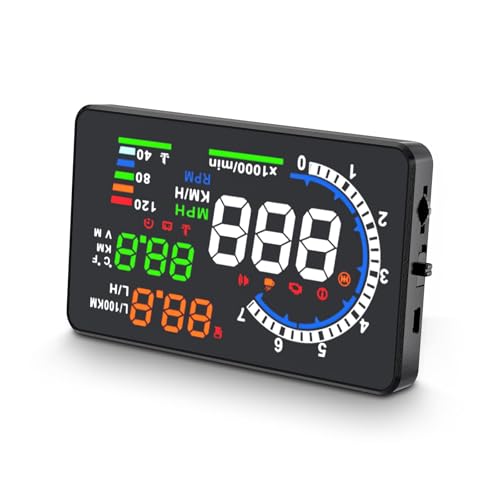
- Large 5.5-inch HD display
- Shows speed, RPM, temperature, and voltage
- Supports selected vehicle diagnostics
Best For: Compatible OBDII or EOBD vehicle owners
Best All-in-One Upgrade
VIVIHUD V3-SE Wireless Car HUD

- Wireless Apple CarPlay and Android Auto
- HD anti-reflection display with auto brightness
- Bluetooth audio and adjustable stable mount
Best For: Older vehicles needing a portable infotainment upgrade
GPS Accuracy Pick

- GPS + BDS positioning with 10Hz refresh
- MPH/KM/H switching and manual calibration
- Adjustable brightness and overspeed alert
Best For: Drivers wanting a customizable GPS speed display
Automatic Brightness Pick

- Automatic day-and-night brightness control
- Large MPH display up to 115 MPH
- USB setup without an OBD connection
Best For: Drivers prioritizing easy viewing and simple installation
GPS Co-Pilot Green
Plug-and-Play Portable Heads-Up Speed Display
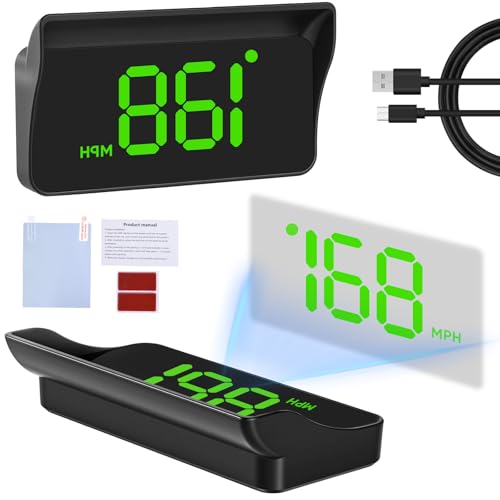
- GPS+BDS positioning with a 10Hz refresh rate
- USB setup without OBD wiring
- Automatic brightness for day and night
Best For: Drivers wanting a simple green MPH display for daily use
HD Large-Font Pick
Compact Portable Heads-Up Car Display

- Large-font HD speed display up to 199 MPH
- Compact 1-ounce ABS design
- Includes projection and adhesive mounting accessories
Best For: Drivers seeking a lightweight HUD with a prominent readout
GPS Co-Pilot Colorful

- Colorful large MPH display for forward-view checks
- GPS+BDS positioning with 10Hz updates
- 2-year manufacturer warranty and USB setup
Best For: Drivers wanting a colorful, multi-vehicle GPS HUD
Best GPS Visibility – Dual-Mode USB Car HUD
This compact option is a practical pick for drivers seeking portable heads-up car displays with straightforward USB installation. Its GPS+BDS positioning, 10 Hz refresh rate, automatic brightness adjustment, and large MPH readout focus on clear speed information without complicated setup.
Best For: Drivers who want a simple GPS speed display for a car, motorcycle, truck, or other vehicle with a USB port.
Pros:
- Dual-mode GPS+BDS reception supports up to 32 satellite signals and a 10 Hz refresh rate.
- Automatic brightness adjustment helps keep the display readable in changing light.
- Plug-and-play USB design works with vehicles that provide a 5V USB port.
- Large MPH display and anti-reflective shading support quick viewing.
Cons:
- GPS accuracy can vary by approximately 0.6–1.8 mph.
- Signal interruptions may occur in tunnels, garages, poor weather, or behind metallic windshield film.
- It primarily provides speed-focused information rather than smartphone navigation.
Choose this model if easy installation and a dedicated GPS speed readout matter most. As with other satellite-based displays, performance is best in open areas with a clear signal.
Best Smartphone Integration – CarPlay HUD Projection Display
This model is aimed at drivers who want portable heads-up car displays with smartphone connectivity. Its CarPlay function projects compatible iPhone applications onto the display, while the built-in light sensor adjusts brightness for daytime and nighttime viewing.
Best For: iPhone users who want CarPlay functionality in a windshield-oriented HUD system.
Pros:
- CarPlay support can project iPhone applications onto the HUD.
- Automatic brightness adjustment is designed for different lighting conditions.
- Designed as a plug-and-play, vehicle-mounted head-up display.
- Includes a one-year warranty description and stated 24-hour support response.
Cons:
- The supplied information specifically identifies mobile-phone compatibility but does not detail Android Auto support.
- GPS reception may be affected by tunnels, underground garages, heavy rain, fog, or metallic windshield film.
- Brand and detailed hardware specifications are limited in the supplied listing information.
This is a reasonable choice when projecting iPhone apps is more important than extensive vehicle diagnostics. Confirm your phone and vehicle setup before purchase, especially if your windshield has metallic film.
Best Vehicle Data – wiiyii A8 5.5-Inch HUD
The wiiyii A8 stands out among portable heads-up car displays for its broad vehicle-data coverage. With a 5.5-inch HD screen, it can show speed, RPM, water temperature, voltage, driving distance, fuel consumption, and multiple alarms when connected to a compatible OBDII or EOBD vehicle.
Best For: Owners of compatible OBDII or EOBD vehicles who want a large screen with diagnostic and driving information.
Pros:
- Large 5.5-inch, 800×480 display provides room for multiple readings.
- Shows speed, RPM, water temperature, voltage, fuel consumption, and distance.
- Includes speeding, voltage, and other alarm prompts.
- Can read certain vehicle fault information and support fault detection, alarms, and clearing.
Cons:
- Only supports OBDII and EOBD vehicles; it does not support OBD I or JOBD.
- Compatibility depends on the vehicle’s model year and diagnostic system.
- Its feature-rich display may be more than needed for drivers seeking only basic speed information.
Consider the A8 if you want a dashboard-style data monitor rather than a speed-only display. Verify OBDII or EOBD compatibility before ordering to avoid an unsuitable connection.
Best All-in-One Upgrade – VIVIHUD V3-SE Wireless Car HUD
The VIVIHUD V3-SE is designed for drivers who want portable heads-up car displays with modern smartphone features. It combines wireless Apple CarPlay and Android Auto with an HD anti-reflection screen, Bluetooth audio, hands-free calling, screen mirroring, and a stable adjustable mount.
Best For: Drivers of older vehicles, SUVs, pickups, vans, RVs, or cars without built-in CarPlay who want a broad infotainment upgrade.
Pros:
- Supports wireless Apple CarPlay and Android Auto for navigation, music, calls, messages, and voice assistants.
- Plug-and-play installation does not require replacing the original screen.
- HD anti-reflection display and automatic brightness support visibility in varied conditions.
- Adjustable viewing angle, non-slip base, Bluetooth audio, and screen mirroring add flexibility.
Cons:
- Wireless smartphone features require a compatible iPhone or Android device.
- The listing does not provide detailed screen-size or resolution specifications.
- It adds a separate dashboard display rather than integrating into the vehicle’s original screen.
This is the most versatile choice of the group for drivers seeking navigation and entertainment as well as HUD-style viewing. Its two-year warranty and after-sales support may also appeal to buyers planning a longer-term upgrade.
GPS Accuracy Pick – Dual-Mode Car HUD
This portable heads-up car display uses GPS and BDS positioning with a 10Hz refresh rate to provide large, real-time speed readings. It connects by USB, supports MPH or KM/H, and adds manual calibration, brightness adjustment, and an overspeed alert for flexible everyday use.
Best For: Drivers who want a straightforward GPS speedometer with calibration and customizable speed alerts.
Pros:
- Dual-mode GPS and BDS positioning supports up to 32 satellites.
- USB plug-and-play setup with MPH/KM/H switching.
- Manual speed calibration, adjustable brightness, and overspeed alerts.
- Large, anti-reflective display designed for quick viewing.
Cons:
- GPS reception can be affected by tunnels, garages, severe weather, or metallic windshield film.
- Requires a compatible USB power source.
Its combination of calibration and overspeed settings makes this a practical choice when you want more control than a basic speed display. Keep the GPS limitations in mind when driving in obstructed areas.
Automatic Brightness Pick – Smart HUD Co-Pilot
For drivers comparing portable heads-up car displays, this smart HUD emphasizes easy viewing with large MPH digits, automatic brightness adjustment, and an anti-reflective shade. It uses GPS and BDS positioning, connects to a standard 5V USB source, and does not require an OBD connection.
Best For: Commuters and long-distance drivers who prefer automatic brightness and simple USB installation.
Pros:
- Automatic brightness adjusts for changing daylight conditions.
- Large MPH display supports readings up to 115 MPH.
- USB plug-and-play design requires no OBD connection or wiring modification.
- Two-year manufacturer warranty is listed in the product details.
Cons:
- Displays MPH rather than offering a stated KM/H switching feature.
- GPS reception may be limited indoors, in tunnels, garages, severe weather, or behind metallic film.
- GPS speed variation of approximately 0.6–1.8 MPH may occur.
Automatic brightness is the main convenience advantage here, reducing the need to adjust the display manually. Its broad USB-powered vehicle compatibility also makes it flexible, provided the vehicle is used in an area with sufficient GPS reception.
High-Visibility Pick – White Car HUD
This portable heads-up car display provides a large MPH or KM/H speed readout using dual-mode GPS and BDS positioning. Its adjustable brightness, anti-reflective shading, USB power, speed calibration, and overspeed alert cover the key features needed for a simple windshield or dashboard speed reference.
Best For: Drivers who want a high-visibility display with flexible units and manual speed adjustment.
Pros:
- Switches between MPH and KM/H for regional preferences.
- Manual calibration can help match the vehicle’s dashboard reading.
- Multiple brightness levels support daytime and nighttime use.
- Large display and anti-reflective shading help with quick reading.
Cons:
- GPS performance may be affected in tunnels, underground garages, heavy rain or fog, and behind metallic windshield film.
- Brightness is adjusted manually rather than automatically.
This white-display version is a solid option for shoppers who value unit switching and hands-on calibration. It offers a similar feature set to the other K4-style model while differing in the listed color and weight.
GPS Co-Pilot Green – Plug-and-Play Portable Heads-Up Speed Display
For drivers comparing portable heads-up car displays, this ATNPTN model provides a straightforward way to keep MPH information near your forward view. Its GPS and BDS positioning, large digits, USB power, and automatic brightness make it suited to everyday driving without an OBD connection.
Best For: Daily commuters and drivers who want a compact green MPH display with simple USB installation.
Pros:
- GPS+BDS positioning supports responsive speed updates with a 10Hz refresh rate.
- USB plug-and-play setup requires no OBD connection or wiring modification.
- Automatic brightness and an anti-reflective shade support daytime and nighttime viewing.
- Works with various USB-equipped vehicles, including cars, trucks, motorcycles, and ATVs.
Cons:
- GPS speed may vary from approximately 0.6 to 1.8 MPH.
- Satellite lock and reception can be affected indoors, in tunnels, underground garages, or behind metallic windshield film.
- The display is limited to MPH and speeds up to 115 MPH.
This is a practical choice when easy installation and a readable green speed display matter more than vehicle-data integration. Allow time for the first satellite lock and use the factory speedometer as the primary reference.
HD Large-Font Pick – Compact Portable Heads-Up Car Display
This compact option stands out among portable heads-up car displays with a large-font HD readout and a claimed display range up to 199 MPH. It uses GPS+BDS positioning, plugs into a vehicle USB port, and includes projection stickers and adhesive for positioning the display.
Best For: Drivers who prioritize a lightweight, compact HUD with a large green readout and included mounting accessories.
Pros:
- Large-font HD display is designed for quick speed checks.
- Automatic brightness adjusts for brighter daytime and darker nighttime viewing.
- Small ABS housing measures 3.63 by 2.00 by 0.87 inches and weighs 1 ounce.
- Includes a USB cable, projection sticker, scraper, adhesive, and manual.
Cons:
- GPS signals may be affected in tunnels, underground garages, and other weak-signal locations.
- It requires an available USB port for power.
- The notes do not specify a warranty period.
Choose this model if a small footprint and installation accessories are important. Its large display and adjustable brightness make it useful for quick viewing, while GPS limitations remain a consideration in enclosed or obstructed areas.
GPS Co-Pilot Colorful – Portable Heads-Up Car Display
This colorful ATNPTN model is one of the more flexible portable heads-up car displays for drivers who want speed information in their line of sight. It combines GPS+BDS positioning, a 10Hz refresh rate, USB power, and automatic brightness in a compact ABS enclosure.
Best For: Drivers who prefer a colorful display and want a simple HUD that works across multiple USB-equipped vehicle types.
Pros:
- GPS+BDS positioning supports real-time MPH updates and up to 32 satellites.
- USB plug-and-play operation avoids OBD connections and vehicle wiring changes.
- Automatic brightness and an anti-reflective shade help manage changing light conditions.
- Backed by a stated 2-year manufacturer warranty.
Cons:
- GPS readings can normally vary by approximately 0.6 to 1.8 MPH.
- First satellite lock typically takes 10 to 30 seconds in an open area.
- Reception may be limited indoors, in tunnels, underground garages, severe weather, or behind metallic windshield film.
The colorful version offers the same practical installation and positioning features as a dedicated GPS speed reference, with the added reassurance of a stated two-year warranty. It is best suited to open-road use where satellite reception is reliable.
How We Picked the Best Portable Heads-Up Car Displays
We focused on the features that matter most in everyday driving: display readability, GPS or OBD2 data accuracy, installation method, power requirements, compatibility, and adjustment options. We also considered whether each unit supports useful extras such as navigation mirroring, Bluetooth, smartphone integration, adjustable brightness, and large-font speed readings.
Because these devices vary considerably, the best choice depends on whether you want a basic speed display or a more capable dashboard replacement. Product descriptions and specifications were weighed alongside practical considerations such as windshield visibility, cable management, and ease of setup.
Quick Comparison
| Display type | Best for | Features to look for |
|---|---|---|
| GPS speedometer HUD | Simple speed tracking | Fast satellite lock, large numbers, brightness control |
| OBD2 HUD | Vehicle data and speed | OBD2 compatibility, warning indicators, stable connection |
| CarPlay or Android HUD | Navigation and connected driving | Wireless pairing, screen mirroring, clear projection |
| Windshield-mounted display | Flexible placement | Adjustable angle, anti-slip base, compact design |
Key Buying Factors for Portable Heads-Up Car Displays
GPS, OBD2, or Both
GPS-based units are usually the simplest to install because they only need power and satellite reception. OBD2 models can provide additional vehicle information, but compatibility may vary by car and model year. If you want broader functionality, check whether the display supports both connection types.
Readability and Brightness
Choose large, high-contrast characters that remain visible in daylight without becoming distracting at night. Adjustable brightness is particularly useful, and an adjustable viewing angle can help reduce glare or double images on the windshield.
Power and Installation
USB plug-and-play models are convenient for most drivers, while OBD2 installation can reduce clutter and enable extra diagnostics. Confirm that the included cable reaches your preferred mounting position and that the unit will not obstruct your view.
Smartphone Integration
CarPlay and Android-compatible models are useful if navigation is a priority, but they may require more setup than basic speed displays. Verify phone compatibility, wireless or wired connection requirements, and whether navigation information appears clearly at a glance.
Who Should Buy Which Portable Heads-Up Car Displays?
Choose a basic GPS HUD if you mainly want a visible digital speedometer with minimal installation. Choose an OBD2 model if you want vehicle data or a direct car connection and have confirmed compatibility. Choose a CarPlay or Android HUD if turn-by-turn navigation and smartphone access are more important than simplicity. For frequent night driving, prioritize brightness adjustment and low-glare positioning. Whichever model you choose, mount it where it supplements—not blocks—your normal view of the road.
