

10 Best Portable Wheel Alignment Machines for Accurate Garage and Shop Setup in 2026

Portable wheel alignment machines make it easier to check and correct wheel angles without committing to a permanently installed alignment bay. The options in this roundup range from compact manual kits for home mechanics to full 3D systems designed for busy automotive shops.
Use the comparisons below to match wheel-size compatibility, measurement technology, lift requirements, and included accessories with the vehicles and alignment work you handle most often.
Best 10 Portable Wheel Alignment Machines Picks for 2026
Best Hands-Free Value
Pro Portable Digital Alignment Kit

- Fits 13–22-inch wheels
- Measures caster, camber, and toe
- Works without a level surface
Best For: DIY users, mobile mechanics, and budget-conscious shops
Best Shop-Scale 3D System

- 3D measurement with ±0.01° claimed accuracy
- Automatic process without manual calibration
- Includes reports and collision measurement
Best For: Tire shops and professional auto repair facilities
Best Compact Slider Kit
4th Gen Portable Wheel Alignment System

- Fits 13–18-inch wheels
- Works with rims with or without a lip
- Weighs 8 pounds
Best For: Trackside work, home garages, and mobile mechanics
Best Connected 3D Option
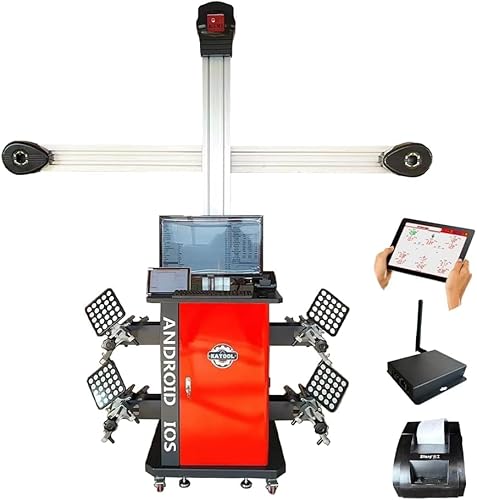
- Uses 3D camera measurement
- Displays readings on PC, phone, or tablet
- Includes a 5-megapixel optical system
Best For: Technicians wanting flexible connected displays
Best Home Alignment Kit
DIY Camber Caster Alignment Tool

- Checks camber, caster, and kingpin inclination
- Turn plates support up to 4 tons
- Fits 11- to 25-inch rims
Best For: DIY garages and manual front-end alignment checks
Best Professional Shop System
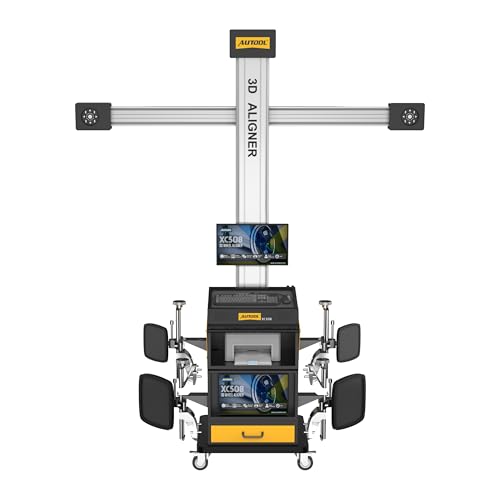
- Dual 20-inch displays and built-in printer
- Database covers 80,000-plus vehicle models
- Measures full alignment and chassis parameters
Best For: Busy repair shops needing reporting and broad vehicle coverage
Best Lift-Compatible 3D System

- Works with two-post and scissor lifts
- Includes tablet, 30-inch monitor, and printer
- Automatic four-wheel 3D measurement
Best For: Professional garages using multiple compatible lift types
Best Budget DIY Pick
Portable 4-Wheel Alignment Kit

- Checks caster, camber, and toe
- Fits wheels up to 18 inches
- Lightweight USA-made aluminum design
Best For: DIY owners and home mechanics
Best Real-Time Shop System

- Five-axis precision with live imaging
- Guided software simplifies alignment jobs
- Heavy-duty frame for busy service bays
Best For: Professional automotive and tire shops
Best Database-Driven Professional Option

- ±0.01° 3D measurement accuracy
- Database covers 60,000+ vehicle models
- Prints reports with voice and LED guidance
Best For: High-volume tire and repair shops
Best Hands-Free Value – Pro Portable Digital Alignment Kit
If you want portable wheel alignment machines for occasional shop, garage, or mobile work, this 4th Gen Pro kit offers a compact digital approach. It is designed for 13- to 22-inch wheels and measures caster, camber, and toe without requiring a level surface.
Best For: DIY users, mobile mechanics, and family-owned shops seeking an affordable hands-free alignment solution.
Pros:
- Fits wheels from 13 to 22 inches.
- Measures caster, camber, and toe.
- Digital degree measurement with hands-free operation.
- No level surface required.
Cons:
- Manual operation mode may require more user involvement than a fully automated system.
- Designed as a kit rather than a complete computerized alignment workstation.
This is a practical choice when portability, broad wheel compatibility, and straightforward measurements matter more than shop-scale automation.
Best Shop-Scale 3D System – 42-Inch Monitor Wheel Aligner
For repair facilities comparing portable wheel alignment machines with full workshop equipment, this GIYI 3D system emphasizes automated measurement and clear on-screen guidance. Its camera-based setup measures key alignment angles and includes reporting and collision-repair functions.
Best For: Tire shops and auto repair facilities that need a high-capability 3D alignment workstation.
Pros:
- 3D cameras measure toe, camber, thrust angle, and setback.
- Claims accuracy of ±0.01°.
- Automatic measurement begins by pushing the vehicle forward.
- 42-inch display, voice guidance, printable reports, and data tracking.
Cons:
- At 346 pounds, it is substantially less portable than compact alignment kits.
- Its large package and workshop-oriented design may not suit home garages or mobile service.
- The supplied notes do not specify supported wheel sizes.
This model is better viewed as a feature-rich shop system than a lightweight portable tool, especially where reporting and collision-related measurements justify the larger footprint.
Best Compact Slider Kit – 4th Gen Portable Wheel Alignment System
This QuickTrick slider kit is one of the more compact portable wheel alignment machines for trackside use, home garages, and mobile mechanics. It works with 13- to 18-inch wheels and supports rims both with and without a lip.
Best For: Mobile mechanics, home-garage users, and trackside technicians who prioritize a lightweight kit.
Pros:
- Works with rims with or without a lip.
- Measures caster, camber, and toe.
- Lightweight 8-pound design.
- Suitable for trackside, home-garage, and mobile use.
Cons:
- Wheel compatibility is limited to 13- to 18-inch wheels.
- The supplied notes do not identify digital readouts or automated measurement.
Its small size and flexible rim compatibility make it a sensible portable option, provided your vehicles fall within the stated wheel-size range.
Best Connected 3D Option – KATOOL Android Wheel Aligner
KATOOL KT-AV9 Android System 3D Wheel Alignment Machine Wheel Aligner Automotive Tire Alignment Tool
Check Price On AmazonAmong portable wheel alignment machines with connected display options, the KATOOL KT-AV9 stands out for its Android-based 3D camera system. Readings can be displayed on a PC, smartphone, tablet, or compatible Apple iOS device, giving users flexibility in how they view alignment data.
Best For: Workshops and technicians who want 3D alignment measurements with phone, tablet, or PC display flexibility.
Pros:
- Uses 3D camera measurement technology.
- Supports synchronized readings on PC, smartphone, and tablet.
- Compatible with Apple iOS display devices according to the supplied notes.
- Uses a four-wheel positioning optical system with 5-megapixel cameras.
Cons:
- The supplied notes do not provide wheel-size compatibility.
- Display flexibility may still require a suitable PC, phone, or tablet.
- The notes do not specify the machine’s weight or physical portability.
This is a versatile choice for users who value connected viewing and modern 3D measurement, though buyers should confirm the complete setup and supported vehicle requirements before purchase.
Best Home Alignment Kit – DIY Camber Caster Alignment Tool
For drivers comparing portable wheel alignment machines for home use, this compact mechanical kit provides a hands-on way to check front-end geometry. It includes turn plates, a wheel clamp, and an analog 3-in-1 gauge for camber, caster, and kingpin inclination on vehicles with 11- to 25-inch rims.
Best For: Home garages and DIY suspension work where portability, simple setup, and repeat-use mechanical tools matter more than computerized reporting.
Pros:
- Measures camber, caster, and kingpin inclination with one analog gauge.
- Turn plates support up to 4 tons and allow up to 60 degrees of wheel movement.
- Universal clamp fits 11- to 25-inch rims and the kit stores in a padded case.
Cons:
- It does not include ramps, toe plates, or a digital gauge.
- Setup requires a plank runway and manual drive-on procedure.
- Its 41-pound weight is less convenient than a small handheld tool.
This is a practical portable alignment setup for checking front-end angles before and after suspension or tie-rod work. Buyers should account for the manual process and the fact that toe measurement equipment is not included.
Best Professional Shop System – AUTOOL 3D Wheel Aligner
Among portable wheel alignment machines for busy garages, the AUTOOL 3D Wheel Aligner is a full workstation designed for measurement, reporting, and vehicle-data coverage. Its mobile cart combines dual 20-inch displays, industrial cameras, a built-in printer, and a database covering more than 80,000 vehicle models.
Best For: Professional repair shops that need a movable alignment station with broad vehicle support, printed reports, and measurements for camber, caster, toe, thrust angle, wheelbase, and track differences.
Pros:
- Dual HD screens let technicians view data and operate the system at the same time.
- Built-in thermal printer produces alignment reports without extra equipment.
- Includes accident-chassis inspection functions and smart lift tracking.
- Lockable casters and a metal cabinet support flexible garage placement.
Cons:
- Its professional workstation format is more equipment than a home user may need.
- The supplied notes do not specify lift compatibility or overall package weight.
- It requires a 110V garage setup.
The AUTOOL is aimed at shops that value workflow efficiency and customer-ready documentation. Its large database, multi-language interface, and broad measurement suite make it a more complete alternative to basic manual alignment tools, but also a larger investment in garage equipment.
Best Lift-Compatible 3D System – AV9 Pro Mobile Wheel Aligner
The AV9 Pro is a substantial option among portable wheel alignment machines, using a mobile 3D system that works with both two-post and scissor lifts. It combines automatic four-wheel positioning with tablet, monitor, printer, Wi-Fi, and USB connectivity for flexible shop operation.
Best For: Professional garages that use different lift types and want a connected 3D alignment system with tablet viewing, a large monitor, and included printing equipment.
Pros:
- Compatible with both two-post and scissor lifts without additional modification.
- Supports Android and iOS tablet use with automatic 3D measurement.
- Includes a 30-inch monitor, printer, Wi-Fi device, mouse, keyboard, and USB support.
- Measures four-wheel positioning across a 1500- to 3000-mm distance range.
Cons:
- The listed package weight is 529.11 pounds, so unloading requires a forklift or equivalent.
- Its large package and professional configuration are not suited to casual home use.
- The supplied information does not detail the system’s vehicle database size.
This system stands out for lift flexibility and included display hardware rather than compact portability. It may suit a commercial shop with appropriate unloading equipment, floor space, and a need to move one alignment station between compatible lifts.
Best Budget DIY Pick – Portable 4-Wheel Alignment Kit
For home mechanics comparing portable wheel alignment machines, this QuickTrick kit offers a compact way to check caster, camber, and toe on hard surfaces. It supports standard and offset wheels up to 18 inches and is designed for straightforward DIY use.
Best For: DIY vehicle owners and mechanics who want an affordable alignment-checking kit after bumps, curb impacts, or tire replacements.
Pros:
- Checks caster, camber, and toe for four-wheel alignment evaluation.
- Works with most standard and offset wheels up to 18 inches.
- Includes instructions and requires no prior alignment experience.
- USA-made aluminum construction weighs 6.44 pounds.
Cons:
- Designed for checking alignment rather than providing a full shop-style computerized system.
- Limited to wheels up to 18 inches.
This is the most practical choice for budget-conscious users who want portable alignment measurements without investing in heavy shop equipment. Its compact design and broad DIY focus make it easier to store and use at home.
Best Real-Time Shop System – KATOOL 5D Wheel Aligner
Among portable wheel alignment machines for professional garages, the KATOOL KT-5DA stands out as a heavy-duty 5D system with real-time imaging. Its computer-controlled software and high-definition cameras are intended to help technicians diagnose and correct alignment issues efficiently.
Best For: Automotive shops, tire centers, and performance garages serving passenger vehicles and light trucks.
Pros:
- Five-axis alignment precision provides detailed diagnostic information.
- Real-time camera imaging mirrors adjustments on screen.
- Factory-set calibration helps reduce setup and manual adjustment work.
- Reinforced alloy steel frame and industrial-grade sensors are built for daily shop use.
Cons:
- At 309 pounds, it is substantially less portable than a compact DIY kit.
- Its professional-shop design may be excessive for occasional home alignment checks.
The KT-5DA is better viewed as movable shop equipment than a lightweight portable tool. For busy service bays, its live imaging, guided software, and durable construction can support faster, more repeatable alignment work.
Best Database-Driven Professional Option – 3D Wheel Alignment Machine
This 3D wheel alignment machine is designed for repair shops and tire-service businesses that need automated measurements, broad vehicle coverage, and documented results. Its push-and-measure workflow, 24-inch monitor, and built-in database are suited to regular professional use.
Best For: Tire shops and auto repair facilities handling a high volume of passenger vehicles, SUVs, and light trucks.
Pros:
- Industrial 3D cameras measure toe, camber, caster, and kingpin to ±0.01°.
- Push-and-measure operation requires no manual calibration.
- Database includes more than 60,000 vehicle models with software upgrades.
- Provides printable reports, voice and LED guidance, and collision-related measurement support.
Cons:
- At 350 pounds and over 108 inches long, it requires substantial installation space.
- Corded electric operation and Windows 10 make it a fixed professional setup rather than a lightweight portable tool.
Choose this system when workflow speed, vehicle-data coverage, and recordkeeping matter more than compact storage. Its lift and alignment-pit compatibility adds installation flexibility, while the rugged targets are intended to reduce maintenance concerns in busy shops.
How We Picked These Portable Wheel Alignment Machines
We focused on the features that most affect real-world alignment work: measurement method, wheel-size range, setup flexibility, lift compatibility, display and software design, included accessories, and intended user. The selection includes basic camber and caster tools, portable slider kits, and professional 3D aligners so buyers can compare systems at very different price and capability levels.
We also considered whether each type of equipment suits occasional DIY checks, mobile service work, tire shops, or high-volume repair facilities. A more advanced machine is not automatically the best choice if your workspace, budget, or vehicle coverage does not support it.
Quick Comparison
- DIY alignment kits: Best for basic front-end measurements, suspension work, and occasional home-garage adjustments.
- Portable slider kits: A practical middle ground for repeat use on compatible wheel sizes without installing a permanent alignment rack.
- 3D alignment systems: Best for faster, more comprehensive measurements, printed reports, and professional service environments.
- Mobile systems: Useful for shops that need to move equipment between two-post or scissor lifts.
Key Buying Factors for Portable Wheel Alignment Machines
Measurement Technology and Accuracy
Manual tools can help with basic camber, caster, and toe checks, but 3D systems generally provide a faster overview of all four wheels and more repeatable readings. Verify the machine’s calibration process, target or clamp design, and software update policy before buying.
Wheel and Vehicle Compatibility
Check the supported rim diameter carefully. Several kits cover 13-18-inch or 13-22-inch wheels, while other tools accommodate a wider range. Also confirm whether the system supports the vehicle types, suspension layouts, and alignment specifications you service most often.
Workspace, Lift, and Portability
“Portable” can mean a compact hand tool, a movable cart, or a complete mobile 3D unit. Measure storage space and consider whether the machine works with your lift type. Cable routing, target placement, battery life, and setup time matter when equipment must be moved frequently.
Displays, Reports, and Included Equipment
Large screens, dedicated input devices, built-in printers, vehicle databases, and real-time readings can improve workflow in a commercial shop. For occasional use, those extras may add cost without providing much benefit. Confirm exactly which turn plates, clamps, targets, software, and calibration tools are included.
Who Should Buy Which Portable Wheel Alignment Machines?
Home mechanics and occasional users should start with a straightforward DIY kit if they mainly need suspension-setting checks and can work methodically. Mobile technicians and smaller garages may prefer a portable slider kit or mobile 3D system that balances repeatability with flexible storage and lift access.
Tire shops and professional repair facilities are better served by a 3D machine with a broad vehicle database, clear multi-wheel readings, fast setup, and reporting features. Before choosing, compare after-sales support, calibration availability, software licensing, and replacement parts—not just the headline accuracy or screen size.
