

10 Best Professional Automotive Paint Thickness Gauges for Smarter Inspections in 2026

Paint-depth readings can reveal overspray, heavy filler, repeated refinishing, and uneven repair work that a visual inspection may miss. The right gauge helps turn those clues into measurable evidence.
We selected 10 professional automotive paint thickness gauges spanning compact digital meters, wider measurement ranges, external probes, and app-connected options. Use the guide below to match features and accuracy with your inspection needs.
Best 10 Professional Automotive Paint Thickness Gauges Picks for 2026
Best Ready-to-Use Pick
CM-224 Auto Digital Paint Thickness Gauge

- Factory calibrated for immediate car inspections
- Detects steel, aluminum, and galvanized steel
- Offers single and continuous measurement modes
Best For: Used-car inspections and body-shop panel checks
Best Extended-Range Automotive Pick
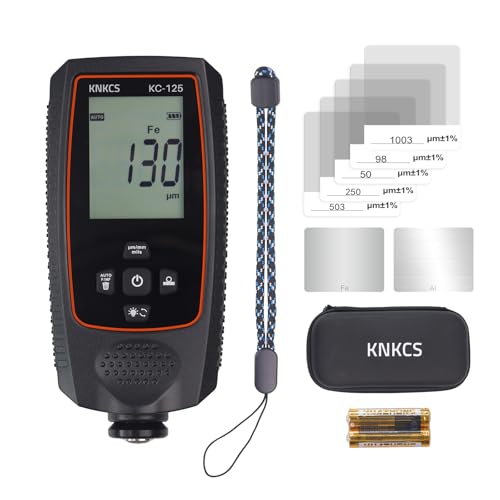
- Covers a broad 0–2500 μm range
- Recognizes filler and iron-zinc substrates
- Supports continuous scanning with a rotating screen
Best For: Body shops and used-car inspections involving repairs or thicker coatings
Best for Industrial Documentation
CM-208Z Coating Thickness Gauge

- Measures thick coatings up to 3000 μm
- External probe handles curved surfaces
- Stores 2000 readings and exports via USB
Best For: Industrial and automotive quality-control inspections
Best Complete Kit for Panel Scanning
POROMETISTO CTG01 Paint Thickness Gauge

- Scans steel and aluminum up to 2000 μm
- Includes calibration materials and batteries
- Stores 30 sets and exports through USB-C
Best For: Automotive panel inspections with portable field scanning
Best All-Around Inspector
UNI-T UT343D Coating Thickness Gauge

- Automatic Fe/NFe detection for mixed-metal panels
- Quick-test LED and audio thickness alerts
- Auto-rotating display and curved-surface sensor
Best For: Used-car buyers and automotive inspectors needing fast, flexible measurements
Best Value Metal-Panel Meter
CM-205FN Paint Thickness Gauge

- 0.1 µm resolution for detailed panel checks
- Automatic Fe/NFe detection for steel and aluminum
- Single, continuous, and calibration modes
Best For: Dealership inspections and used-car checks on painted metal panels
Best for High-Thickness Detection
LS239 Professional Coating Thickness Gauge
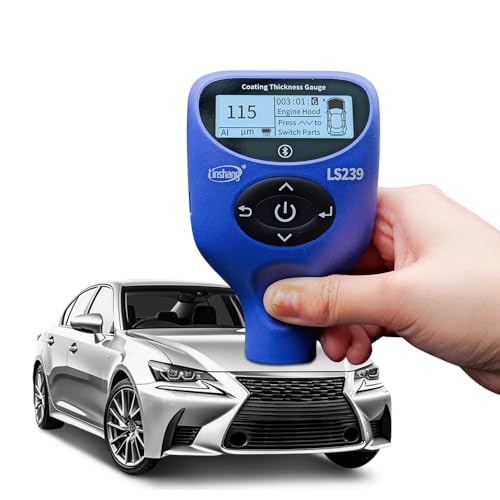
- Wide 0–5000 µm measurement range
- Stores readings for up to 999 vehicles
- Recognizes steel, aluminum, galvanized steel, and non-metal bodies
Best For: Professional inspectors documenting detailed, high-thickness vehicle assessments
Used-Car Inspection Pick
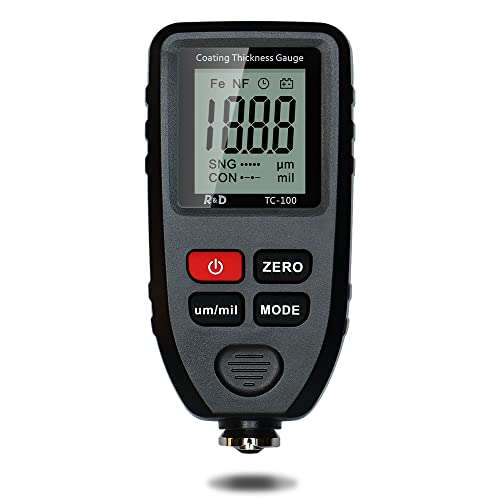
- Auto-detects steel and aluminum substrates
- Includes calibration foils and reference plates
- Three-year replacement warranty
Best For: Used-car buyers checking metallic body panels
Portable Detailer Pick

- 2-mil resolution for quick digital readings
- Backlit display with mils and µm units
- Pocket-sized 2-ounce design
Best For: Portable vehicle and detailing inspections
Connected Professional Pick

- Bluetooth reporting for iOS and Android
- 0–5000 μm measurement range
- Creates and shares vehicle inspection reports
Best For: Dealers and mechanics needing documented inspections
Best Ready-to-Use Pick – CM-224 Auto Digital Paint Thickness Gauge
For buyers comparing professional automotive paint thickness gauges, the CM-224 Auto stands out for its factory-calibrated, ready-to-use operation. It measures coatings from 0–1500 μm with 0.1 μm resolution and automatically recognizes steel, aluminum, and galvanized steel panels.
Best For: Used-car buyers, vehicle appraisers, body shops, and detailing professionals who want quick metal-panel checks without initial calibration.
Pros:
- Factory calibrated and ready to use after installing the included batteries.
- Automatically detects Fe, NFe, and Fe+Zn substrates.
- Supports single-point checks and continuous scanning.
- Large backlit LCD and optional advanced calibration controls.
Cons:
- Designed for metal surfaces only; it does not measure plastic, carbon fiber, or composites.
- Its 1500 μm range is narrower than some industrial-focused gauges.
The CM-224 Auto is a practical choice when convenience matters most. Its automatic substrate recognition and clear display simplify panel comparisons, while the Fe+Zn mode can help identify potentially replaced or non-original galvanized panels.
Best Extended-Range Automotive Pick – KC-125 Paint Thickness Gauge
The KC-125 is one of the more versatile professional automotive paint thickness gauges for users who want a broad 0–2500 μm measurement range. Its 0.1 μm resolution, rotating screen, and continuous measurement mode support detailed inspections of painted metal panels and filler repairs.
Best For: Auto body shops, detailing professionals, used-car buyers, and inspectors who need extended range and material-recognition features.
Pros:
- Measures from 0–2500 μm with stated accuracy of ±(3% + 1 μm).
- Recognizes iron powder filler and iron-zinc coated substrates.
- Continuous measurement helps scan panels efficiently.
- Includes a 5-year maintenance program and lifetime technical support.
Cons:
- The supplied notes do not specify included batteries or calibration accessories.
- It is intended for metal-based surfaces rather than plastic or composite panels.
Choose the KC-125 if your inspections may involve thicker filler, coatings, or varied automotive applications. The extended range and filler-recognition capability make it especially useful when checking for hidden repairs, while the rotating display improves readability from different working angles.
Best for Industrial Documentation – CM-208Z Coating Thickness Gauge
The CM-208Z is the strongest fit for professional automotive paint thickness gauges users who also inspect heavy-duty coatings and structural metal. Its external probe, 0–3000 μm range, statistical analysis, data storage, and USB export are designed for organized quality-control workflows.
Best For: Inspectors, contractors, body or fabrication facilities, and quality-control teams checking thick coatings on steel and aluminum structures.
Pros:
- Measures up to 3000 μm, or 120 mils, for thick coating systems.
- External ruby-tipped probe suits curved and hard-to-reach surfaces.
- Displays mean, minimum, maximum, standard deviation, and reading count.
- Stores up to 2000 readings and exports data through USB.
Cons:
- Its industrial features may be more than needed for occasional used-car checks.
- Measures metal substrates only and is not suitable for plastic or composite materials.
For automotive facilities that need traceable inspection records—or users working beyond car panels—the CM-208Z offers a more complete documentation package than a basic handheld gauge. The remote probe and statistical tools are particularly valuable for repeated measurements across complex surfaces.
Best Complete Kit for Panel Scanning – POROMETISTO CTG01 Paint Thickness Gauge
The POROMETISTO CTG01 combines automotive-focused features with a useful accessory kit, making it a capable option among professional automotive paint thickness gauges. It measures steel and aluminum coatings up to 2000 μm, supports single or continuous scanning, and stores up to 30 measurement sets.
Best For: Used-car buyers, dealerships, body-shop technicians, detailers, and quality inspectors who want scanning, data storage, and calibration materials in one package.
Pros:
- Automatically detects ferrous and non-ferrous metal substrates.
- Continuous mode refreshes readings every 0.3 seconds and shows recent average, maximum, and minimum values.
- Includes calibration foils, a bare substrate, USB-C cable, and three AAA batteries.
- Color auto-rotating screen and USB-C export improve field usability.
Cons:
- Requires zero calibration on the included bare substrate before first use.
- Cannot measure plastic bumpers, fiberglass, carbon fiber, or other non-metal parts.
- Stores 30 groups, fewer than the CM-208Z’s 2000-reading capacity.
The CTG01 is a well-rounded choice for automotive panel work when a complete starter kit and easy scanning matter. Its guidance around probe placement and calibration rewards careful use, while the hold, memory, and USB-C functions add convenience during dealership or workshop inspections.
Best All-Around Inspector – UNI-T UT343D Coating Thickness Gauge
For shoppers comparing professional automotive paint thickness gauges, the UNI-T UT343D combines broad material compatibility with quick, readable measurements. It automatically detects ferrous and non-ferrous substrates, measures curved or uneven surfaces, and offers a 0.1 µm resolution at the lower end of its range.
Best For: Used-car buyers, automotive inspectors, and technicians who want flexible measurements with visual and audible thickness alerts.
Pros:
- Measures ferrous and non-ferrous coatings from 0 to 1250 µm.
- Automatic Fe/NFe detection and a sensor designed for concave, rough, and convex surfaces.
- Quick-test range alerts use a three-color LED and audio alarm.
- Large auto-rotating 2-inch TFT display with single or continuous measurement modes.
Cons:
- Its maximum range is lower than some specialized high-thickness meters.
- Accuracy is specified as ±(3%H+1) µm, so it is not a laboratory-grade instrument.
The UT343D is a well-rounded choice when ease of use and fast screening matter. Its alert system and flexible sensor design are particularly useful for checking multiple automotive panels efficiently.
Best Value Metal-Panel Meter – CM-205FN Paint Thickness Gauge
The CM-205FN is a practical option among professional automotive paint thickness gauges for inspecting painted metal body panels. Its dual magnetic-induction and eddy-current technology automatically selects the appropriate method for steel, iron, aluminum, or copper, while the 0–1500 µm range covers many repainting and coating checks.
Best For: Mobile appraisers, dealership inspectors, detailers, and buyers checking doors, hoods, roofs, fenders, and other metal panels.
Pros:
- 0.1 µm resolution with stated ±(3%+2 µm) accuracy.
- Automatic Fe/NFe substrate detection supports common steel and aluminum vehicle panels.
- Single and continuous modes help with spot checks or scanning larger panels.
- Factory calibrated, with optional zero and multi-point calibration.
Cons:
- Designed for metal surfaces only; it does not measure plastic, carbon fiber, fiberglass, or composites.
- It lacks the broader 5000 µm range offered by some high-thickness models.
Choose the CM-205FN when straightforward operation and dependable metal-panel coverage are more important than advanced vehicle data storage. Its clear limitation to metal substrates should be kept in mind during a complete vehicle inspection.
Best for High-Thickness Detection – LS239 Professional Coating Thickness Gauge
The LS239 stands out among professional automotive paint thickness gauges with a measurement range reaching 5000 µm and a workflow designed for detailed vehicle analysis. Its expert mode stores readings across 19 vehicle components, while material recognition and customizable alerts help identify unusually thick or refinished areas.
Best For: Professional vehicle inspectors and evaluators who need extensive measurement storage, broad material recognition, and high-thickness detection.
Pros:
- Measures coatings from 0 to 5000 µm for detecting unusually thick layers.
- Recognizes steel, aluminum, galvanized steel, and non-metal bodies.
- Stores data for up to 999 vehicles in Pro Mode, with six points across each of 19 components.
- Offers simple and expert modes, customizable alerts, and a three-color display.
Cons:
- The greater number of modes and data features may require more setup than a basic spot-check meter.
- The supplied notes do not specify a measurement accuracy or resolution figure.
The LS239 is the strongest fit for organized, repeatable vehicle assessments rather than occasional one-panel checks. Its high range and storage capacity make it especially useful when documenting many readings or investigating heavy refinishing.
Used-Car Inspection Pick – Dual-Substrate Paint Meter
For shoppers comparing professional automotive paint thickness gauges, this RDINSCOS meter is a practical choice for checking coating consistency across steel and aluminum body panels. Its automatic substrate detection helps simplify inspections, while the included calibration pieces support setup before use.
Best For: Used-car buyers and inspectors checking metallic panels for repainting or prior accident repairs.
Pros:
- Automatically recognizes ferrous and non-ferrous substrates.
- Includes iron and aluminum substrates plus five standard foils for calibration.
- Supplied with a 9V battery, storage bag, and user manual.
- Backed by a three-year replacement warranty.
Cons:
- Designed for metallic surfaces only; it cannot measure plastic, fiberglass, or wood.
- Its 9V battery format is less compact than some pocket-style alternatives.
This is a straightforward, warranty-backed option when your inspections focus on steel and aluminum vehicle panels. Confirming consistent readings still requires checking multiple panels and using the supplied calibration accessories.
Portable Detailer Pick – Backlit Mini Paint Gauge
Among professional automotive paint thickness gauges, this compact digital meter emphasizes quick readings and easy portability. The backlit display, selectable mils or micrometers, and simple two-button layout make it convenient for garage, auction, and dealership inspections.
Best For: Car buyers, detailers, and dealership inspectors who want a lightweight gauge for fast metal-panel checks.
Pros:
- Provides fast digital measurements with a stated 2-mil resolution.
- Backlit LCD supports reading in dim garages and outdoor conditions.
- Switches between metric and imperial units.
- Compact 2-ounce design includes auto power-off and a battery indicator.
Cons:
- Intended for automotive metal surfaces, so it is not a general-purpose nonmetal material tester.
- The compact two-button interface favors simplicity over advanced reporting features.
Choose this model when portability and uncomplicated operation matter most. It is well suited to comparing panel readings, but buyers needing Bluetooth records or automated vehicle reports should consider a more connected gauge.
Connected Professional Pick – APP Vehicle Report Gauge
For users seeking professional automotive paint thickness gauges with connected workflow features, this APP-enabled meter adds Bluetooth reporting to conventional coating measurements. It is designed to identify repainting, filler, and galvanized panels while storing and sharing inspection results through iOS or Android devices.
Best For: Dealers, mechanics, and serious buyers who want documented vehicle inspections and shareable reports.
Pros:
- Generates a vehicle condition report after testing and includes a vehicle database.
- Bluetooth connectivity supports data storage, report creation, and sharing on iOS and Android.
- Offers a stated 0–5000 μm measurement range with stable digital readings.
- Uses a ruby probe tip and dual LCD/OLED display for durability and visibility.
Cons:
- Its app-connected feature set may be more than needed for occasional buyers.
- At 1 pound, it is heavier than the compact mini gauge in this roundup.
- App compatibility and connected functions add setup considerations compared with standalone meters.
This is the strongest fit for professional workflows where inspection history and shareable documentation matter. Its broader range and reporting tools add value for repeated vehicle assessments, provided you are comfortable using a phone-based process.
How We Picked These Professional Automotive Paint Thickness Gauges
We focused on the features that matter during real automotive inspections: compatibility with ferrous and nonferrous panels, measurement range, resolution, probe design, display readability, calibration support, and ease of use. The selection includes gauges designed for quick used-car checks as well as models with broader ranges or more specialized controls for body shops, detailers, inspectors, and restoration work.
Because advertised specifications and included accessories can vary, verify the current listing for calibration standards, batteries, probe type, unit options, and stated accuracy before buying.
Quick Comparison
| What to Compare | Best Match |
|---|---|
| Fast used-car checks | Simple automatic Fe/NFe digital gauge |
| Steel and aluminum panels | Automatic ferrous/nonferrous detection |
| Large or awkward surfaces | External-probe design |
| Very thick coatings or filler | Higher-range model, such as one reaching 3,000–5,000 μm |
| Remote logging or phone-based work | App-connected gauge |
Key Buying Factors
Substrate Compatibility
Most automotive meters use magnetic induction on steel and eddy-current measurement on aluminum or other nonferrous surfaces. Automatic Fe/NFe detection is convenient, but confirm that the gauge supports the panel materials you inspect most often.
Range, Resolution, and Accuracy
A broad range is useful for body filler, industrial coatings, and restoration projects, while a fine resolution helps identify smaller differences between adjacent panels. Do not confuse resolution with accuracy: calibration quality and repeatability matter just as much.
Calibration and Repeatability
Look for zeroing, multi-point calibration, and included reference foils or test plates. Take several readings on known original paint and compare matching areas rather than treating one number as definitive proof of a repair.
Probe and Display Design
Integrated probes are quick for walk-around inspections. An external probe can reach recessed areas and improve handling on curved panels. A backlit, high-contrast display is valuable in garages, driveways, and bright outdoor conditions.
Units and Data Features
Microns and mils are the most useful units for automotive work. Hold functions, memory, automatic shutoff, audible feedback, and app connectivity can speed up repeated inspections, but they should not replace sound measurement technique.
Who Should Buy Which Professional Automotive Paint Thickness Gauges?
Used-car buyers: Choose a straightforward, portable meter with automatic Fe/NFe detection and a clear display. Ease of use and consistent readings are more important than an oversized range.
Detailers and mobile inspectors: Prioritize fast startup, readable backlighting, durable construction, and repeatable readings across many vehicles. A memory function or app may help document findings.
Body shops and restorers: Consider a higher-range model, external probe, finer resolution, and stronger calibration controls for filler, primer, and multilayer coatings.
Professional inspectors: Select a gauge that matches your reporting workflow. Confirm accuracy specifications, calibration accessories, measurement limits, and support before relying on it for paid assessments.
