

10 Best Quiet Garage Air Compressors for 2026: Low-Noise Picks for Every Workshop

A loud compressor can make an otherwise useful garage setup frustrating to operate. The best quiet garage air compressors reduce startup noise while still delivering enough pressure and airflow for your tools.
Our 2026 roundup includes compact portable models, oil-free designs, and larger tanks suited to woodworking, automotive work, inflation, and light spray painting.
Best 10 Quiet Garage Air Compressors Picks for 2026
Quietest Compact Pick

- 60 dBA operation
- 8-gallon aluminum tank
- 37.3 pounds with wheels
Best For: Quiet indoor garage work and light-duty tools
High-Capacity Shop Pick
Klutch 20-Gallon Air Compressor

- 20-gallon tank
- 4.2 SCFM at 90 PSI
- 175 PSI maximum
Best For: Garage workshops needing more air reserve
Portable Trim-Tool Pick

- 200 PSI maximum
- 36-pound compact design
- Dual quick couplers
Best For: Trim work and finish nailers
Quiet Large-Tank Pick

- 20-gallon steel tank
- 70 dB operation
- 5.30 CFM at 90 PSI
Best For: Quieter, higher-volume garage work
Best Large-Tank Quiet Pick
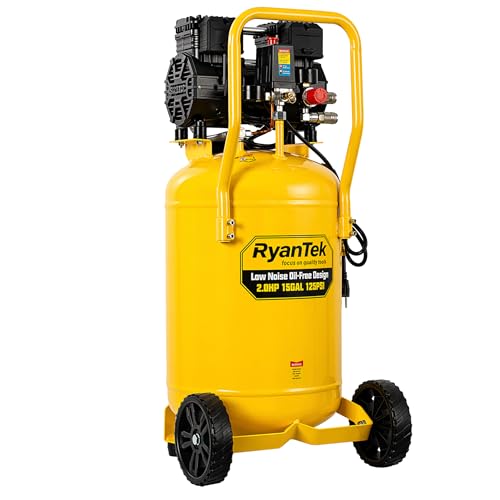
- 66 dB oil-free twin-cylinder operation
- 4.5 CFM at 90 PSI and 125 PSI maximum
- Wheels and vertical design improve mobility
Best For: Longer garage projects, nail guns, painting, and woodworking
Best Compact Quiet Pick
FORNAX 1.3-Gallon Air Compressor
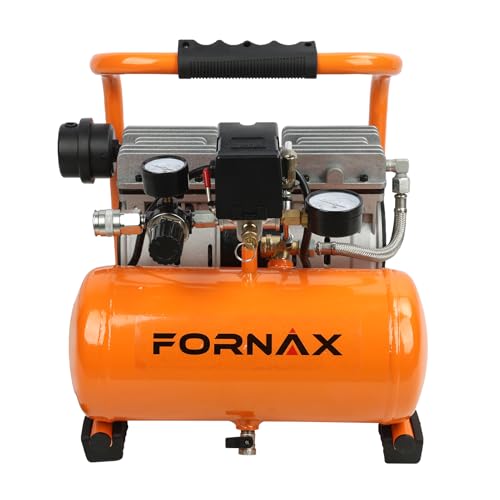
- Quietest listed operation at 65 dB
- Lightweight, portable oil-free design
- 1.7 CFM at 90 PSI with 125 PSI maximum
Best For: Tire inflation, airbrushing, trim work, and portable DIY use
Best Mid-Size Airflow Pick
AAIN 6.3-Gallon Quiet Compressor
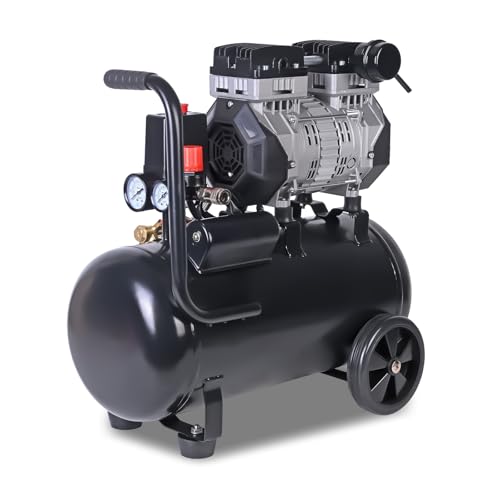
- 5.5–6 CFM actual airflow at 116 PSI
- 6.3-gallon tank reportedly fills in 2.75 minutes
- Oil-free twin-cylinder operation at 70 dB
Best For: Inflation, air blowing, and short small-tool sessions
Best Large-Tank Value
VEVOR 13-Gallon Quiet Compressor

- 13-gallon tank with 2HP motor
- 66dB oil-free operation
- Wheels and included accessories
Best For: Longer garage projects and versatile DIY use
Best Ultra-Quiet Compact Pick

- Very quiet 59dB operation
- Lightweight 25.2-pound design
- Quick coupler for tool changes
Best For: Nailing and compact garage projects
Best Mid-Size Quiet Workhorse

- 2HP motor with 6.4-gallon tank
- Approximately 60dB claimed operation
- Oil-free design with safety features
Best For: Versatile indoor garage and workshop tasks
Quietest Compact Pick – California Air Tools 8010A
For shoppers comparing quiet garage air compressors, the California Air Tools 8010A stands out with a 60 dBA noise rating, an oil-free pump, and a portable 8-gallon aluminum tank. Its 3.10 CFM at 40 PSI and 2.20 CFM at 90 PSI suit tasks such as nailing, inflation, blow cleaning, and light spraying.
Best For: Indoor garages and users who prioritize low noise, portability, and low maintenance.
Pros:
- Very quiet 60 dBA operation for noise-sensitive spaces
- Lightweight 37.3-pound design with wheels
- Oil-free pump supports cleaner, maintenance-friendly operation
- 120 PSI maximum pressure with a 165-second fill time
Cons:
- Its 2.20 CFM at 90 PSI is better suited to lighter-duty tools
- The 8-gallon tank offers less reserve than larger shop models
The 8010A is a practical choice when quiet operation matters more than high-volume air delivery. Its compact, wheeled design also makes it easier to reposition around a home garage.
High-Capacity Shop Pick – Klutch 20-Gallon Air Compressor
The Klutch 20-Gallon compressor is a strong option among quiet garage air compressors when tank capacity and sustained shop use are priorities. It delivers 4.2 SCFM at 90 PSI, reaches 175 PSI, and uses an oil-free pump with thermal overload protection.
Best For: Garage workshops needing a larger tank, dependable recovery, and portable shop-style performance.
Pros:
- Large 20-gallon tank provides useful air reserve
- 175 PSI maximum pressure and 4.2 SCFM at 90 PSI
- Oil-free pump reduces routine maintenance
- Large rubber wheels and an ergonomic handle aid movement
Cons:
- Its 80 dB rating is louder than the quieter California Air Tools models
- At 90 pounds and 41.5 inches tall, it is less convenient to carry
- The 14-amp draw may require attention to circuit capacity
This Klutch model favors capacity and shop utility over minimum noise. It makes sense for users who want a substantial tank and reliable air delivery for nailing and spraying.
Portable Trim-Tool Pick – DEWALT DWFP55130
The DEWALT DWFP55130 is a compact choice for shoppers seeking quiet garage air compressors for trim work and nailers. Its oil-free design provides 3.0 SCFM at 90 PSI, while the 2.5-gallon tank and 200 PSI maximum help support quick recovery in a portable format.
Best For: Trim carpentry, finish nailers, and garages where compact storage is important.
Pros:
- Compact 2.5-gallon design weighs 36 pounds
- 200 PSI maximum pressure supports extended nailer use
- Dual quick couplers can support two nailers
- Vertical or horizontal storage adds flexibility
Cons:
- At 71.5 dBA, it is not as quiet as the 60 dBA model
- The smaller tank is less suited to sustained high-volume applications
- It is specified primarily for spraying and nailer-oriented tasks
With its roll cage, cord wrap, and flexible storage positions, the DWFP55130 is easy to fit into a busy garage. It is best viewed as a portable trim-tool compressor rather than a high-capacity shop unit.
Quiet Large-Tank Pick – California Air Tools 20020
The California Air Tools 20020 combines a 20-gallon tank with a 70 dB noise rating, making it a compelling option among quiet garage air compressors for users who need more capacity. Its 2 HP motor produces 5.30 CFM at 90 PSI, and the oil-free pump keeps maintenance straightforward.
Best For: Larger garages and workshops that need quiet operation with higher air volume.
Pros:
- 20-gallon tank provides substantial air storage
- 5.30 CFM at 90 PSI supports more demanding shop tasks
- 70 dB operation is relatively quiet for its capacity
- Wheels and a 110-volt, 14-amp setup add practical flexibility
Cons:
- At about 134 pounds, it is difficult to move compared with compact models
- The 45-inch height may require dedicated floor space
- Its one-year limited warranty is shorter than the Klutch model’s stated warranty
The 20020 is a sensible middle ground for buyers who want a quieter compressor without giving up large-tank capacity. Its weight and tall profile make it better suited to a mostly permanent garage location.
Best Large-Tank Quiet Pick – 15-Gallon 2HP Air Compressor
For quiet garage air compressors that can handle longer work sessions, this 15-gallon, oil-free model offers a useful balance of capacity and portability. Its 66 dB operation, 4.5 CFM at 90 PSI, and 125 PSI maximum make it suitable for several home and workshop applications.
Best For: Garage users who need a larger tank for nail guns, spray painting, inflation, woodworking, and other intermittent pneumatic tasks.
Pros:
- Large 15-gallon tank helps reduce motor cycling during extended use.
- Oil-free, twin-cylinder pump operates at a listed 66 dB.
- Vertical design, wheels, and integrated handle make it easier to move and store.
- Upward-facing gauge and dual air outlets improve day-to-day usability.
Cons:
- At 68.3 pounds, it is less convenient to carry than compact models.
- The larger footprint and tank may be more than needed for simple tire inflation.
This is the strongest capacity-focused choice of the three. Choose it when tank size and sustained garage utility matter more than minimizing weight.
Best Compact Quiet Pick – FORNAX 1.3-Gallon Air Compressor
If portability is a priority when comparing quiet garage air compressors, the FORNAX is a compact option with a 65 dB noise rating. Its oil-free 1 HP motor, 1.7 CFM at 90 PSI, and 125 PSI maximum suit lighter-duty garage and DIY work.
Best For: Users who want an easy-to-carry compressor for tire inflation, airbrushing, trim work, staplers, nail guns, and small pneumatic tools.
Pros:
- Listed 65 dB noise level makes it the quietest model in this comparison.
- Lightweight design is convenient for carrying, storage, and occasional job-site use.
- Oil-free 1 HP motor requires less routine maintenance.
- Compact tank and rapid refill design support repetitive light-duty tasks.
Cons:
- The small tank provides less reserve air than the larger 6.3- and 15-gallon models.
- Its 1.7 CFM at 90 PSI is better suited to light-duty tools than demanding continuous use.
The FORNAX makes the most sense when low noise and easy transport outweigh tank capacity. It is a practical fit for smaller garages, mobile tasks, and everyday inflation.
Best Mid-Size Airflow Pick – AAIN 6.3-Gallon Quiet Compressor
The AAIN is a middle-ground option among quiet garage air compressors, combining a 6.3-gallon tank with listed airflow of 5.5–6 CFM at 116 PSI. Its oil-free twin-cylinder motor runs at 70 dB and is designed for garages, workshops, and short-duration pneumatic work.
Best For: Garage users seeking more airflow and reserve capacity than a compact compressor provides for inflation, air blowing, and short small-tool sessions.
Pros:
- 6.3-gallon tank offers more reserve air than the compact FORNAX.
- Listed 5.5–6 CFM actual airflow supports efficient inflation and short pneumatic-tool use.
- Oil-free twin-cylinder design reduces routine maintenance.
- Tank is reported to fill to 116 PSI in about 2.75 minutes.
Cons:
- At 70 dB, it is louder than the other two listed models.
- Its 116 PSI maximum is lower than the 125 PSI rating of the other options.
- The notes position it for short-time small-tool operation rather than continuous heavy-duty use.
This model is a sensible compromise for buyers who want useful tank capacity and airflow without moving up to a 15-gallon unit. Consider it for general garage tasks where moderate noise is acceptable.
Best Large-Tank Value – VEVOR 13-Gallon Quiet Compressor
For shoppers comparing quiet garage air compressors, this VEVOR model offers a useful balance of tank capacity, power, and noise control. Its 13-gallon tank, 2HP motor, 125 PSI maximum pressure, and 66dB operation suit longer DIY, automotive, woodworking, and painting tasks.
Best For: Garage users who need a larger tank for tire inflation, auto repairs, woodworking, or spray painting.
Pros:
- 13-gallon tank and 2HP motor build air in under 3 minutes.
- Oil-free design operates at a relatively quiet 66dB with no routine oil maintenance.
- Wheels and foot pads make the 71-pound unit easier to move.
- Includes pressure gauges, filters, wheels, mounting hardware, and a manual.
Cons:
- At 71 pounds, it is less convenient to carry than compact one-gallon models.
- Its 17.5-by-16.5-by-33.3-inch footprint requires dedicated storage space.
The VEVOR is a practical choice when tank capacity matters more than maximum portability. Its 66dB rating keeps garage work more comfortable while the larger reservoir supports extended projects.
Best Ultra-Quiet Compact Pick – Metabo HPT EC28M
Among quiet garage air compressors, the Metabo HPT EC28M stands out for its 59dB operating level and compact one-gallon format. It is designed for users who prioritize easy carrying, low noise, and quick pneumatic-tool changes over extended air capacity.
Best For: Nailing tasks, small garage projects, and users who need a lightweight compressor that allows normal conversation while cycling.
Pros:
- Ultra-quiet 59dB operation is suitable for shared or indoor workspaces.
- At 25.2 pounds, it is easy to carry around a jobsite or garage.
- Universal quick coupler supports fast tool changes.
- Oil-free construction and overload protection help reduce maintenance demands.
Cons:
- The one-gallon tank is better suited to nailing and smaller tasks than sustained, high-demand applications.
- Its stated recommended use is nailing, so it offers less project flexibility than larger models.
The EC28M is the strongest fit when quiet operation and portability come first. Its small tank keeps the unit manageable, but users planning spray painting or lengthy pneumatic work may need more capacity.
Best Mid-Size Quiet Workhorse – 6.4-Gallon 2HP Compressor
This 6.4-gallon model is a compelling option for shoppers seeking quiet garage air compressors with more working capacity than a compact nailer compressor. Its 2HP motor, approximately 60dB operation, 115 PSI maximum pressure, and oil-free design support varied garage tasks.
Best For: Indoor workshops and garages handling tire inflation, auto repair, spray painting, and woodwork nailing.
Pros:
- Approximately 60dB operation is designed for quieter indoor use.
- 2HP, 1500W motor and 6.4-gallon tank provide a useful middle ground for garage projects.
- Oil-free construction avoids compressor-oil maintenance.
- Includes a handle, pressure gauge, standard G1/4 outlet, and condensate drain.
Cons:
- The supplied details list conflicting capacity and airflow figures, so buyers should verify specifications before purchase.
- Its 115 PSI maximum pressure is lower than the 125 PSI rating of the other larger model here.
- The product details report a 75dB noise figure despite the approximately 60dB claim, creating uncertainty about actual operating volume.
This compressor offers a practical mid-size format and broad-use positioning, but the conflicting listed specifications deserve attention. Confirm the noise, tank, and airflow ratings if those measurements are important to your garage setup.
How We Picked the Best Quiet Garage Air Compressors
We focused on compressors that balance noise control, usable airflow, tank capacity, portability, and everyday reliability. The lineup includes models ranging from one-gallon portable units to 20-gallon workshop compressors, so different garage users can find an appropriate match.
We paid particular attention to published decibel ratings, horsepower, maximum pressure, CFM at 90 PSI, oil-free operation, voltage, and features such as wheels, handles, and compact footprints. Because manufacturer ratings can be measured under different conditions, treat noise numbers as useful comparisons rather than guarantees of identical real-world performance.
Quick Comparison
| Best For | Recommended Type | What to Prioritize |
|---|---|---|
| Nailers and trim work | 1–6 gallon portable compressor | Low noise, quick recovery, easy carrying |
| Tires and general garage tasks | 6–13 gallon compressor | Balanced CFM, portability, tank capacity |
| Frequent pneumatic-tool use | 15–20 gallon compressor | Higher CFM, longer duty cycles, stable pressure |
| Spray painting | Larger tank with strong continuous airflow | CFM at the required PSI, moisture control |
Key Buying Factors for Quiet Garage Air Compressors
Noise Level
A rating near 60–70 dBA is generally more comfortable for a home garage than a conventional loud compressor. Still, vibration, floor surfaces, and the distance from walls can affect perceived noise. Rubber feet and a stable location can help reduce rattling.
Airflow and Pressure
Maximum PSI tells you the pressure the tank can hold, but CFM at 90 PSI is usually more important for tool performance. Nailers and inflators need relatively little airflow, while grinders, sanders, and spray guns can require substantially more. Compare the compressor’s delivered CFM with your tool’s stated requirement and leave some headroom.
Tank Size and Recovery
A larger tank provides a longer reserve before the motor restarts, but it also adds weight and takes up space. Small tanks are convenient for intermittent tasks; 15- to 20-gallon models are better suited to repeated tool use. Recovery speed matters when a tool is used continuously.
Power, Maintenance, and Portability
Most models here use standard household power, but confirm the voltage and circuit requirements before buying. Oil-free pumps simplify maintenance and avoid oil changes, while wheels and handles make larger compressors easier to position. Check the warranty, drain access, hose fittings, and available replacement parts as well.
Who Should Buy Which Quiet Garage Air Compressors?
Choose a compact one-gallon model if you mainly inflate tires, use a brad nailer, or need a compressor that stores easily. An 6- to 13-gallon unit is the most versatile choice for typical garage owners handling inflation, finish carpentry, and occasional automotive work. Choose a 15- or 20-gallon compressor if you value longer operating periods and need more consistent airflow for demanding pneumatic tools.
For spray painting, select the model with the strongest verified CFM that meets your spray gun’s requirements, then add a suitable filter and regulator. If minimizing disturbance is your top priority, compare both the published dBA rating and the compressor’s size, vibration control, and placement options before purchasing.
