

10 Best Vehicle Ramps for Professional Mechanics in 2026: Heavy-Duty Picks for Safer Service

Professional mechanics need vehicle ramps that support heavy loads, provide dependable traction, and make routine service more efficient. The right ramp can simplify oil changes, inspections, and underbody work without taking up the space of a full lift.
We selected 10 heavy-duty options for different shop and garage needs, comparing capacity, ramp design, clearance, portability, and safety-focused features.
Best 10 Vehicle Ramps for Professional Mechanics Picks for 2026
High-Capacity Low-Profile Pick
R.O.BLOCK Heavy-Duty Car Ramps

- 13,000-lb gross vehicle weight rating
- 6.1-inch lift with 12-inch width
- Traction features and portable plastic build
Best For: Garage and professional shop maintenance across varied vehicle types
Reliable Shop Workhorse

- 12,000-lb capacity per pair
- 6,000-lb rating per ramp
- Non-skid tread and rubber feet
Best For: Routine maintenance on cars, trucks, SUVs, and vans
Maximum-Capacity Wide-Tire Option
- 16,000-lb capacity per pair
- 7.1-inch lift for larger vehicles
- 13-inch width for wider tires
Best For: SUV and truck maintenance on hard, level surfaces
Space-Saving Shop Pick
MaxxHaul 50947 Stackable Ramps

- Stackable polypropylene construction
- 6.7-inch lift with ribbed traction surface
- Side handles support easy transport
Best For: Compact shops and mobile mechanics needing convenient storage
Heavy-Duty Pick
16,000-lb High-Clearance Car Ramps
- 16,000-lb stated capacity
- 7-inch lift for underbody work
- Anti-skid pads and front stop curbs
Best For: Heavy-duty trucks and SUVs
Portable Choice
MaxxHaul Detachable Extendable Ramps

- 6,500-lb capacity per pair
- Detachable and extendable design
- Built-in handles for portability
Best For: Portable shop and garage use on level surfaces
Adjustable Lift

- Adjusts from 9.84 to 14.96 inches
- Heavy-duty alloy-steel construction
- Designed for cars, trucks, and SUVs
Best For: Workshops needing variable underbody clearance
Heavy-Duty Steel Pick
- 8,000-lb capacity per pair
- Traction surface with raised edges
- 35-inch ramps for routine service
Best For: Oil changes and inspections on compatible vehicles
Hydraulic Lift Pick
Adjustable Hydraulic Service Ramps

- 11,000-lb pair capacity
- 9.8- to 16.21-inch adjustable lift
- Extended design for lowered vehicles
Best For: Shop maintenance needing adjustable working height
Wide-Load Plastic Pick
Heavy-Duty Honeycomb Car Ramps

- 8,000-lb capacity per pair
- 6.7-inch lift with 20-degree incline
- 12-inch-wide textured loading surface
Best For: Portable routine service in shops or home garages
High-Capacity Low-Profile Pick – R.O.BLOCK Heavy-Duty Car Ramps
For professional mechanics seeking vehicle ramps for professional mechanics, the R.O.BLOCK pair combines a 13,000-pound gross vehicle weight rating with a 6.1-inch lift. Its 12-inch width, 17-degree approach, and traction-focused design make it suited to routine service work on cars, SUVs, pickups, and light trucks.
Best For: Garage and professional shop maintenance where broad vehicle compatibility and a high load rating matter.
Pros:
- 13,000-pound gross vehicle weight rating for cars, SUVs, pickups, and light trucks
- 12-inch-wide ramps with curved tire grooves and front bumper strips
- Honeycomb plastic construction, drainage channels, and bottom non-slip pads
- Side and rear openings make the 17.88-pound pair easier to carry and store
Cons:
- The 6.1-inch lift is lower than some competing options in this roundup
- Plastic construction may not suit buyers specifically seeking steel ramps
The R.O.BLOCK is a strong all-around option when a professional needs substantial capacity, wide tire support, and portability for repeated garage or shop use.
Reliable Shop Workhorse – Ironton Poly Car Ramp Set
The Ironton set is a practical choice for professionals comparing vehicle ramps for professional mechanics. Rated at 6,000 pounds per ramp and 12,000 pounds per pair, it supports cars, trucks, SUVs, and vans while remaining relatively light at 20.6 pounds per pair.
Best For: Mechanics who want a durable, broadly compatible ramp set for oil changes, brake work, tire rotations, and inspections.
Pros:
- 6,000-pound capacity per ramp and 12,000 pounds per pair
- High-impact poly construction with a honeycomb internal structure
- Non-skid tread and rubber feet help limit tire and ground movement
- 12-inch width and gradual approach suit a range of vehicle sizes
Cons:
- Its 8.5-inch overall height does not equal the stated working lift height
- Pair weight is higher than some lighter plastic ramp options
With a clear per-ramp rating, rubber feet, and a wide tread surface, the Ironton is a sensible repeated-use option for mixed-vehicle service work.
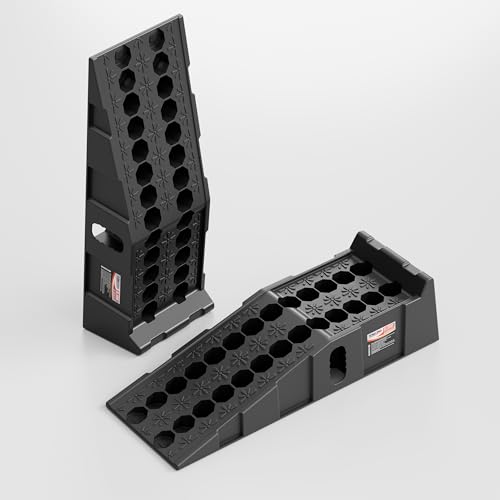
Maximum-Capacity Wide-Tire Option – 16,000-Lb Car Ramps
For vehicle ramps for professional mechanics handling larger vehicles, this polypropylene pair offers the highest stated capacity in the group: 16,000 pounds per pair. The 7.1-inch lift and wide 13-inch dimensions provide useful clearance and tire room for SUVs and trucks.
Best For: Professional mechanics servicing heavier SUVs and trucks that need added lift and a wider driving surface.
Pros:
- 16,000-pound capacity per pair
- 7.1 inches of lift for oil changes and inspections
- 13-inch-wide design accommodates wider tires
- Textured surface and 17-degree incline support controlled ramping
Cons:
- Must be used only on hard, flat, level surfaces
- Notes specifically caution against dirt, grass, gravel, and sand
- No storage or carrying feature is specified in the supplied details
This is the capacity-focused pick for demanding vehicle service, provided the shop can use it on a suitable level surface and stays within the stated load limit.
Space-Saving Shop Pick – MaxxHaul 50947 Stackable Ramps
MaxxHaul 50947 Lift Stackable Vehicle Car Ramp 6500 LBS Capacity Per Pair 3250 LBS Per Ramp 2 Pack
Check Price On AmazonThe MaxxHaul 50947 stands out among vehicle ramps for professional mechanics who need convenient storage and transport. Its stackable polypropylene design provides a 6.7-inch lift, while side handles and a ribbed platform make the pair practical for mobile work or a compact shop.
Best For: Mechanics who prioritize stackable storage, portability, and moderate-capacity service access.
Pros:
- Stackable design simplifies storage and transportation
- Built-in side handles improve portability
- 6.7-inch lift provides clearance for maintenance tasks
- Ribbed platform surface adds traction
Cons:
- 6,500-pound capacity per pair is lower than the other listed options
- Rated for 3,250 pounds per ramp, requiring careful vehicle-load matching
- The supplied dimensions list 8.25 inches in one detail and 8.5 inches in the feature description
The MaxxHaul is best when organization and portability matter more than maximum load capacity, but professionals should verify the vehicle weight against the per-ramp and pair ratings.
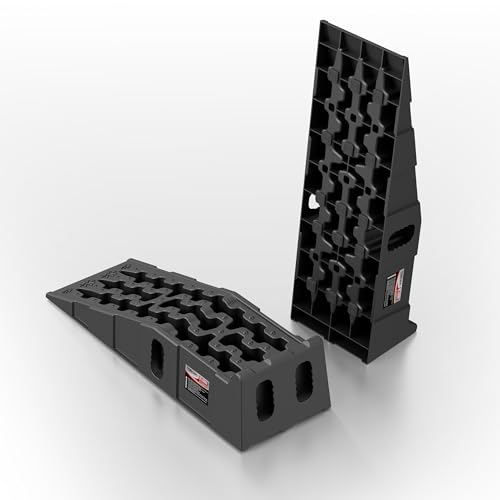
Heavy-Duty Pick – 16,000-lb High-Clearance Car Ramps
For professional mechanics seeking vehicle ramps for professional mechanics, this pair is built for heavy-duty SUVs, pickups, and light trucks. Its 16,000-pound capacity, 7-inch lift, wide platforms, and traction-focused design support routine underbody service such as oil changes, filter replacement, and inspections.
Best For: Heavy-duty truck and SUV maintenance where high capacity and extra clearance matter.
Pros:
- Supports up to 16,000 pounds per the supplied specifications.
- Provides 7 inches of clearance for common underbody work.
- Uses 15 anti-skid rubber pads, a honeycomb traction surface, and front stop curbs.
- A 17° gradual incline and extra-wide platforms help with drive-on access.
Cons:
- Plastic construction may not suit mechanics who specifically prefer steel ramps.
- The 7-inch lift is lower than the adjustable height offered by a hydraulic ramp system.
This is the strongest capacity-focused option in the group, with useful positioning feedback and a traction-oriented base. It is a practical choice for larger vehicles, provided the work surface is appropriate for ramp use.
Portable Choice – MaxxHaul Detachable Extendable Ramps
For shops that value portability and flexible storage, these MaxxHaul ramps offer a detachable design and built-in side handles. They provide 6,500 pounds of capacity per pair and a 6-1/2-inch lift, making them a practical option among vehicle ramps for professional mechanics who work on suitable hard, level surfaces.
Best For: Mechanics who need portable ramps with detachable sections and manageable storage.
Pros:
- Rated for 3,250 pounds per ramp and 6,500 pounds per pair.
- Detachable sections can free space beneath the vehicle.
- Optional sectional extensions can increase overall ramp length.
- Built-in handles and a 33-pound ramp-set weight support portability.
Cons:
- Must be used on a hard, smooth, level surface; loose or uneven surfaces are specifically excluded.
- The 6,500-pound pair capacity is lower than the other listed options.
- The warranty is limited to 90 days.
The detachable layout is the defining advantage here, especially for mobile work or compact storage. Its surface requirements and lower capacity make careful setup essential before loading a vehicle.
Adjustable Lift – 5-Ton Hydraulic Car Ramps
These hydraulic steel ramps are aimed at mechanics who need adjustable working height rather than a fixed incline. The hydraulic section adjusts from 9.84 to 14.96 inches, while the alloy-steel construction is intended for vehicle maintenance and inspections in professional workshops or home garages.
Best For: Mechanics who want adjustable clearance for oil changes, inspections, and broader under-vehicle repairs.
Pros:
- Hydraulic height adjustment spans approximately 9.84 to 14.96 inches.
- Supplied specifications state an 11,060-pound hydraulic lift capacity.
- Heavy-duty alloy-steel construction is finished to help resist rust.
- Designed for low-profile cars, trucks, and SUVs.
Cons:
- At 83.8 pounds, the set is substantially heavier than the portable MaxxHaul option.
- Hydraulic adjustment adds installation, use, and maintenance considerations compared with fixed ramps.
- The supplied details list both 11,060-pound hydraulic capacity and a 10,000-pound load-capacity field, so buyers should verify the applicable rating.
For jobs where fixed 6- or 7-inch clearance is limiting, the adjustable hydraulic design offers the broadest height range in this roundup. Its steel build favors a more permanent workshop setup over frequent transport.
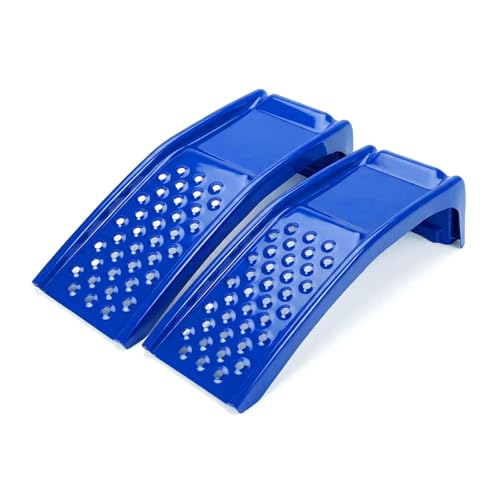
Heavy-Duty Steel Pick – Solid Steel Vehicle Ramps
For professional mechanics seeking vehicle ramps for professional mechanics, these solid-steel ramps provide a straightforward setup for oil changes, inspections, and routine underbody service. Their 8,000-pound-per-pair capacity is substantial, but the 9-inch internal tire track means fit and clearance should be verified before purchase.
Best For: Routine garage maintenance on compatible cars and light vehicles, including oil changes and inspections.
Pros:
- Solid steel construction with an 8,000-pound capacity per pair.
- Traction-hole surface and raised side edges help with tire contact and alignment.
- 35-inch length and 9.5-inch height provide useful underbody access.
- Two-ramp set is convenient for repeated home-garage maintenance.
Cons:
- The 9-inch internal tire track may not suit wider tires.
- Vehicle approach angle and underbody clearance must be checked before use.
- At 32.1 pounds per set, storage and handling still require some space.
This is a practical, no-frills steel ramp set for compatible vehicles. Confirm tire width, approach clearance, and use only on a flat, hard surface before relying on it for service work.
Hydraulic Lift Pick – Adjustable Hydraulic Service Ramps
These hydraulic service ramps are aimed at mechanics who need more adjustable working height than fixed ramps provide. The pair supports up to 11,000 pounds and lifts from 9.8 to 16.21 inches, while the extended length is intended to help lowered vehicles approach without bottoming out.
Best For: Professional garages and vehicle maintenance requiring adjustable lift height for cars, trucks, and lowered sports cars.
Pros:
- Hydraulic lift system adjusts the working height from 9.8 to 16.21 inches.
- Pair capacity is rated up to 11,000 pounds, or 5 tons.
- Anti-slip surfaces and bottom pads are designed to improve stability.
- Long 45-inch base can help accommodate lowered sports cars.
Cons:
- The pair weighs about 86 pounds, making transport and setup less convenient.
- The 9.4-inch platform width still requires checking vehicle and tire compatibility.
- Hydraulic components add operating complexity compared with fixed ramps.
Among these vehicle ramps for professional mechanics, this is the most versatile option for adjustable access and heavier vehicles. Its size and weight favor a dedicated shop environment rather than frequent repositioning.
Wide-Load Plastic Pick – Heavy-Duty Honeycomb Car Ramps
For shops that want a lighter alternative to steel, these hardened-plastic ramps combine a 6.7-inch lift with a 20-degree incline. The 12-inch width, textured traction surface, and 8,000-pound-per-pair load rating make them suitable for many cars, SUVs, pickups, and light agricultural vehicles.
Best For: Home garages or professional shops needing portable ramps for oil changes, repairs, and jack support.
Pros:
- Hardened-plastic honeycomb construction is designed for durability.
- 12-inch-wide ramps provide a broad loading surface.
- Curved grooves, bumper strips, and textured surfaces help maintain tire grip.
- At about 25 pounds per set, they are relatively easy to handle and store.
Cons:
- The 6.7-inch lift is lower than the hydraulic ramps in this roundup.
- Plastic construction may be less appealing for mechanics who prefer steel equipment.
- Vehicle weight, tire fit, and approach clearance should still be confirmed before use.
This set is a practical portability-focused choice among vehicle ramps for professional mechanics. It offers useful access without the weight of steel, while the moderate lift suits routine service rather than maximum underbody clearance.
How We Picked the Best Vehicle Ramps for Professional Mechanics
We focused on ramps designed for repeated automotive service rather than occasional light-duty use. Our comparison considered stated gross vehicle weight and per-pair load ratings, construction materials, ramp width, approach angle, traction features, clearance, and storage requirements. We also included several designs—solid steel, polymer, stackable, extendable, and hydraulic—to cover different shop layouts and vehicle types.
Always verify the manufacturer’s capacity, use the ramps on a level and stable surface, and follow the supplied wheel-chocking and parking-brake instructions. A ramp’s rating should comfortably exceed the supported axle load, not merely match the vehicle’s total curb weight.
Quick Comparison
| Ramp type | Best suited to | Main advantage | Potential trade-off |
|---|---|---|---|
| Heavy-duty steel | Busy professional shops and trucks | High strength and durability | Heavy to move and store |
| Polymer | Portable service and lighter vehicles | Lower weight and corrosion resistance | May offer less clearance or capacity |
| Stackable | Variable-height maintenance | Flexible lift height | Requires careful assembly and alignment |
| Hydraulic | Frequent height adjustment | Adjustable lifting position | More components to inspect and maintain |
| Extendable or detachable | Changing vehicle profiles | Improved portability and fit | More connection points to check |
Key Buying Factors for Vehicle Ramps for Professional Mechanics
Capacity and Vehicle Compatibility
Check both the gross vehicle weight rating and the maximum load per ramp or pair. Confirm that the ramp width, height, and approach angle suit the tires, wheelbase, and ground clearance of the vehicles you service most often.
Construction and Traction
Steel ramps are typically preferred for high-frequency commercial work, while reinforced polymer can be easier to transport and resist rust. Look for textured surfaces, raised lips, stop blocks, and a stable base to reduce tire slip and prevent overrun.
Clearance and Working Access
Higher ramps provide more room for oil pans, exhaust work, and inspections, but they may require a longer approach. Low-profile designs are better for lowered cars, provided they still deliver enough working clearance.
Portability and Storage
Consider ramp weight, handles, stackability, and whether one person can position the pair safely. Compact or detachable designs are useful when a shop shares floor space with parking or other equipment.
Who Should Buy Which Vehicle Ramps for Professional Mechanics?
Choose heavy-duty steel ramps for a professional bay handling SUVs, pickups, agricultural equipment, or frequent service work. Polymer ramps make sense for mechanics who prioritize portability and corrosion resistance. Stackable models suit shops that need more than one working height, while hydraulic ramps are a practical choice when adjustable positioning matters. For lowered vehicles, prioritize a genuinely low approach angle over maximum lift height.
Before purchasing, compare the ramp’s actual working dimensions with your vehicles and service procedures. The best Vehicle Ramps for Professional Mechanics are the ones that provide adequate capacity, predictable traction, usable clearance, and a setup your team can repeat safely every day.
