

OBD2 Scanner Car Code Reader Review 2026: Beginner-Friendly Diagnostics With Voltage Test

OBD2 Scanner Car Code Reader review is best approached as a practical buyer’s guide, not a gadget showcase.
It targets drivers who want a simple way to read and clear engine codes, check basic vehicle status, and keep a small diagnostic tool in the glove box.
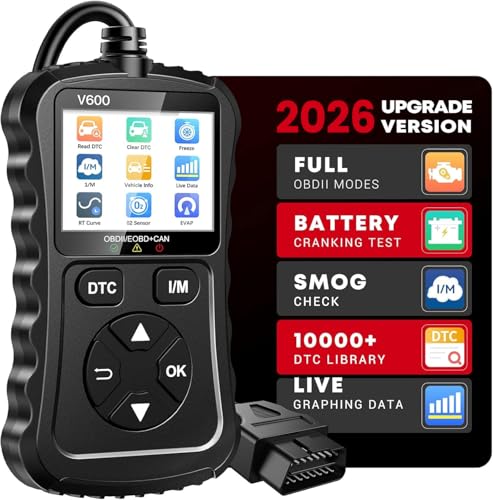
OBD2 Scanner Car Code Reader Review Summary
This OBD2 scanner makes sense for buyers who want a plug-and-play code reader with a broader feature set than a bare-bones fault-code tool.
Based on the listing, it combines core OBDII reading and clearing with live data, freeze frame viewing, MIL status, I/M readiness monitoring, and a built-in voltage test, so it is aimed at everyday troubleshooting rather than advanced shop-level repairs.
The strongest case for it is simplicity.
The scanner is described as beginner-friendly, with six buttons, dedicated I/M and DTC shortcut keys, a compact body, a color screen, and a long flexible cable.
That combination matters more than flashy spec sheets for most drivers, because the real value of an OBD2 tool is how quickly it gets you from a warning light to a useful diagnosis.
Review Scorecard
| Category | Score | Editorial rationale |
|---|---|---|
| Code reading and clearing | 8/10 | Designed to read and clear engine error codes with a large fault-code database. |
| Ease of use | 9/10 | Plug-and-play operation, shortcut keys, and a beginner-friendly layout lower the learning curve. |
| Diagnostic depth | 7/10 | Includes live data, freeze frame, MIL status, and readiness checks, but stays in the consumer scanner tier. |
| Compatibility | 8/10 | Claims support for most 1996+ US cars plus many EU and Asian models using OBDII protocols. |
| Extra utility | 7/10 | The voltage test adds practical value for basic electrical screening. |
| Portability and build | 8/10 | Compact, lightweight, and made with an impact-resistant housing and flexible cable. |
| Buyer value fit | 8/10 | A strong match for DIY owners who want a dependable, simple scan tool rather than a professional platform. |
Key Features and Specifications of OBD2 Scanner Car Code Reader
The listing positions this as a general-purpose OBDII diagnostic tool for cars and light-duty vehicles.
It is meant to read engine fault codes, clear them when appropriate, and help you interpret what the vehicle is doing through live data and freeze frame information.
Key listed capabilities include:
- Reads and clears engine error codes
- Supports a database of 30,000+ fault codes
- Shows real-time data streaming
- Offers graphical analysis
- Displays freeze frame information
- Checks MIL status
- Supports I/M readiness monitoring
- Includes a real-time voltage test
- Uses an enhanced chip for faster data processing
- Features a color screen and six operation buttons
- Includes dedicated I/M and DTC shortcut keys
Compatibility is one of the bigger selling points.
The listing says it supports most 1996+ US vehicles, over 2000 EU and Asian models, and all OBDII protocol vehicles.
It also mentions SUVs and light trucks, while separately noting that it cannot detect trucks or motorcycles.
That mixed wording means buyers should treat the compatibility claims as broad but still verify their exact vehicle before ordering.
The listing also calls out language support, with 10 languages including English, German, Spanish, and French.
That is not the main reason to buy this scanner, but it does help if you are sharing the tool across different users or prefer a non-English interface.
For physical design, the product is described as compact and lightweight, with a sturdy non-slip housing, a bright display, and a long flexible cable.
Those are sensible details for a tool that may live in a trunk, toolbox, or center console rather than on a workbench.
Pros and Cons of OBD2 Scanner Car Code Reader
Pros
- Simple to use: The plug-and-play design and shortcut keys make it approachable for beginners.
- Useful everyday functions: Reading, clearing, readiness checks, freeze frame, and live data cover the most common DIY needs.
- Voltage test adds value: The built-in voltage feature is helpful for quick electrical checks.
- Broad compatibility claim: The listing covers a wide range of 1996+ OBDII vehicles.
- Portable format: Compact size, light weight, and a flexible cable improve convenience.
Cons
- Not a full professional scanner: The listed features are solid, but they stop short of advanced shop diagnostics.
- Compatibility still needs checking: The listing includes broad support language, but some vehicle-specific limits are noted.
- Clearance is not magic: The notice says codes can only be cleared by the computer in a 4S shop if the car is not repaired.
- Mixed listing copy: The product page language is inconsistent in places, which makes careful verification more important.
Who Should Buy OBD2 Scanner Car Code Reader?
This scanner is a good fit for drivers who want a practical check-engine-light tool without paying for a more complex diagnostic platform.
It is especially suitable if you want a readable screen, basic graphing, and the convenience of shortcut keys rather than a menu-heavy interface.
It also fits DIY owners who handle routine maintenance and want a tool they can keep handy for quick triage.
If you are the kind of buyer who sees an engine light, wants to know whether it is urgent, and likes to confirm readiness monitors before a trip or inspection, this kind of scanner serves a real purpose.
It is less compelling for buyers who need deep system coding, bidirectional controls, or advanced technician workflows.
If your use case includes frequent module-level diagnosis, programming, or professional repair work, you should treat this as an entry-level to mid-range code reader rather than a primary shop tool.
Diagnostic Depth and Daily Use
Reading Trouble Codes Quickly
The core job of this scanner is straightforward: pull fault codes, show them clearly, and help you decide the next step.
The listing’s 30,000+ code database and DTC shortcut key suggest a focus on fast interpretation, which is exactly what most drivers need when a warning light appears.
Live Data and Freeze Frame
Live data streaming and freeze frame support are the features that move this tool beyond a minimal reader.
They do not make it a professional-grade diagnostic workstation, but they do give you more context than a code-only device when you are trying to separate a minor nuisance from a more serious issue.
Voltage Testing for Basic Electrical Checks
The built-in voltage test is one of the more useful extras here.
For many owners, battery and charging-system awareness matters just as much as engine codes, and an integrated voltage readout adds convenience without adding much complexity.
Beginner-Friendly Hardware Design
The physical design is clearly aimed at accessibility.
The listing highlights a compact body, sturdy non-slip housing, a bright color screen, and six buttons.
That matters because a diagnostic tool should reduce friction, not become another object you need to study for an hour before using.
Alternatives to OBD2 Scanner Car Code Reader
If you want a comparable Amazon search starting point, the most obvious alternatives are:
FIXD is a common consumer-facing choice if you want a more app-centered experience.
BlueDriver is worth considering if you want a well-known connected scanner line with a strong reputation among DIY users.
ANCEL and Autel both cover a broad range of handheld scanner options, from basic readers to more capable diagnostics, so they are useful comparison points if you want to balance simplicity against feature depth.
When comparing alternatives, focus on three things: whether the scanner supports your exact vehicle, whether you want handheld simplicity or app-assisted workflows, and whether you need more than engine-code reading and clearing.
Those factors matter more than broad marketing claims.
Is OBD2 Scanner Car Code Reader Worth It?
Yes, for the right buyer.
This is worth considering if you want a straightforward OBD2 scanner that emphasizes ease of use, basic diagnostic visibility, and a few genuinely useful extras like voltage testing and live data.
It is not the best choice if you need advanced repair functions or professional-grade diagnostic depth.
But if your goal is to keep a simple, reliable code reader in reach for warning lights and routine checks, this product’s feature mix is sensible and easy to justify.
For most everyday drivers and DIY owners, the value proposition is clear: buy it if you want practical diagnostics without a steep learning curve; skip it if you need a full technician tool.
