

Power Queen 2-Bank Marine Battery Charger 20A Review 2026: Dual-channel charging for boats and RVs

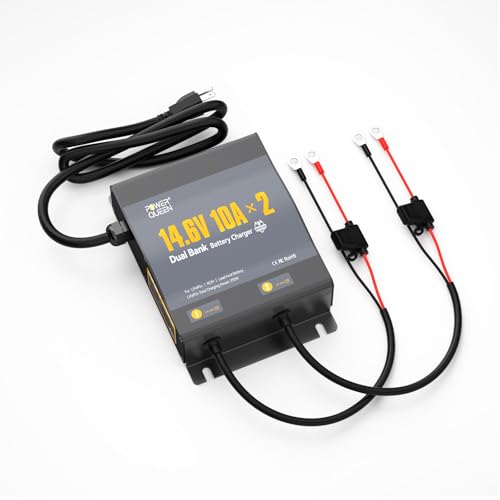
Power Queen 2-Bank Marine Battery Charger 20A is a focused option for buyers who need to charge two 12V batteries at the same time.
It is built for marine, RV, trolling motor, and outdoor battery setups rather than general bench charging.
Power Queen 2-Bank Marine Battery Charger 20A Review Summary
The Power Queen 2-Bank Marine Battery Charger 20A makes sense if you want a charger that can manage two batteries independently, switch between supported chemistry types, and hold up in wet or dusty environments.
Its appeal is practical: each channel delivers 10A, it supports 12V LiFePO4, NCM, and lead-acid batteries, and the IP65-rated sealed build is aimed at boating and other outdoor use.
This is a strong fit for owners who value convenience, battery compatibility, and ruggedness more than app features or a highly configurable charging system. It is less compelling if you only charge one battery at a time or want a charger with detailed diagnostics and advanced tuning.
Review Scorecard
| Category | Score | Rationale |
|---|---|---|
| Dual-battery convenience | 9/10 | Independent 10A per channel simplifies charging two batteries at once without interference. |
| Battery compatibility | 8/10 | Supports 12V LiFePO4, NCM, and lead-acid batteries with one-click mode selection. |
| Outdoor durability | 9/10 | IP65 waterproof and dustproof design with an aluminum shell suits marine and RV use. |
| Safety and protection | 9/10 | Built-in short-circuit, reverse connection, over-current, over-voltage, over-temperature, and under-voltage protection. |
| Charging intelligence | 8/10 | 3-stage charging and memory function add convenience and consistency after outages. |
| Ease of use | 8/10 | LED status indicators and simple battery-type selection keep operation straightforward. |
| Best buyer fit | 9/10 | Especially useful for boat, RV, and trolling motor owners who need a durable dual-bank charger. |
Key Features and Specifications of Power Queen 2-Bank Marine Battery Charger 20A
Power Queen positions this charger as a dual-channel, independent battery charger with a wide voltage input range.
The key practical detail is the output split: it provides 10A per bank, so you can charge two batteries simultaneously without one channel interfering with the other.
It supports three battery types through a simple selection button: 12V LiFePO4 at 14.6V, NCM at 16.8V, and lead-acid at 14.7V.
That makes it a broader-use charger than a single-chemistry unit, but the buyer still needs to choose the right mode instead of assuming automatic chemistry detection.
The listing also calls out an activation function for BMS-protected lithium batteries.
That is a meaningful feature for buyers using LiFePO4 packs, because it suggests the charger is designed to help wake batteries that have protective electronics engaged.
The enclosure is another major selling point.
Power Queen says the charger uses a sturdy aluminum shell, a sealed design, and IP65 waterproof and dustproof construction.
For marine and RV storage areas, that matters more than decorative design.
Other listed features include:
- Dual-channel independent charging
- 10A output per bank
- One-click battery compatibility selection
- Activation function for BMS-protected lithium batteries
- LED indicators for standby, charging, full, fault, and battery type
- Protection against short circuit, reverse connection, over-current, over-voltage, over-temperature, and under-voltage
- 3-stage smart charging: pre-charge, constant current, constant voltage
- Memory function that keeps the last selected battery mode after a power outage
For buyers comparing options, the overall spec profile suggests a charger built around reliability and everyday usability rather than flashy controls.
Pros and Cons of Power Queen 2-Bank Marine Battery Charger 20A
Pros
- Charges two batteries at once with independent 10A channels.
- Supports 12V LiFePO4, NCM, and lead-acid batteries.
- Includes a battery activation function for BMS-protected lithium batteries.
- IP65 construction is appropriate for boats, RVs, and outdoor storage.
- LED indicators make charging status easy to read at a glance.
- Memory function reduces reset hassle after a power outage.
Cons
- Not a universal “set and forget” charger for every battery type and voltage.
- The listing focuses on core charging and protection, not advanced customization.
- Best value is tied to dual-battery or outdoor use; single-battery buyers may not need it.
- The marketing does not provide extra detail on cable length, mounting flexibility, or runtime behavior.
Who Should Buy Power Queen 2-Bank Marine Battery Charger 20A?
Buy this if you regularly maintain two 12V batteries and want a charger that can handle them at the same time.
It is especially sensible for boat owners, RV users, and people charging trolling motor batteries where moisture resistance and durability matter.
It also fits buyers who use LiFePO4 batteries and want a charger that explicitly supports that chemistry, including activation for BMS-protected packs.
If your setup mixes battery types, the one-click mode selection is useful because it lowers the chance of choosing the wrong charge profile.
Skip it if you only need a simple charger for one battery, or if you want advanced programmable controls. The feature set is practical and targeted, not experimental or highly configurable.
If you keep batteries in tough conditions, the sealed aluminum build is a real reason to consider it.
If your charging happens indoors, in a controlled space, or with a single battery, the rugged marine focus may be more charger than you need.
Charging and Protection Details
Dual-bank Independence
The main advantage is the ability to charge two batteries simultaneously with separate 10A outputs.
That keeps the charger useful for paired marine batteries, RV bank maintenance, and other multi-battery setups where downtime matters.
Battery-Type Selection
The charger supports 12V LiFePO4, NCM, and lead-acid batteries through a one-button selection process.
That is a clear benefit for mixed-use owners, but it also means the user should pay attention to the mode rather than relying on fully automatic chemistry detection.
Protection and Status Feedback
Power Queen lists multiple protections, including reverse connection, over-current, over-voltage, over-temperature, short-circuit, and under-voltage protection.
The LED indicators also help make faults and charge state easier to understand, which is useful in boat compartments or garages where you want quick confirmation.
Marine and Outdoor Fit
The IP65 rating and sealed aluminum shell are the features that separate this charger from indoor-only alternatives.
If your battery gear lives near spray, humidity, or dust, that construction choice is one of the strongest reasons to choose it.
Alternatives to Power Queen 2-Bank Marine Battery Charger 20A
If you want a different charger style, consider these Amazon search options:
- NOCO Genius marine battery charger
- Litime LiFePO4 charger
- Battery Tender marine charger
- Dual Pro marine battery charger
NOCO is worth a look if you want a widely known charging line with multiple models.
Litime is a practical alternative if your main concern is LiFePO4 compatibility.
Battery Tender is the conservative choice for buyers who want a familiar brand in maintenance charging.
Dual Pro is a common comparison point for marine users who want a purpose-built multi-bank solution.
Is Power Queen 2-Bank Marine Battery Charger 20A Worth It?
Yes, if your use case matches the design. Power Queen 2-Bank Marine Battery Charger 20A is worth considering when you need dual independent charging, 12V battery compatibility across common chemistries, and a waterproof enclosure for marine or RV conditions.
It is not the most feature-rich charger you can buy, but that is not its point.
The value is in the combination of two-bank charging, simple battery selection, built-in safety protections, and rugged outdoor construction.
If you manage boats, RV batteries, or trolling motor packs, this looks like a practical purchase.
If you are shopping for a general-purpose or single-battery charger, a simpler alternative may be enough.
