

10 Best Automotive Paint Thickness Gauges for Home Garages in 2026

Finding hidden bodywork, uneven refinishing, or excessive filler is much easier with the right paint thickness gauge. These meters help home mechanics and used-car shoppers measure coating depth without relying on appearance alone.
Our roundup covers affordable digital gauges, Fe/NFe models, broad-range meters, and connected options with app support. The buying guide below explains which specifications matter most in a home garage.
Best 10 Automotive Paint Thickness Gauges for Home Garages Picks for 2026
Best Ready-to-Use Pick
CM-224 Auto Digital Paint Thickness Gauge

- Factory calibrated for immediate car-panel checks
- Detects steel, aluminum, and galvanized steel
- Backlit display with spot and continuous modes
Best For: Home garages and used-car buyers inspecting metal panels
Best Connected Option
CM-226Pro Bluetooth Paint Thickness Gauge

- Bluetooth app support for iOS and Android
- Car Mode organizes readings by body panel
- Rechargeable battery and advanced statistics
Best For: Tech-focused garages and organized vehicle inspections
Best for Continuous Scanning
KC-125 Automotive Paint Thickness Gauge
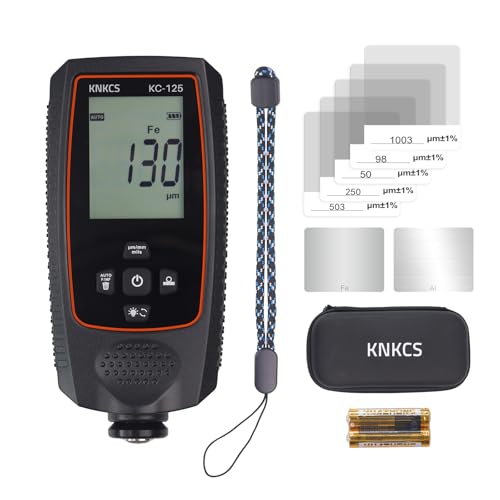
- Continuous mode helps scan broad panels
- Recognizes iron powder filler and iron-zinc coatings
- 0–2500 μm range with 0.1 μm resolution
Best For: DIY inspections focused on hidden repairs and filler
Best for Data Review
CM-208FN USB Coating Thickness Gauge

- USB export supports inspection documentation
- Shows average, minimum, maximum, and count
- Automatic steel and aluminum detection
Best For: Garages and detailers that document coating results
Best All-Around Garage Gauge
Digital Automotive Paint Depth Gauge

- Measures up to 3,000 μm with automatic substrate detection
- Stores readings by vehicle panel and supports up to 999 vehicles
- Includes calibration options, alarms, voice readout, and USB-C charging
Best For: Used-car inspections and DIY paint correction
Best Simple Scanning Gauge
POROMETISTO Car Paint Thickness Meter

- Measures steel and aluminum panels up to 2,000 μm
- Continuous mode displays recent average, maximum, and minimum readings
- Stores 30 sets and supports USB-C transfer to a Windows PC
Best For: Quick inspections of metal vehicle panels
Best for Quick Pass/Fail Checks

- Automatically measures ferrous and non-ferrous coatings
- Uses colored LEDs and an audio alarm for preset ranges
- Handles concave, rough, and convex surfaces with single or continuous modes
Best For: Fast used-car checks and varied surface shapes
Best All-Around Choice
CM-205FN Digital Paint Thickness Gauge

- Auto-detects steel and aluminum substrates
- 0–1500 µm range with 0.1 µm resolution
- Single and continuous measurement modes
Best For: Home mechanics and used-car buyers inspecting metal body panels
Best Value for Used-Car Checks
RDINSCOS Car Coating Thickness Meter
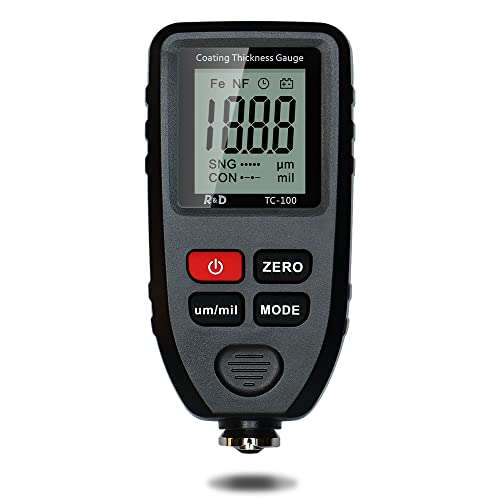
- Auto-detects steel and aluminum
- Helps compare thickness across car panels
- Includes calibration accessories and 3-year replacement warranty
Best For: Budget-minded buyers checking used cars for prior repairs
Best for Detailed Panel Scanning
CM-206X Automotive Paint Gauge

- Detects steel, aluminum, and zinc automatically
- 0–59.1 mil range with fine stated resolution
- Ruby probe and backlit multi-unit display
Best For: Frequent DIY or mobile inspections of mixed-material vehicles
Best Ready-to-Use Pick – CM-224 Auto Digital Paint Thickness Gauge
For home garages seeking automotive paint thickness gauges for home garages, the CM-224 Auto is a straightforward choice for checking metal car panels. It arrives factory calibrated, automatically identifies common substrates, and provides fast readings without a setup routine.
Best For: Used-car buyers, DIY inspectors, detailers, and home garages that want quick measurements on steel, aluminum, or galvanized metal panels.
Pros:
- Factory calibrated and ready to use after installing the included AAA batteries.
- Automatically detects Fe, aluminum, and Fe+Zn substrates.
- Offers 0.1 μm resolution, a backlit display, and single or continuous measurement modes.
- Supports optional zero and multipoint calibration plus factory reset.
Cons:
- Designed for metal surfaces only; it cannot measure plastic, carbon fiber, or composite panels.
- Uses two AAA batteries rather than a rechargeable battery.
The CM-224 Auto emphasizes simplicity and honest automotive functionality. Its Fe+Zn detection can be useful when comparing galvanized or potentially replaced panels, while the metal-only limitation should be kept in mind when inspecting modern vehicles with nonmetal body components.
Best Connected Option – CM-226Pro Bluetooth Paint Thickness Gauge
The CM-226Pro adds smartphone connectivity to the automotive paint thickness gauges for home garages category. Its Bluetooth app, dedicated Car Mode, rechargeable battery, and measurement statistics make it suited to inspections where readings need to be organized and reviewed.
Best For: Tech-oriented home garages, mobile inspectors, detailers, and buyers who want panel-by-panel records on a phone.
Pros:
- Connects to iOS and Android devices through Bluetooth.
- Car Mode organizes measurements by hood, doors, fenders, roof, and trunk.
- Measures up to 3000 μm with 0.1 μm resolution and recognizes several metal substrates.
- Rechargeable 600mAh battery, backlit display, voice prompts, and one-button operation support convenient use.
Cons:
- The app and Bluetooth features may be more than needed for occasional spot checks.
- The supplied notes do not specify compatibility with nonmetal body panels.
This is the most feature-rich option in the group for organizing inspection data. Its statistics, alarms, storage, and vehicle-focused workflow can help turn scattered readings into a more systematic assessment of repainting, filler, or uneven coating.
Best for Continuous Scanning – KC-125 Automotive Paint Thickness Gauge
The KC-125 is a compact choice among automotive paint thickness gauges for home garages, especially when scanning across larger panels. It combines continuous measurement with recognition of iron powder filler and iron-zinc coated substrates for more informed used-car checks.
Best For: DIY buyers, auto body hobbyists, and small garages that need continuous readings while checking for hidden repairs or filler.
Pros:
- Provides 0.1 μm resolution across a 0–2500 μm measurement range.
- Recognizes iron powder filler and iron-zinc coated substrates.
- Continuous measurement supports faster panel scanning.
- Includes a stated 5-year maintenance program and lifetime technical support.
Cons:
- The supplied notes do not mention a backlit display, data storage, or smartphone connectivity.
- Its applications are focused on metal substrates and automotive or industrial inspections.
The KC-125 stands out for users who prefer moving across a panel rather than taking isolated spot measurements. Its filler-recognition capability is particularly relevant when a home-garage inspection aims to uncover bodywork that may not be obvious from the paint surface alone.
Best for Data Review – CM-208FN USB Coating Thickness Gauge
The CM-208FN is a practical pick for automotive paint thickness gauges for home garages when inspection records matter. It automatically identifies steel and aluminum, summarizes measurement statistics, and exports data through USB for later review or documentation.
Best For: Detailers, inspectors, and home-garage users who want to compare readings, document findings, or transfer results to a computer.
Pros:
- Automatically detects Fe and nonferrous metal substrates.
- Displays average, minimum, maximum, and reading count statistics.
- USB data export supports reporting and analysis.
- Integrated ruby-tip probe is designed for quick one-hand measurements on flat and moderately curved surfaces.
Cons:
- Measures metal substrates only, not plastic, composite, or carbon-fiber parts.
- The supplied notes do not specify a rechargeable battery or smartphone app.
Choose the CM-208FN if a simple reading is not enough and you want a measurement trail to review later. Its statistical display and USB export are useful for documenting coating variations, though users inspecting mixed-material vehicles should account for its metal-only design.
Best All-Around Garage Gauge – Digital Automotive Paint Depth Gauge
For home garages comparing automotive paint thickness gauges, this model stands out for broad measurement coverage and vehicle-focused organization. It measures up to 3,000 μm, identifies ferrous and non-ferrous substrates automatically, and can also detect non-magnetic metallic coatings and body filler.
Best For: Used-car buyers, detailers, and DIY paint-correction work where panel-by-panel records and clear-coat warnings are useful.
Pros:
- Measures 0–3,000 μm with ±(3% + 1 μm) accuracy and a customizable thickness alarm.
- Car Mode stores readings for 19 body panels and supports up to 999 vehicles.
- Supports zero, two-point, and factory-reset calibration, including curved-surface capabilities.
- Backlit rotating display and voice readout improve usability while working.
Cons:
- Its advanced vehicle-record features may be more than a casual user needs.
- The supplied dimensions appear unusually large, so verify the intended storage space before buying.
With its body-filler detection, rechargeable USB-C battery, and paint-correction alarm, this is a versatile choice for garages that want more than a basic single-reading meter.
Best Simple Scanning Gauge – POROMETISTO Car Paint Thickness Meter
This POROMETISTO is a practical option among automotive paint thickness gauges for home garages, especially if you mainly inspect steel and aluminum body panels. It automatically detects Fe and NFe substrates, offers single or continuous scanning, and keeps the controls straightforward.
Best For: DIY buyers checking hoods, doors, roofs, fenders, and other metal panels on used cars.
Pros:
- Reads 0–2,000 μm with 0.1 μm resolution below 100 μm.
- Continuous mode refreshes every 0.3 seconds and shows recent average, maximum, and minimum values.
- Stores 30 data groups and can transfer them to a Windows PC over USB-C.
- Includes calibration foils, a bare substrate, AAA batteries, and a two-year warranty.
Cons:
- It is limited to metal panels and will not measure plastic, fiberglass, carbon fiber, wood, or drywall.
- Accurate use requires careful calibration and a flat, vertical probe position.
Its continuous-scan mode and straightforward operation make it well suited to quickly finding uneven paint, spot repairs, or repainted metal panels, provided you stay within its material limitations.
Best for Quick Pass/Fail Checks – UNI-T UT343D Coating Gauge
The UNI-T UT343D is a strong fit for home garages that want automotive paint thickness gauges with fast visual feedback. It automatically measures ferrous and non-ferrous materials, supports single and continuous readings, and uses preset limits with colored LEDs and an audio alarm.
Best For: Used-car buyers and garage users who want quick coating-range checks across varied surface shapes.
Pros:
- Measures 0–1,250 μm with automatic F/NF detection.
- Quick-test feature uses three-color LED feedback and an audio alarm for preset ranges.
- Dynamic sensor design supports concave, rough, and convex surfaces.
- Auto-rotating 2-inch TFT display and Max/Min/Avg modes improve readability.
Cons:
- Its maximum range is lower than the 2,000–3,000 μm range offered by the other listed gauges.
- The included cable uses Micro USB rather than USB-C.
- The notes mention one included battery but do not specify the battery type.
This model prioritizes quick decisions and flexible surface handling over extensive vehicle data storage, making it a sensible choice when simple range alerts matter most.
Best All-Around Choice – CM-205FN Digital Paint Thickness Gauge
For home garages comparing automotive paint thickness gauges for home garages, the CM-205FN is a practical all-around option for checking painted steel and aluminum panels. Its automatic substrate detection, backlit display, and broad 0–1500 µm measuring range make it useful for used-car inspections, detailing, and repair checks.
Best For: Home mechanics and used-car buyers who want quick readings across mixed-metal body panels.
Pros:
- Automatically detects ferrous and non-ferrous substrates.
- Offers 0.1 µm resolution and a 0–1500 µm range.
- Includes single and continuous measuring modes.
- Factory calibrated, with optional zero and multi-point calibration.
Cons:
- Designed for metal surfaces only; it will not measure plastic, fiberglass, carbon fiber, or composites.
- Its extra calibration options may be more than casual users need.
The CM-205FN balances straightforward operation with useful inspection flexibility. It is a strong fit when your garage work includes both quick spot checks and broader scans of steel and aluminum panels.
Best Value for Used-Car Checks – RDINSCOS Car Coating Thickness Meter
Among automotive paint thickness gauges for home garages, this RDINSCOS meter focuses on the essentials for used-car shopping: comparing coating readings from panel to panel to uncover possible repairs or refinishing. It automatically recognizes steel and aluminum and includes calibration foils and substrates for setup and verification.
Best For: Budget-conscious used-car buyers who need a simple metal-panel inspection tool.
Pros:
- Automatically detects ferrous and non-ferrous surfaces.
- Useful for comparing paint consistency across vehicle panels.
- Includes a 9V battery, storage bag, manual, foils, and iron and aluminum substrates.
- Backed by a stated three-year replacement warranty.
Cons:
- Only measures coatings on metallic surfaces, not plastic, fiberglass, or wood.
- The supplied notes do not specify a measuring range or resolution.
This model is a sensible choice when your main goal is detecting inconsistent coating thickness before buying a used vehicle. Its included accessories and replacement warranty add practical value for occasional garage use.
Best for Detailed Panel Scanning – CM-206X Automotive Paint Gauge
For garage users who want detailed comparisons, the CM-206X is one of the more feature-focused automotive paint thickness gauges for home garages. It measures up to 1500 µm, automatically recognizes steel, aluminum, and zinc, and adds a ruby probe, illuminated display, and portable design for repeated panel-to-panel checks.
Best For: Serious DIY inspectors and mobile users who scan complete vehicles in varied conditions.
Pros:
- Detects Fe, NFe, and zinc substrates automatically.
- Measures 0–59.1 mils (0–1500 µm) with a stated 0.001 mil resolution.
- Ruby probe is designed for stable contact and reduced surface wear.
- Backlit multi-unit display and wide operating temperature range support field use.
Cons:
- Limited to coating measurements on compatible metal substrates.
- The fine resolution and additional substrate detection may be unnecessary for occasional spot checks.
The CM-206X stands out for detailed, repeatable vehicle scanning rather than bare-bones testing. Choose it if you regularly inspect mixed-material vehicles or want a compact gauge suited to both garages and outdoor evaluations.
How We Picked the Best Automotive Paint Thickness Gauges for Home Garages
We focused on gauges suited to practical vehicle inspection rather than factory or laboratory use. The selected models were compared for measurement range, stated resolution, support for ferrous and non-ferrous panels, zinc or galvanized-metal detection, display usability, and suitability for checking doors, hoods, fenders, and other painted body panels.
We also considered useful extras such as automatic substrate recognition, calibration support, Bluetooth connectivity, mobile apps, compact designs, and the ability to display readings in microns or mils. Because product specifications and included accessories can vary by seller, verify the current listing before purchase.
Quick Comparison
| Feature | Why It Matters | Best For |
|---|---|---|
| Fe/NFe detection | Measures steel and aluminum panels | Most modern vehicles |
| Fe/NFe/Zn support | Adds useful galvanized-steel identification | Detailed body inspections |
| 0–1500 or 0–2000 µm range | Accommodates normal paint and heavier filler | Used-car and repair checks |
| Bluetooth and app support | Helps record and review readings | Organized inspection reports |
| 0.1 µm or 0.001 mil resolution | Shows small measurement changes | Fine comparative checks |
Key Buying Factors for Automotive Paint Thickness Gauges for Home Garages
Substrate Compatibility
Choose a model that detects both ferrous and non-ferrous metals if you inspect mixed-material vehicles. Steel panels are magnetic, while aluminum panels require a gauge designed for non-ferrous substrates. Zinc detection can provide additional context on galvanized panels, but it does not replace careful interpretation.
Range and Units
A range reaching 1500 or 2000 microns is useful when looking for thick filler or multiple paint layers. Microns are common in automotive specifications, while mils are convenient for some repair references. A readable display and simple unit switching matter more than impressive resolution alone.
Calibration and Consistency
Calibration plates and zeroing procedures help maintain reliable readings. Take several measurements on adjacent areas, keep the probe flat, and compare similar panels rather than treating one number as definitive. Temperature, curves, dirt, and poor probe contact can affect results.
Connectivity and Ergonomics
Bluetooth is worthwhile if you need saved readings or inspection records. For occasional garage use, a responsive screen, automatic substrate recognition, quick startup, and comfortable one-handed operation may be more valuable than an app.
Who Should Buy Which Automotive Paint Thickness Gauges for Home Garages?
Choose a straightforward digital gauge such as the CM-224 Auto, CM-205FN, or a basic car coating meter for occasional checks and simple panel comparisons. Buyers inspecting aluminum-bodied vehicles should prioritize reliable Fe/NFe detection, including models such as the CM-226Pro, CM-208FN, CM-206X, or UNI-T UT343D.
Pick a Bluetooth model if you regularly document inspections or want to organize readings on a phone. A wider-range meter is the better choice for evaluating suspected filler, repaired panels, or heavily refinished vehicles. Whichever model you select, use repeated readings across every panel and combine the results with visual inspection, panel-gap checks, paint texture, and service history.
