

10 Best Automotive Paint Thickness Gauges for Professional Mechanics in 2026

Finding hidden bodywork, inconsistent refinishing, and excessive filler requires more than a visual inspection. The best automotive paint thickness gauges help professional mechanics measure coating depth quickly across steel, aluminum, and zinc panels.
This roundup compares 10 promising options by measurement range, material detection, resolution, usability, and workflow features so you can choose a gauge that fits inspections, appraisals, detailing, or body-shop quality control.
Best 10 Automotive Paint Thickness Gauges for Professional Mechanics Picks for 2026
Best Ready-to-Use Gauge

- Factory calibrated for immediate inspections
- Detects steel, aluminum, and galvanized steel
- Backlit display with single and continuous modes
Best For: Fast metal-panel checks in shops and used-car inspections
Best Connected Inspection Tool

- Bluetooth app support for iOS and Android
- Car mode organizes readings by body panel
- Rechargeable battery and 3000 μm range
Best For: Logged inspections and professional repair verification
Best for Data Transfer

- Stores up to 500 readings with USB transfer
- Offers single- and two-point calibration
- Uses visual and audio thickness alerts
Best For: PC-backed inspection records and workshop testing
Best for Paint Correction

- Displays readings in microns or mils
- iOS Bluetooth app logs multiple vehicles
- Includes calibration substrates and case
Best For: Detailing and paint-correction preparation
Best Precision Pick
KNKCS KC-125 Automotive Paint Thickness Gauge
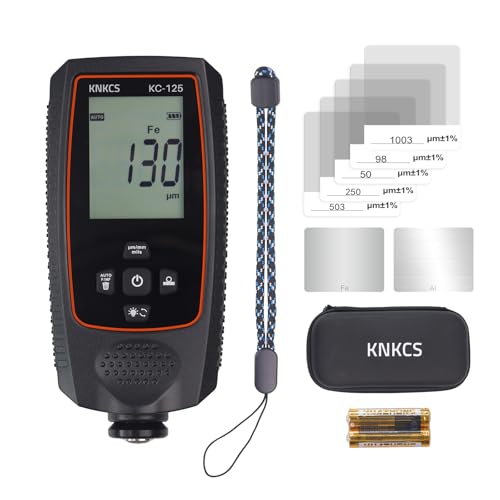
- 0–2500 μm range with 0.1 μm resolution
- Recognizes iron, aluminum, zinc, and iron powder filler
- Continuous measurement with long-term support
Best For: Professional mechanics and auto body inspections
Best for Documented Inspections
CM-208Z Industrial Coating Thickness Gauge

- 0–3000 μm range for thick coatings
- External probe for curved surfaces
- Stores 2,000 readings with USB export
Best For: Quality-control teams and documented metal inspections
Best Compact Panel Scanner
POROMETISTO CTG01 Paint Thickness Gauge

- 0–2000 μm measurement range for steel and aluminum
- Continuous scanning with average, maximum, and minimum readings
- USB-C export, rotating display, and included calibration kit
Best For: Routine vehicle-panel inspections and body-shop work
Professional Shop Pick
UNI-T UT343D Coating Thickness Gauge

- 0–1250 µm range with automatic F/NF detection
- Quick-test LED and audio range alerts
- Rotating 2-inch TFT display and multiple measurement modes
Best For: Professional mechanics checking varied vehicle surfaces
Used-Car Inspection Value
RDINSCOS Car Coating Thickness Meter
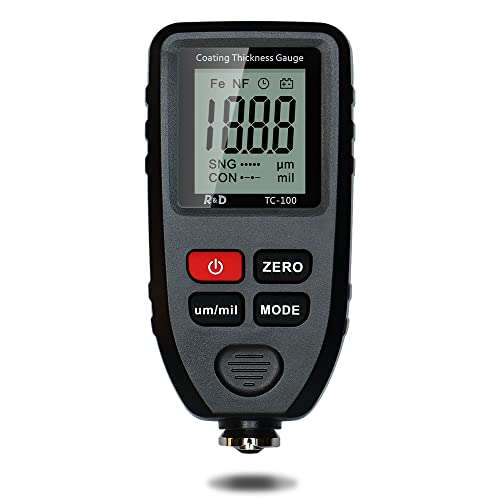
- Automatic steel and aluminum detection
- Designed to compare coating across vehicle panels
- Includes calibration foils and metal substrates
Best For: Used-car inspections on painted metal surfaces
Detailed Panel Analysis

- 0–1500 µm range with 0.001 mil resolution
- Detects steel, aluminum, and galvanized zinc
- Ruby probe and backlit display for field inspections
Best For: Detailed mixed-material vehicle panel comparisons
Best Ready-to-Use Gauge – CM-224 Auto
For professionals who want automotive paint thickness gauges for professional mechanics that work with minimal setup, the CM-224 Auto offers factory-calibrated readings for quick vehicle inspections. It measures metal panels across steel, aluminum, and galvanized steel, with a backlit display for shop or outdoor use.
Best For: Used-car inspections, body shops, vehicle appraisers, and detailing professionals who need fast checks on metal panels.
Pros:
- Factory calibrated and ready to use after installing the included batteries.
- Automatically detects Fe, NFe, and Fe+Zn substrates.
- Offers 0.1 μm resolution, single or continuous measurement modes, and a large backlit LCD.
Cons:
- Designed for metal surfaces only; it is not suitable for plastic, carbon fiber, or composite panels.
- Its 0–1500 μm range is narrower than some higher-range alternatives.
The CM-224 Auto is a practical choice when straightforward, repeatable metal-panel readings matter more than app connectivity or extensive data logging.
Best Connected Inspection Tool – CM-226Pro
The CM-226Pro is a strong option among automotive paint thickness gauges for professional mechanics who want organized measurements and smartphone access. Bluetooth connectivity, a dedicated car mode, and a rechargeable battery support inspection workflows across dealerships, body shops, and mobile service work.
Best For: Professional inspectors, collision-repair verification, dealerships, detailing businesses, and technicians who want vehicle-specific measurement records.
Pros:
- Connects to iOS and Android devices through Bluetooth and supports car-panel organization.
- Measures up to 3000 μm with 0.1 μm resolution.
- Includes statistics, data storage, alarm settings, voice prompts, and USB charging.
Cons:
- App-connected features may require more setup than a basic standalone gauge.
- Designed for coated metal surfaces rather than plastic or composite body parts.
Choose the CM-226Pro if your work benefits from stored readings, panel-by-panel organization, and a high measurement range instead of a purely manual inspection process.
Best for Data Transfer – UNI-T UT343D
UNI-T UT343D Digital Coating Thickness Gauge Meter Tester Range 0 to 1250um with USB Data Function
Check Price On AmazonThe UNI-T UT343D suits automotive paint thickness gauges for professional mechanics who need measurement controls, visual alerts, and PC data transfer. It automatically identifies ferrous and non-ferrous substrates and stores up to 500 readings for later analysis.
Best For: Workshops and inspectors who need calibration options, pass/fail-style alerts, and a record of measurements for PC review.
Pros:
- Stores 500 sets of data and transfers readings through USB.
- Supports single-point and two-point calibration for different materials.
- Provides single and continuous modes, max/min/average readings, and red, green, and yellow alerts.
Cons:
- Its 0–1250 μm range is more limited than the CM-226Pro.
- Uses two AA batteries rather than a rechargeable battery.
The UT343D is a sensible shop instrument when documented results and quick visual judgments are central to your workflow.
Best for Paint Correction – Griot's Garage BOSS
Griot’s Garage BOSS is designed for technicians who need automotive paint thickness gauges for professional mechanics during paint correction and vehicle evaluation. It measures ferrous and non-ferrous metal substrates, displays readings in microns or mils, and pairs with an iOS app for logging.
Best For: Paint-correction professionals, detailers, and inspectors checking for repaints, bodywork, or damage before polishing.
Pros:
- Measures within 2% of a micron according to the supplied product information.
- Bluetooth iOS app support helps log readings and track multiple vehicles.
- Includes batteries, calibration substrates, and a carrying case.
Cons:
- The app is specified for iOS-based use, so platform support may be less flexible for Android users.
- Measures metal substrates only and does not cover non-metal body materials.
With calibration substrates included and a workflow aimed at polishing decisions, the BOSS is particularly appealing for detailers and paint-correction specialists.
Best Precision Pick – KNKCS KC-125 Automotive Paint Thickness Gauge
For automotive paint thickness gauges for professional mechanics, the KNKCS KC-125 stands out when precise readings and efficient panel scanning matter. It measures coatings from 0–2500 μm with 0.1 μm resolution, supports continuous measurement, and recognizes iron, aluminum, zinc-coated substrates, and iron powder filler.
Best For: Professional mechanics, auto body shops, used-car inspections, and automotive coating assessments.
Pros:
- Offers ±(3% + 1 μm) accuracy and 0.1 μm resolution.
- Measures across a broad 0–2500 μm range.
- Supports continuous measurement and material recognition.
- Includes a 5-year maintenance program and lifetime technical support.
Cons:
- The supplied information does not specify data storage or USB export.
- Its advanced features may be more than occasional DIY users need.
The KC-125 is a strong choice for mechanics who want detailed automotive paint inspections, particularly when checking for filler, repairs, or inconsistent coating depth across a vehicle.
Best for Documented Inspections – CM-208Z Industrial Coating Thickness Gauge
Among automotive paint thickness gauges for professional mechanics, the CM-208Z is especially useful when measurements need to be recorded and reviewed. Its external probe, automatic Fe/NFe detection, statistical functions, 2,000-reading storage, and USB export support structured inspection workflows.
Best For: Professional inspectors, quality-control teams, contractors, and mechanics evaluating metal panels or heavy protective coatings.
Pros:
- Measures 0–3000 μm with 0.1 μm or 0.001 mil resolution.
- Automatically identifies ferrous and non-ferrous metal substrates.
- External probe suits curved and hard-to-reach surfaces.
- Stores up to 2,000 readings and exports data by USB.
Cons:
- Designed for metal substrates only, not plastic, composite, or other non-metal surfaces.
- At 1.3 pounds, it is heavier than the compact automotive-focused options listed here.
The CM-208Z is the better fit when a shop or inspection team values repeatable documentation, statistical summaries, and computer-based reporting alongside coating measurements.
Best Compact Panel Scanner – POROMETISTO CTG01 Paint Thickness Gauge
The POROMETISTO CTG01 is a practical option for automotive paint thickness gauges for professional mechanics who inspect steel and aluminum body panels. It combines automatic Fe/NFe detection with single and continuous scan modes, a rotating color display, data hold, and USB-C transfer.
Best For: Body-shop technicians, dealers, detailing studios, used-car inspections, and mechanics checking hoods, doors, roofs, and fenders.
Pros:
- Measures steel, iron, aluminum, and copper automatically across 0–2000 μm.
- Continuous mode refreshes readings every 0.3 seconds and shows recent average, maximum, and minimum.
- Stores 30 measurement groups and transfers data through USB-C.
- Includes calibration foils, bare substrate, batteries, and a 2-year repair-or-replace warranty.
Cons:
- Will not measure plastic bumpers, fiberglass, carbon fiber, wood, or drywall.
- Requires calibration and careful probe positioning for reliable results.
- Convex curves under 5 mm, weld seams, rust, and dirt should be avoided.
The CTG01 offers a useful balance of portability and inspection features for routine vehicle-panel checks, especially when technicians want a quick scan plus basic measurement records.
Professional Shop Pick – UNI-T UT343D Coating Thickness Gauge
For professional mechanics comparing automotive paint thickness gauges, the UNI-T UT343D combines automatic ferrous/non-ferrous detection with a broad 0–1250 µm measuring range. Its quick-test alerts and rotating display are useful when checking multiple panels or working around contoured surfaces.
Best For: Mechanics and inspectors who want flexible measurements, quick range-based checks, and readable results on steel and aluminum vehicle panels.
Pros:
- Measures ferrous and non-ferrous materials with automatic detection.
- Measures concave, rough, and convex surfaces using a dynamic sensor design.
- Three-color LED and audio alerts help identify readings within a preset range.
- Offers single or continuous measurement, plus maximum, minimum, and average modes.
Cons:
- Resolution changes from 0.1 µm below 100 µm to 1 µm at higher readings.
- The listed accuracy is ±(3%H+1) µm.
The UT343D is a feature-rich choice for shop or field inspections, particularly when speed and flexible surface measurement matter. Its included standard piece and portable bag support routine use.
Used-Car Inspection Value – RDINSCOS Car Coating Thickness Meter
For mechanics seeking automotive paint thickness gauges for professional inspections, this RDINSCOS meter focuses on straightforward panel-to-panel comparison. Automatic steel and aluminum recognition can help reveal inconsistent coating thickness associated with previous repairs, while the included calibration pieces support setup.
Best For: Used-car inspections, repair checks, and mechanics who primarily measure painted metal panels.
Pros:
- Automatically recognizes ferrous and non-ferrous substrates.
- Useful for comparing paint consistency across vehicle panels.
- Includes five standard foils, iron and aluminum substrates, a battery, and storage bag.
- Backed by a stated three-year replacement warranty.
Cons:
- Designed for metallic surfaces only; it cannot measure plastic, fiberglass, or wood.
- The supplied notes do not specify the measuring range or resolution.
This is a practical, focused option for automotive metal-panel checks, especially when the main goal is spotting variations across a used vehicle. Confirm that the vehicle areas being tested are metallic before choosing it.
Detailed Panel Analysis – CM-206X Paint Thickness Gauge
Among automotive paint thickness gauges for professional mechanics, the CM-206X stands out for detailed panel comparisons. It measures up to 1500 µm, automatically recognizes steel, aluminum, and zinc surfaces, and uses a ruby probe intended for consistent contact during repeated vehicle inspections.
Best For: Mobile inspectors, dealerships, and mechanics comparing factory paint with refinished areas across mixed-material vehicle panels.
Pros:
- Provides a 0–59.1 mil range with 0.001 mil resolution.
- Automatically detects Fe, NFe, and galvanized zinc surfaces.
- Ruby probe supports stable, controlled contact and reduced surface wear.
- Backlit multi-unit display and -13°F to 131°F operating range suit field work.
Cons:
- Requires two AAA batteries.
- Fine resolution does not replace the need for consistent probe placement during comparisons.
The CM-206X is well suited to systematic full-vehicle scans where small differences between panels matter. Its zinc detection and field-oriented design add useful flexibility for modern vehicles and mobile inspections.
How We Picked the Best Automotive Paint Thickness Gauges for Professional Mechanics
We focused on gauges suited to repeated automotive inspections rather than treating every coating meter as interchangeable. The comparison considers support for ferrous and nonferrous metals, measurement range, resolution, automatic substrate recognition, calibration controls, probe design, display readability, portability, and data-transfer options.
For professional use, a gauge should produce consistent readings across adjacent panels and make unusual results easy to investigate. Bluetooth or USB connectivity can be valuable when documenting inspections, while a simple handheld meter may be preferable when speed and reliability matter more than reporting features.
Quick Comparison
| What to Compare | Why It Matters |
|---|---|
| Material modes | Steel, aluminum, and zinc panels require compatible detection technology. |
| Measurement range | A wider range accommodates factory coatings, repainting, and heavier filler. |
| Resolution and repeatability | Finer readings help identify small differences between neighboring panels. |
| Data features | Bluetooth, USB, memory, or export tools simplify inspection records. |
| Probe configuration | Integrated probes are convenient; external probes can improve access in tight areas. |
Key Buying Factors for Automotive Paint Thickness Gauges for Professional Mechanics
Substrate Compatibility
Choose a model that detects both ferrous and nonferrous substrates if you inspect modern vehicles. Steel remains common, but aluminum body panels and galvanized or zinc-coated components can produce different measurement conditions. Automatic Fe/NFe or Fe/Al/Fe+Zn recognition reduces setup time, but it should not replace verification with test standards.
Accuracy, Range, and Calibration
Do not judge a gauge by resolution alone. A display showing thousandths of a mil is useful only when readings are repeatable and the instrument is properly calibrated. Look for zero, foil, or multi-point calibration support, and select a range broad enough for both normal paint and suspected filler. Keep calibration shims or certified reference pieces available during professional inspections.
Workflow and Durability
A bright display, quick response, automatic shutoff, and comfortable grip make a difference during a full vehicle scan. Bluetooth or USB models are better for saving evidence, while compact standalone meters are often faster for walk-around evaluations. Check battery access, probe durability, operating temperature, and the availability of replacement accessories before committing.
Who Should Buy Which Automotive Paint Thickness Gauges for Professional Mechanics?
For used-car inspections: prioritize fast automatic material detection, clear readings, and a compact design. Data logging is useful when you need to share findings with a buyer.
For professional mechanics and appraisers: choose a repeatable gauge with broad Fe/NFe coverage, calibration controls, and memory or connectivity for traceable reports.
For body shops and refinishing quality control: favor a wide measurement range, fine resolution, dependable calibration, and an external probe if access around edges or curved panels is important.
For occasional home use: a straightforward digital meter may provide better value than a connected model with features you will rarely use. Regardless of price, confirm readings on known reference material and compare multiple points rather than relying on a single measurement.
