

10 Best Commercial-Grade Automotive Spot Welders for Professional Body Repair in 2026

Choosing the right automotive spot welder can improve repair consistency, reduce panel distortion, and help a busy shop work more efficiently. The best commercial-grade machines balance welding capacity, control, portability, and serviceability.
This roundup compares 10 selected models, including handheld resistance welders, stud-welding dent repair kits, and specialized battery spot welders. Use the guide below to match equipment features with your repair volume, material requirements, and shop setup.
Best 10 Commercial-Grade Automotive Spot Welders Picks for 2026
Compact Professional Pick

- Compact 9 x 3 x 2-inch design
- AC-powered spot-welding setup
- Made for compatible 208/230V workspaces
Best For: Compact workshop spot-welding applications
Heavy-Duty Handheld Choice
Stark USA 220V Portable Spot Welder

- 2.5KVA input and 6,750A maximum output
- Welds material up to 1/8 inch
- Includes replaceable copper tips
Best For: Automotive body work and sheet-metal fabrication
Complete Dent-Repair Kit

- Includes stud gun and pulling hammer
- Thermal protection at 95°C
- Supplies include 1,000 repair nails
Best For: Automotive stud-welding dent repair
High-Power 120V Option

- 8KW input capacity
- 1.2mm + 1.2mm welding capacity
- Runs on 110–120V power
Best For: Automotive sheet-metal repair on 120V power
High-Current Battery Specialist
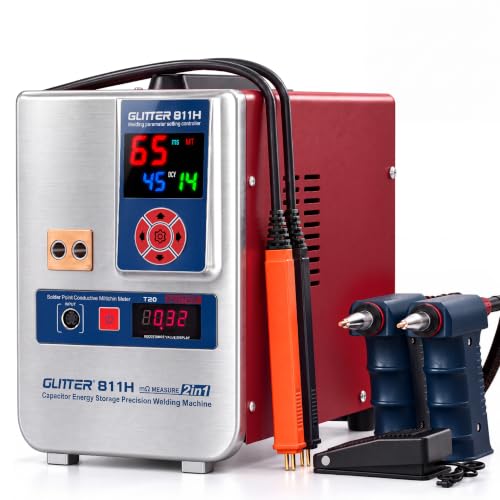
- 7000A output and 42KW pulse welding
- Supports copper, nickel, and composite tabs
- Built-in milliohm resistance testing
Best For: Professional battery-pack assembly and repair
Adjustable Sheet-Metal Workhorse

- 110V operation with normal and pulsed modes
- Adjustable thickness up to 1/8-inch combined
- Includes replaceable electrode arms
Best For: General sheet-metal and overlap welding
Automotive Dent-Repair System

- Six modes for dent pulling and body repair
- Manual and automatic operating modes
- 0.6–1.6mm single-side welding support
Best For: Vehicle dent repair and iron-sheet bodywork
Portable Automotive Workhorse
Stark USA 110V Portable Spot Welder
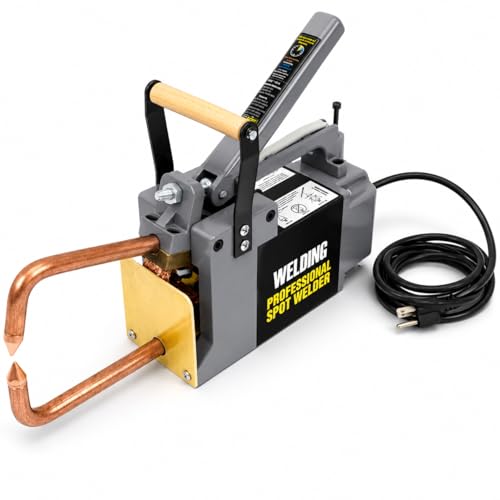
- 110V portable design with 6-inch throat
- Listed 1/8-inch sheet-metal capacity
- Copper tips and simple lever operation
Best For: Portable automotive repair and sheet-metal work
Automotive Dent-Repair Specialist
VEVOR Stud Welder Dent Puller Kit

- 1.8KW system for steel-panel dent repair
- Automatic and manual welding modes
- Five stud types with toolbox accessories
Best For: Auto-body dent pulling on flat or curved steel panels
Compact Sheet-Metal Option

- Portable design with 6-inch throat depth
- Listed 1/8-inch sheet-metal capacity
- 5500A maximum output specification
Best For: Routine automotive repair and light fabrication
Compact Professional Pick – Lenco Lencospot II 208/230V
The Lenco LCO-L-4000 Mii Lencospot II is a compact AC spot welder for buyers seeking commercial-grade automotive spot welders in a small, purpose-built package. Its listed spot-welding installation method and 208/230V electrical specification make it a focused option for compatible workshop setups.
Best For: Buyers who want a compact Lenco spot welder for a compatible 208/230V AC workspace.
Pros:
- Compact 9 x 3 x 2-inch listed dimensions
- AC power source for workshop use
- Designed specifically for spot-welding applications
Cons:
- Requires a compatible 208/230V power setup
- Supplied notes provide limited information about capacity and controls
The Lencospot II is best considered a specialized, space-saving choice rather than a broadly documented general-purpose machine. Confirm electrical compatibility and required welding capacity before purchasing.
Heavy-Duty Handheld Choice – Stark USA 220V Portable Spot Welder
The Stark USA 220V Portable Spot Welder combines a 2.5KVA input rating with a listed 6,750A maximum output current and up to 1/8-inch welding capacity. For shoppers comparing commercial-grade automotive spot welders, its handheld format, copper tips, and automotive body-welding applications make it a practical fabrication-focused option.
Best For: Automotive body work, sheet-metal fabrication, and users who need a portable 220V spot-welding machine.
Pros:
- Rated at 2.5KVA with a listed 6,750A maximum output
- Welding capacity listed up to 1/8 inch
- Includes replaceable copper tips and a portable handle
- Designed for carbon steel, aluminum, sheet metal, and auto body welding
Cons:
- Requires 220V corded-electric power
- At 28.9 pounds, it is portable but not especially light
- Handheld operation still requires proper pressure and technique
With clear output and capacity specifications, this Stark USA model is one of the more application-oriented choices in the group. Its 220V requirement and 28.9-pound weight should be checked against your shop setup and mobility needs.
Complete Dent-Repair Kit – VEVOR 5500 Stud Welder
The VEVOR 5500 Stud Welder is a dent-repair system rather than a conventional sheet-metal spot welder. Its stud gun, slide hammer, thermal protection, and large accessory assortment give buyers considering commercial-grade automotive spot welders a flexible setup for pulling vehicle dents.
Best For: Auto-body dent repair involving welded studs, pull hammers, pads, and repair wires.
Pros:
- Includes a multifunction pulling hammer and complete dent-repair accessories
- Thermal protection activates when the transformer reaches 95°C
- ABS housing and copper electrode are designed for durability
- Includes 500 each of 2.0mm and 2.5mm nails
Cons:
- Designed specifically for stud-based dent repair, not general spot welding
- Requires 110V AC power
- At 28.5 pounds, the kit may be cumbersome for frequent relocation
This VEVOR kit stands out when the job involves pulling dents rather than joining ordinary sheet-metal panels. Its included consumables and slide hammer reduce the need to assemble a separate repair setup.
High-Power 120V Option – Hoteche Portable Spot Welder
Hoteche Portable Spot Welder Single Phase Spot Welding Machine with Durable Components
Check Price On AmazonThe Hoteche Portable Spot Welder offers an 8KW input rating, 120V operation, and a stated capacity of 1.2mm plus 1.2mm material. It is a useful candidate for shoppers comparing commercial-grade automotive spot welders who need a portable machine for sheet metal and automotive repair without a 220V supply.
Best For: Automotive repair and sheet-metal welding in workshops equipped with standard 110–120V service.
Pros:
- Listed 8KW input capacity
- Welds material listed at 1.2mm + 1.2mm
- Uses a 110–120V American-plug setup
- 50% duty cycle supports repeated welding with reduced overheating concerns
Cons:
- Listed material capacity may not suit heavier sheet-metal work
- Weighs 26 pounds, limiting effortless portability
- Supplied notes list only a pair of electric poles as included components
Hoteche’s main advantage is its combination of high listed input power and ordinary 120V compatibility. Review the 1.2mm-plus-1.2mm capacity carefully to ensure it matches your automotive panel thickness and workload.
High-Current Battery Specialist – GLITTER 811H Pro
For battery manufacturers, repair shops, and advanced builders, the GLITTER 811H stands out among commercial-grade automotive spot welders for high-current battery connections. Its 7000A capacitor output, 42KW pulse technology, and copper-welding capability are suited to demanding tab and busbar work.
Best For: Professional battery workshops, EV battery repair, energy-storage assembly, and advanced DIY battery-pack construction.
Pros:
- Handles copper, nickel, and nickel-aluminum composite connections.
- Built-in milliohm testing helps verify weld resistance and consistency.
- 50mm² high-current cable supports efficient power transfer.
- Includes a foot pedal, welding pen, and resistance-test leads.
Cons:
- Its specialized battery-welding design may be excessive for basic sheet-metal repairs.
- The 19.32-pound unit is less portable than compact welders.
The 811H is the strongest fit here when weld quality verification and high-current copper work matter more than general body-panel versatility. It is a purpose-built professional system rather than an all-around automotive dent-repair machine.
Adjustable Sheet-Metal Workhorse – F3000 Portable Spot Welder
The F3000 is a practical option for buyers seeking commercial-grade automotive spot welders for overlapping sheet metal and reinforcement mesh. Its 110V operation, selectable welding modes, adjustable thickness range, and replaceable electrode arms make it adaptable for recurring workshop use.
Best For: Sheet-metal fabrication, galvanized or stainless panels, overlap welding, and wire reinforcement mesh.
Pros:
- Adjusts for material thickness from 0.6+0.6mm to 2+2mm.
- Offers normal and pulsed welding modes.
- Includes three pairs of replaceable electrode arms.
- One-click controls select mode, thickness, and welding time.
Cons:
- Its listed capacity is limited to a combined sheet thickness of 1/8 inch.
- It is designed for 110V AC power rather than cordless operation.
Choose the F3000 when adjustable sheet-metal capacity and replaceable electrodes are priorities. It is more broadly suited to panel and fabrication work than the battery-focused GLITTER, though it lacks the latter’s resistance-testing function.
Automotive Dent-Repair System – BELEY 4200A Stud Welder
The BELEY 4200A is aimed directly at collision and bodywork applications, making it a specialized choice among commercial-grade automotive spot welders. Its manual and automatic controls, six welding modes, digital display, and dent-puller accessories support varied iron-sheet repair tasks.
Best For: Car, truck, and motorcycle dent repair involving thin iron sheet and controlled stud-pulling work.
Pros:
- Six modes cover stud pulling, wave-line welding, single-sided welding, and more.
- Manual and automatic operation accommodates detailed or faster repairs.
- Supports single-side welding from 0.6 to 1.6mm.
- Automatic overheat protection shuts the unit down as temperatures rise.
Cons:
- Its dent-repair focus makes it less suitable for battery-tab welding.
- At 45.6 pounds, it is relatively heavy for a portable workshop machine.
- The supplied notes list a 3800A super-high-current output, while the title identifies the unit as 4200A.
The BELEY is the most targeted choice for automotive body repair, especially when dent-pulling modes and small weld tracks are more important than broad fabrication flexibility. Its thermal protection and dual operating modes add useful control for repeated repairs.
Portable Automotive Workhorse – Stark USA 110V Portable Spot Welder
For buyers comparing commercial-grade automotive spot welders, this Stark USA model offers a portable 110V design, a listed 1/8-inch capacity, and a 6-inch throat depth. Its 1.5KVA rated input and stated 5500A maximum output suit sheet-metal, auto-body, fabrication, and similar spot-welding tasks.
Best For: Automotive repair and general sheet-metal work where portability and straightforward lever operation are priorities.
Pros:
- Portable 110V single-phase design with an attached handle.
- Listed 1/8-inch capacity and 6-inch throat depth.
- Copper welding tips and simple pull, pressure, and press operation.
- Suitable for automotive repair, fabrication, electronics assembly, and metal manufacturing.
Cons:
- The supplied specifications list a 1.5KVA rated input but also state 6600 watts, so buyers should verify the electrical requirements.
- The handheld format may be less convenient than a dedicated dent-repair system for pulling body dents.
This is a practical choice when you need a compact resistance spot welder for varied repair and fabrication work. Verify the power specifications and ensure the stated capacity matches your material and joint requirements.
Automotive Dent-Repair Specialist – VEVOR Stud Welder Dent Puller Kit
Among commercial-grade automotive spot welders, this VEVOR kit is focused specifically on steel-panel dent repair. The 1.8KW system provides automatic and manual welding modes, seven default settings, and multiple stud types for addressing different dent sizes and shapes.
Best For: Auto-body technicians, mechanics, and experienced DIY users repairing minor dings through larger dents on flat or curved steel panels.
Pros:
- Designed for controlled stud welding and dent pulling on steel car panels.
- Seven welding modes accommodate different welding studs.
- Manual mode supports precise work, while automatic mode targets faster dent repair.
- Includes five stud types, accessories, a toolbox, and a portable handle.
Cons:
- Its dent-pulling focus makes it less versatile for general sheet-metal spot welding than a standard resistance welder.
- The supplied details list 110V in the title but 220V in the specifications; confirm the required voltage before purchase.
- At 43.2 pounds, it is less lightweight than handheld spot-welding guns.
This kit stands out when dent removal is the main goal and adjustable welding control matters. The conflicting voltage information should be resolved before ordering, particularly for shop installation or mobile use.
Compact Sheet-Metal Option – Stark USA 110V Spot Welder
This Stark USA unit is a compact option for shoppers seeking commercial-grade automotive spot welders for routine sheet-metal and auto-repair work. It lists a 1/8-inch capacity, 6-inch throat depth, 1.5KVA rated input, and 5500A maximum output in a portable corded-electric format.
Best For: Automotive repair, light fabrication, and shop users who want a portable spot welder with uncomplicated manual operation.
Pros:
- Portable 110V-class design with a 6-inch throat depth.
- Listed 1/8-inch sheet-metal capacity for automotive and fabrication applications.
- High-power specifications include 1.5KVA rated input and 5500A maximum output.
- Uses a simple lever-based operating method and includes electrode tips.
Cons:
- The supplied notes describe the tips as both steel and copper, so construction should be confirmed.
- The details list 120V input while the product title states 110V; verify compatibility with the intended outlet.
- It is a general spot welder rather than a complete stud-welding dent-puller kit.
This model makes sense for straightforward automotive sheet-metal joining when portability and ease of use outweigh advanced dent-repair features. Check the voltage and electrode specifications before committing to shop use.
How We Picked the Best Commercial-Grade Automotive Spot Welders
We focused on the specifications that matter in professional body shops and serious automotive repair environments: voltage, rated sheet-metal capacity, throat depth, welding modes, electrode design, portability, and control options. We also considered whether each machine is designed primarily for resistance spot welding, stud-based dent pulling, or specialized battery and small-component work.
Because product listings can vary by configuration, verify the included arms, electrodes, cables, accessories, and power requirements before ordering. A machine’s stated capacity is also dependent on metal type, surface preparation, duty cycle, and available electrical service.
Quick Comparison
| Best For | What to Prioritize |
|---|---|
| High-volume body-shop panel work | Higher capacity, robust cooling, adjustable timing, and replaceable electrodes |
| Stud welding and dent pulling | High current output, automatic and manual modes, and compatible stud accessories |
| Mobile or occasional repairs | Portable construction, standard-voltage operation, and simple controls |
| Battery or small-part welding | Precise pulse control, resistance testing, and suitable copper welding tips |
Key Buying Factors for Commercial-Grade Automotive Spot Welders
Power and Material Capacity
Check the machine’s input voltage and maximum recommended sheet thickness. A 110V model may be convenient for mobile work, while a 208V or 230V unit can be better suited to dedicated shop wiring and demanding production use. Do not treat the advertised thickness as a guarantee for every alloy or joint.
Welding Control and Modes
Adjustable weld time, current control, and automatic or manual triggering help operators adapt to different panels and repair techniques. Stud-welding kits with multiple modes can support dent pulling, but more settings are useful only when controls are clearly labeled and repeatable.
Electrodes, Arms, and Serviceability
Replaceable electrode arms and accessible consumables can lower long-term ownership costs. Look for suitable arm reach, included tips, replacement availability, and cooling provisions. A deeper throat can make it easier to reach interior panel areas, but it may increase overall size and weight.
Electrical and Workplace Requirements
Confirm circuit requirements, plug style, duty cycle, grounding, and extension-cord limitations. Professional welding also requires proper ventilation, eye protection, gloves, fire prevention, and preparation of clean, correctly aligned metal.
Who Should Buy Which Commercial-Grade Automotive Spot Welders?
Choose a higher-capacity 208V or 230V unit if your shop performs frequent structural or panel welding and has suitable electrical service. A portable 110V resistance welder is a practical choice for smaller shops, mobile technicians, and repair work where outlet access matters more than maximum throughput.
Choose a stud-welder dent repair kit when pulling collision damage is the primary task and you want dedicated stud-gun accessories and multiple operating modes. For battery tabs or small precision work, select a purpose-built battery spot welder rather than a general automotive panel machine. Whichever category fits your work, prioritize reliable controls, available replacement parts, and a realistic match between rated capacity and your daily workload.
