

10 Best High-Capacity Wheel Balancer Machines for Professional Shops in 2026

Choosing among high-capacity wheel balancer machines means looking beyond spin speed and headline specifications. The right model should match your wheel sizes, daily workload, available power, and the level of measurement automation your shop needs.
This roundup compares 10 options ranging from compact garage equipment to heavy-duty truck and bus balancers, helping you narrow the field by capacity, controls, fitment, and practical service requirements.
Best 10 High-Capacity Wheel Balancer Machines Picks for 2026
Shop-Ready Combo
KATOOL Tire Changer and Wheel Balancer

- 2.0 HP motor with 28-inch turntable
- Extended shaft for larger wheels
- Automatic measurement and laser positioning
Best For: Professional shops needing tire changing and balancing in one setup
Heavy-Wheel Workhorse

- 154.32-pound maximum wheel weight
- 10-24-inch rim capacity
- 36 mm shaft with 110V power
Best For: Shops balancing heavier wheels within a 24-inch rim range
Garage-Friendly Precision
Motool Technology KT-B760 Wheel Balancer

- Automatic A/D measurement
- Under-30-inch rim specification
- 120V operation with laser indicator
Best For: Home garages and smaller repair spaces
Automated Shop Performer
MutsMover Premium Automatic Wheel Balancer
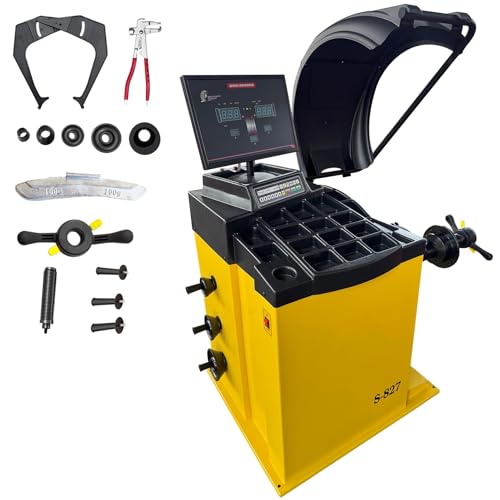
- 10-26-inch rim range with 40 mm spindle
- Automatic A/D measurement and electronic brake
- Laser, LED lighting, and smart balancing modes
Best For: Professional shops prioritizing automation and workflow speed
Heavy-Duty Wide-Wheel Choice

- Longer shaft for wider wheels and custom rims
- Multiple rim-specific balance modes
- Copper motor and stable circuit board
Best For: Tire shops and serious home garages handling varied or custom wheels
Precision Shop Performer

- ±1g stated accuracy with a 0.34HP motor
- Fits 10- to 26-inch rims and up to 143 pounds
- Automatic rim recognition and self-calibration
Best For: Auto shops and garages servicing cars, SUVs, and light trucks
Fast Guided Balancing

- Seven-second cycle with stated ±1g accuracy
- Automatic measurement ruler and laser guide
- Handles wheels up to 30 inches and 65 kilograms
Best For: Garages and tire shops prioritizing fast, guided balancing
Truck-Shop Capacity

- Balances rims up to 51 inches
- 8-second measurement time
- Positioning lasers improve placement accuracy
Best For: Truck, bus, and commercial tire shops
Versatile Shop Pick
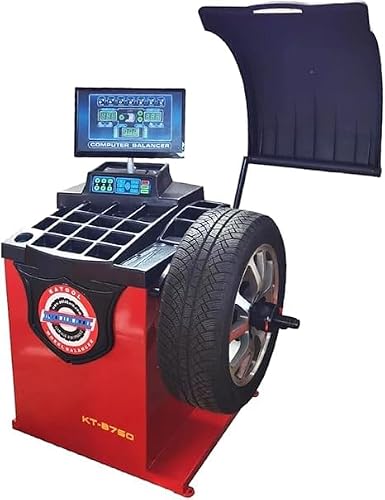
- Supports wheels up to 143 pounds
- Fits 8- to 24-inch rim diameters
- Automatic ruler enters A and D values
Best For: Mixed-wheel automotive workshops
Modes-and-Warranty Value

- Supports 10- to 24-inch rims
- Offers dynamic, static, ALU, and motorcycle modes
- Includes a one-year full warranty
Best For: Commercial shops serving varied standard wheels
Shop-Ready Combo – KATOOL Tire Changer and Wheel Balancer
For shops needing high-capacity wheel balancer machines alongside tire-changing capability, this KATOOL combo offers a broad, workflow-focused setup. Its extended balancer shaft, automatic measurement ruler, laser positioning, and large turntable support varied wheel service tasks.
Best For: Professional shops that want tire changing and wheel balancing equipment in one package.
Pros:
- 2.0 HP motor and 28-inch turntable support demanding tire-mounting work.
- Extended shaft accommodates large-diameter and custom-fit wheels.
- Automatic A/D measurement, laser positioning, and HD display simplify balancing.
Cons:
- At 274 pounds, it is a substantial machine to position.
- The combo format may be more equipment than a balancing-only workspace needs.
This is the most versatile option of the group for a busy shop handling both mounting and balancing. Its broad clamping range and automated balancing features are useful when job variety matters more than a compact footprint.
Heavy-Wheel Workhorse – Senhontal 680S Wheel Balancer
Among high-capacity wheel balancer machines, this 680S stands out for its stated 154.32-pound maximum wheel weight and 24-inch rim capacity. Its 36 mm shaft and 110V single-phase supply make it a practical fit for shops working with heavier passenger-vehicle wheels.
Best For: Service locations prioritizing high wheel-weight capacity and a 10-to-24-inch rim range.
Pros:
- Supports wheel weights up to 154.32 pounds.
- Handles rims from 10 to 24 inches and wheel diameters up to 39 3/8 inches.
- Uses standard 110V, 60Hz, single-phase power.
Cons:
- The supplied notes do not specify automatic measurement, laser guidance, or display features.
- Product listing details provide limited information about dimensions and included accessories.
If maximum stated wheel-weight capacity is your main filter, this model deserves attention. Buyers who need advanced automation should verify those functions before ordering, since they are not detailed in the supplied specifications.
Garage-Friendly Precision – Motool Technology KT-B760 Wheel Balancer
This Motool Technology balancer is a straightforward choice for users comparing high-capacity wheel balancer machines for home-garage or light service work. Automatic A/D input and a laser indicator reduce setup effort, while the under-30-inch rim specification covers a broad range of wheel sizes.
Best For: Home garages and smaller repair spaces seeking automated measurements and laser-guided balancing.
Pros:
- Automatic measurement ruler enters A and D values.
- Supports rim diameters under 30 inches and wheel widths from 3 to 12 inches.
- 120V power and 0.25KW motor suit standard garage-style electrical service.
Cons:
- A wheel guard is optional and costs extra.
- The supplied notes do not state a maximum wheel-weight capacity.
With useful measurement automation and a laser indicator at the 6 o’clock position, the KT-B760 focuses on accessible operation. Confirm the optional guard and capacity details if you expect frequent heavy-duty commercial use.
Automated Shop Performer – MutsMover Premium Automatic Wheel Balancer
Designed for professional workflows, this MutsMover model combines automatic A/D measurement with a 10-to-26-inch rim range, laser guidance, electronic braking, and a 40 mm spindle. It is a strong candidate among high-capacity wheel balancer machines when speed, visibility, and repeatable operation are priorities.
Best For: Professional shops needing automated balancing for a varied range of passenger-vehicle wheels.
Pros:
- Automatic A/D measurement and electronic brake streamline weight placement.
- 40 mm thickened, lengthened spindle improves stated stability for wider wheels.
- Laser guide, LED light box, large display, auto-calibration, and smart balancing modes support efficient operation.
Cons:
- The supplied notes do not specify a maximum wheel-weight rating.
- Advanced features may be unnecessary for occasional home use.
This model offers the most extensive automation package in the selection, including sonic tire-width sensing and automatic balancing-mode changes. Its 12-month warranty and professional-use design add appeal for shops that expect regular machine use.
Heavy-Duty Wide-Wheel Choice – KATOOL KT-B700
KATOOL Wheel Balancer KT-B700 Machines HomeGarageEquipment Service Shop Tools Repair
Check Price On AmazonFor shops needing high-capacity wheel balancer machines, the KATOOL KT-B700 stands out with a longer shaft designed for wider wheels and custom rims. Its rim-specific balance modes support precise setup across different wheel types, while the copper-wound motor and reinforced circuit board are built for dependable operation.
Best For: Tire shops and serious home garages balancing wider wheels, custom rims, and varied wheel types.
Pros:
- Longer shaft accommodates wider wheels and custom rims.
- Multiple rim-specific balance modes help optimize accuracy.
- Pure-copper motor winding supports heat dissipation and extended operating life.
- High-quality circuit board promotes stable power delivery and consistent performance.
Cons:
- At 278 pounds, it is a substantial machine to position and install.
- Its 30 x 35 x 40-inch footprint requires dedicated shop or garage space.
The KT-B700 is a practical choice when wheel compatibility and long-term operating stability matter more than a compact footprint. Its wide-wheel shaft and specialized balance modes make it particularly useful for varied service work.
Precision Shop Performer – KATRAX ME-B600
The KATRAX ME-B600 combines a 0.34HP motor, automatic rim recognition, and stated ±1g accuracy for shops seeking high-capacity wheel balancer machines with guided operation. Its broad fit range covers 10- to 26-inch diameter rims and wheels up to 143 pounds, making it suitable for cars, SUVs, and light trucks.
Best For: Auto shops and home garages that want broad vehicle coverage, automatic setup, and precise balancing.
Pros:
- Supports 10- to 26-inch diameter and 1.5- to 20-inch width rims.
- Handles wheels up to 143 pounds.
- Automatic rim recognition and self-calibration simplify operation.
- Thick welded steel frame and pressure sensor support stable, low-noise performance.
Cons:
- Its 207-pound weight still calls for a sturdy installation area.
- The stated maximum diameter is 26 inches, which is narrower than some larger-wheel options.
With automatic detection, a large LCD screen, and a substantial capacity range, the ME-B600 is geared toward users who want less manual setup without giving up shop-grade construction. It is a strong fit for common passenger-vehicle and light-truck service.
Fast Guided Balancing – KATRAX KT-B750
The KATRAX KT-B750 is one of the high-capacity wheel balancer machines designed for quick, repeatable workflows. Its automatic measurement ruler, laser guide, ±1g accuracy, and seven-second measuring cycle reduce manual input, while the heavy steel construction supports stable sensor performance.
Best For: Home garages and tire shops balancing wheels up to 30 inches in diameter, 12 inches wide, and 65 kilograms.
Pros:
- Automatic ruler measures A and D values for faster setup.
- Seven-second measuring cycle and stated ±1g accuracy support efficient service.
- Handles wheels up to 30 inches in diameter, 12 inches wide, and 65 kilograms.
- Self-calibration and built-in fault diagnosis simplify ongoing use.
Cons:
- At 278 pounds and 41 x 30 x 41 inches, it needs significant floor space.
- The 65-kilogram capacity is lower than the ME-B600’s stated 143-pound capacity.
- The wheel guard is listed as optional rather than included as standard.
The KT-B750 favors speed and guided operation, with automatic measurements, laser assistance, and self-service calibration. Its 30-inch diameter limit is useful for larger wheels, provided the wheel remains within the 65-kilogram and 12-inch width limits.
Truck-Shop Capacity – KATOOL KT-B795
KATOOL KT-B795 Truck Tire Wheel Balancer Machine Truck Bus Tire Balancing Machine Max Rim 51" 220V
Check Price On AmazonFor shops comparing high-capacity wheel balancer machines, the KATOOL KT-B795 stands out for truck and bus applications. It handles rims up to 51 inches, completes measurements in about 8 seconds, and uses positioning lasers to improve weight-placement accuracy.
Best For: Truck tire shops and general automotive service departments that need large-wheel capability.
Pros:
- Supports rims up to 51 inches.
- Handles steel rim widths from 1.5 to 20 inches.
- Positioning lasers help reduce weight-placement mistakes.
- Large screen and stated low-noise operation support easier shop use.
Cons:
- Requires a 220V power supply.
- At 485 pounds, it is a substantial machine to position.
The KT-B795 is specialized equipment for large commercial wheels rather than a compact general-purpose balancer. Its broad rim capacity and laser positioning make it a strong fit where truck and bus service is the priority.
Versatile Shop Pick – KATOOL KT-B750
The KATOOL KT-B750 is a practical choice among high-capacity wheel balancer machines for shops serving varied passenger-vehicle wheels. Its automatic measurement ruler enters the A and D values, while the 110V input supports straightforward installation in many workshops.
Best For: Workshops wanting broad rim compatibility and simplified measurement setup.
Pros:
- Supports wheels weighing up to 143 pounds.
- Fits rim diameters from 8 to 24 inches.
- Handles rim widths from 1.5 to 20 inches.
- Automatic ruler inputs A and D values for faster setup.
Cons:
- Its stated maximum rim diameter is smaller than the KT-B795’s 51-inch capacity.
- The supplied notes do not specify a measurement time.
With 110V operation, a wide range of supported rim sizes, and automatic value entry, the KT-B750 balances convenience with useful shop capacity. It is better suited to mixed wheel service than extremely large truck-wheel work.
Modes-and-Warranty Value – MAYFLOWER 680
MAYFLOWER - Heavy Duty Wheel Balancer Tire Balancers Machine Rim Car 680/1 Year Full Warranty
Check Price On AmazonThe MAYFLOWER 680 offers a heavy-duty, commercial-grade design for buyers evaluating high-capacity wheel balancer machines. It covers 10- to 24-inch rim diameters and 1.5- to 20-inch widths, with multiple balancing modes for different wheel and rim requirements.
Best For: Commercial shops that value flexible balancing modes and included warranty coverage.
Pros:
- Supports rim diameters from 10 to 24 inches.
- Handles rim widths from 1.5 to 20 inches.
- Includes dynamic, static, ALU 1-3, and motorcycle modes.
- Includes a one-year full warranty.
Cons:
- Its maximum diameter is smaller than the KATOOL KT-B795’s 51-inch rating.
- The supplied notes do not list a wheel-weight capacity or measurement time.
The 680 is a flexible commercial balancer for shops working across standard car and motorcycle applications. Its broad operating modes and one-year warranty add practical value, though buyers needing very large truck rims should consider a higher-capacity alternative.
How We Picked These High-Capacity Wheel Balancer Machines
We focused on machines with specifications suited to frequent tire service, including broad rim ranges, heavier wheel capacities, automatic measurement features, laser guides, self-calibration, electronic braking, and durable motors. The selection also covers different use cases: home garages, tire shops, general auto repair facilities, and truck-service operations.
Because product listings can vary by configuration, verify the included cones, adapters, wheel guard, power requirements, warranty, and assembly details before ordering. Those accessories can materially affect real-world compatibility and operating cost.
Quick Comparison
| Best For | Features to Prioritize | Models in This Roundup |
|---|---|---|
| Home garage | Compact footprint, simple controls, standard power | KT-B700, ME-B600, KT-B750 |
| General tire shop | Automatic measurements, laser guidance, wheel guard | KT-B750, KT-B760-T, Premium Automatic Wheel Balancer |
| High-volume service | Durable motor, electronic brake, repeatable calibration | 680S, MAYFLOWER, Premium Automatic Wheel Balancer |
| Truck and bus wheels | Large rim capacity, high load rating, 220V power | KT-B795 |
| Tire-changing workstation | Combined changer and balancer functionality | KATOOL 2.0 HP Combo |
Key Buying Factors for High-Capacity Wheel Balancer Machines
Wheel Range and Load Capacity
Confirm the maximum rim diameter, minimum wheel size, shaft or spindle diameter, and weight limit. A machine designed for passenger-car wheels may not safely accommodate oversized rims, commercial tires, or truck assemblies.
Measurement and Balancing Controls
Automatic A/D measurement reduces setup time and helps maintain consistency. Laser indicators can make weight placement easier, while self-calibration is valuable when the machine is used frequently or moved between work areas.
Motor, Power, and Braking
Compare motor horsepower, operating voltage, and cycle speed with your facility’s electrical service. A 220V truck balancer has different installation needs from a compact garage unit. Electronic braking can also improve weight-placement speed and control.
Safety and Included Accessories
A wheel guard, reliable spindle, cones, adapters, and a clear display all matter during repeated use. Check whether specialty adapters are included or must be purchased separately, especially for truck, motorcycle, or unusual wheel designs.
Who Should Buy Which High-Capacity Wheel Balancer Machines?
Home users and occasional DIY installers should favor a manageable machine such as the KT-B700, ME-B600, or a KT-B750 configuration. Independent tire shops generally benefit from automatic measurement, laser guidance, and wheel-guard features found in the more automated models. High-volume automotive facilities should prioritize calibration stability, braking control, warranty support, and serviceable construction over the lowest purchase price. For truck and bus work, the KT-B795 is the clear category match because its large-wheel capacity and 220V design target commercial applications. Finally, shops that need both mounting and balancing in one station may prefer the KATOOL combo, provided its working range matches the tires they service.
