

10 Best Premium Wheel Alignment Machines for Professional Shops in 2026

Choosing among premium wheel alignment machines is a significant investment for any tire shop, repair facility, or mobile service business. The right system can improve measurement accuracy, speed up vehicle service, and support a wider range of vehicles.
This roundup compares ten professional alignment solutions, from portable digital kits to full 3D systems with large displays, automatic imaging, and broad vehicle databases. Use the guide below to match equipment capabilities with your shop’s workflow, available space, and expected service volume.
Best 10 Premium Wheel Alignment Machines Picks for 2026
Premium Shop Pro
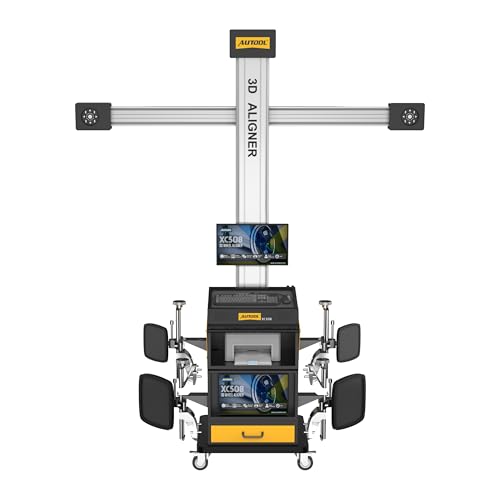
- Dual 20-inch HD displays with movable auxiliary screen
- 80,000+ vehicle database with lifetime updates
- Built-in printer and accident-chassis measurement mode
Best For: Professional garages needing comprehensive alignment reporting
Portable Value Pick

- Measures caster, camber, and toe digitally
- Hands-free operation without a level surface
- Portable, manual design for flexible use
Best For: Mobile technicians and smaller garages
High-Volume 3D Choice

- Up to ±0.01° stated measurement accuracy
- Push-and-measure operation needs no calibration
- 60,000+ vehicle database with reports and voice guidance
Best For: Busy tire shops and professional repair garages
Compact Manual Specialist
Tenhulzen All-in-One Alignment Tool

- Measures camber, caster, and toe
- Camber accuracy stated within 0.1 degrees
- No expensive turn plates required for caster measurement
Best For: DIY mechanics and compact manual alignment work
Most Flexible Premium Pick
AV9 Pro 3D Mobile Alignment System

- Compatible with two-post and scissor lifts
- 3D optical measurement with Android and iOS support
- Includes monitor, tablet, printer, and connectivity accessories
Best For: Shops needing flexible lift compatibility and a complete mobile alignment setup
Best Shop-Focused System
GIYI 3D Wheel Alignment Machine

- Measures key alignment angles to ±0.01°
- Automatic process requires no manual calibration
- 42-inch display with voice guidance and reports
Best For: Busy tire and repair shops needing guided operation and collision measurement
Best Ready-to-Use Option

- Arrives fully calibrated and ready to use
- Stores up to 6,000 vehicle specifications
- Adds voice prompts and LED measurement indicators
Best For: Shops wanting quick setup and guided alignment operation
Best Overall
KATOOL KT-5DA 5D Wheel Aligner

- Five-axis precision for passenger vehicles and light trucks
- Real-time high-definition imaging for live adjustments
- Durable frame with factory-set calibration
Best For: Busy shops and performance garages
Best Connected Display Setup
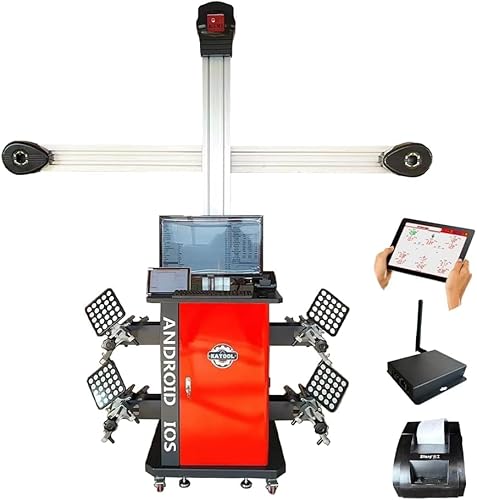
- Android-based 3D camera measurement
- iOS, tablet, smartphone, and PC display support
- 5MP four-wheel optical positioning system
Best For: Shops seeking flexible mobile displays
Best Mobile-Friendly Value
KATOOL KT-AV9 Android 3D Aligner
- Android 3D camera measurement technology
- Compatible with iOS, tablets, and mobile phones
- Synchronized readings across multiple displays
Best For: Shops wanting flexible device-based operation
Premium Shop Pro – AUTOOL 3D Wheel Aligner
For shops seeking premium wheel alignment machines, the AUTOOL XC508 combines dual 20-inch HD screens, industrial 3D cameras, and a built-in printer in a mobile workstation. Its 80,000-plus vehicle database, accident-chassis mode, and lift-following system make it suited to detailed, repeatable shop workflows.
Best For: Professional garages that need broad vehicle coverage, printed reports, and advanced chassis measurements.
Pros:
- Dual interactive screens support efficient operation across a service bay.
- Industrial-grade cameras are designed for stable measurements in demanding garage conditions.
- Includes a built-in thermal printer, accident vehicle inspection mode, and lifetime database updates.
- Mobile cart with lockable casters and automatic lift tracking improves shop flexibility.
Cons:
- Its extensive workstation design may require more space than a compact alignment tool.
- The system is a substantial investment for shops needing only occasional alignment checks.
This AUTOOL model stands out when reporting, vehicle-data breadth, and collision-related measurements matter as much as core alignment readings.
Portable Value Pick – 4th Gen Pro Alignment Kit
This portable digital kit offers a simpler alternative to premium wheel alignment machines for measuring caster, camber, and toe. Its hands-free design and ability to operate without a level surface can be useful for mobile work, smaller garages, and budget-conscious technicians.
Best For: DIY users, mobile technicians, and small shops wanting a portable digital alignment setup.
Pros:
- Portable format is easier to store and transport than a full alignment machine.
- Measures the three key alignment angles: caster, camber, and toe.
- Hands-free operation does not require a level surface.
- Manufactured in the USA by a family-owned company.
Cons:
- Manual operation offers less automation than a full 3D alignment system.
- It does not include the vehicle database, printer, or shop workstation features listed for larger systems.
This kit prioritizes portability and affordability over automated shop throughput, making it a practical choice when space and budget are limited.
High-Volume 3D Choice – Professional 3D Wheel Aligner
This 110V 3D system is built for repair shops and tire stores that need fast, repeatable measurements. It combines stated accuracy up to ±0.01°, push-and-measure operation without calibration, a 60,000-plus vehicle database, voice and LED guidance, and a 24-inch monitor.
Best For: Busy tire shops and professional garages handling frequent passenger-vehicle alignments.
Pros:
- Industrial 3D cameras provide readings for toe, camber, caster, and kingpin.
- Push-and-measure operation eliminates manual calibration and can reduce setup time.
- Waterproof, drop-resistant targets and high-strength brackets are designed for daily shop use.
- Supports printable reports, accident measurement, multiple languages, and several lift configurations.
Cons:
- At about 350 pounds with large listed dimensions, it is not a portable solution.
- It requires corded power and runs on Windows 10.
With automation, durable targets, and broad shop compatibility, this model is a strong fit for businesses focused on alignment speed and consistent documentation.
Compact Manual Specialist – Tenhulzen All-in-One Alignment Tool
Tenhulzen Automotive 2-Wheel Alignment Tool - All-in-one (Camber/Caster/Toe Plates) - Made in USA
Check Price On AmazonThe Tenhulzen all-in-one tool is a compact alternative to full premium wheel alignment machines for users who prefer a hands-on setup. It measures camber, caster, and toe, with camber accuracy stated within 0.1 degrees, and does not require expensive turn plates for caster measurement.
Best For: DIY mechanics and independent users who want a compact tool for foundational alignment measurements.
Pros:
- Combines camber, caster, and toe measurement in one tool.
- Patent-pending wheel stand-offs are designed for accurate positioning.
- Camber measurement is stated accurate within 0.1 degrees.
- Includes step-by-step video instructions and a 9V battery.
Cons:
- It is a manual tool rather than an automated 3D alignment system.
- It lacks a vehicle database, digital shop display, printer, and automated reporting.
- Its two-wheel alignment format may be less suitable for high-volume commercial workflows.
This Made-in-USA tool is best viewed as a focused, space-saving alignment aid rather than a replacement for a complete professional alignment bay.
Most Flexible Premium Pick – AV9 Pro 3D Mobile Alignment System
For shops comparing premium wheel alignment machines, the AV9 Pro stands out for lift flexibility and a broad equipment package. Its 3D optical system supports four-wheel positioning and works with both two-post and scissor lifts without modification.
Best For: Automotive shops that want a mobile 3D aligner with wide lift compatibility and included display equipment.
Pros:
- Works with two-post and scissor lifts without additional modification.
- Uses 3D optical cameras for high-precision measurements across a 1500–3000 mm range.
- Includes a tablet, 30-inch monitor, printer, Wi-Fi device, mouse, keyboard, and USB support.
- Supports Android and iOS tablet compatibility with real-time data viewing.
Cons:
- The package is heavy, and a forklift or equivalent is required for unloading.
- The listed package dimensions may require substantial shop space and handling.
The AV9 Pro is a strong premium option when installation flexibility and an extensive connectivity package matter most. Its one-year warranty and proactive service follow-up add support for shops making a major equipment purchase.
Best Shop-Focused System – GIYI 3D Wheel Alignment Machine
This GIYI model is one of the premium wheel alignment machines aimed squarely at busy tire shops and repair facilities. It combines 3D measurement, automatic operation, a large 42-inch display, printable reports, and a collision-repair measurement function.
Best For: Professional repair shops that need clear operator guidance, report generation, and alignment-related collision assessment.
Pros:
- Measures toe, camber, thrust angle, and setback with stated accuracy of ±0.01°.
- Automatically completes the measurement process after the vehicle is pushed forward, without manual calibration.
- Large 42-inch display includes voice guidance and LED indicators for workshop visibility.
- Provides printable reports, measurement tracking, and an integrated collision repair measurement system.
Cons:
- At 346 pounds, the unit may require careful delivery and installation planning.
- The large display and shop-oriented design may be more equipment than occasional users need.
With automatic measurement and rugged, waterproof, drop-resistant targets, the GIYI is designed for repetitive professional use. Its reporting and collision-measurement features make it particularly useful for shops handling both routine alignments and accident-related repairs.
Best Ready-to-Use Option – HayWHNKN 3D Alignment Machine
For buyers seeking premium wheel alignment machines with a simpler startup path, this HayWHNKN unit arrives fully calibrated and ready to use. Its 3D imaging system, voice prompts, LED indicators, and database capacity of up to 6,000 vehicle specifications support efficient day-to-day operation.
Best For: Shops that prioritize quick setup, guided operation, and broad vehicle-specification storage.
Pros:
- Uses 3D imaging, cameras, sensors, and software algorithms to analyze alignment data.
- Ships fully calibrated to reduce complex installation requirements.
- Stores up to 6,000 vehicle specifications for varied automotive applications.
- Combines voice prompts with LED measurement indicators for clearer operation.
Cons:
- The included 24-inch monitor is smaller than the displays supplied with the other listed systems.
- At 400 pounds, delivery and placement require planning.
- The supplied notes do not specify included printing or remote-monitoring accessories.
This model emphasizes accessibility and fast deployment rather than an extensive accessory bundle. Its large vehicle database and synchronized visual and voice guidance make it a practical choice for shops handling varied vehicles.
Best Overall – KATOOL KT-5DA 5D Wheel Aligner
For shops looking at premium wheel alignment machines, the KATOOL KT-5DA combines five-axis precision, real-time imaging, and factory-set calibration. Its high-definition camera system provides live feedback while technicians make adjustments, helping support a faster, more consistent workflow across passenger vehicles and light trucks.
Best For: Busy automotive shops, tire centers, and performance garages that need durable, guided alignment equipment for varied vehicle types.
Pros:
- Five-axis alignment precision is designed to reduce guesswork.
- Real-time high-definition imaging mirrors adjustments on screen.
- Reinforced alloy steel construction and industrial-grade sensors suit demanding shop use.
- Factory-set calibration and guided software simplify setup and operation.
Cons:
- At 309 pounds, it is substantial shop equipment rather than a portable tool.
- Its 48 x 41 x 28-inch package dimensions require dedicated space.
The KT-5DA is the strongest fit here for high-volume service environments that value durability, visual feedback, and repeatable results. Its heavier construction and advanced five-axis system may be more equipment than a lower-volume shop needs.
Best Connected Display Setup – KATOOL KT-AV9 3D Aligner
The KATOOL KT-AV9 is a flexible option among premium wheel alignment machines, using Android-based 3D camera measurement technology with support for iOS devices. Alignment readings can appear on a PC, smartphone, or tablet, giving shops more freedom in how technicians monitor each job.
Best For: Shops that want mobile display flexibility and synchronized alignment readings across computers, tablets, and smartphones.
Pros:
- Supports Apple iOS devices as display terminals.
- Synchronizes readings across a PC, smartphone, and tablet.
- Uses a four-wheel positioning optical system with a 5MP camera.
- Provides an effective working distance of 1500mm–3000mm.
Cons:
- Operation requires maintaining the machine within about 6 feet of the target.
- The recommended tilt angle is limited to 5°–15°.
- Display flexibility may require compatible devices for the preferred setup.
The KT-AV9 stands out for its connected-device approach rather than a fixed display-only workflow. It is a practical choice when technicians benefit from viewing alignment information on existing mobile devices, provided the installation stays within the stated distance and angle guidelines.
Best Mobile-Friendly Value – KATOOL KT-AV9 Android 3D Aligner
KATOOL KT-AV9 Android System 3D Wheel Alignment Machine Wheel Aligner Automotive Tire Alignment Tool
Check Price On AmazonFor buyers comparing premium wheel alignment machines with mobile-friendly operation, this KATOOL KT-AV9 variant uses Android 3D camera measurement and supports Apple iOS display devices. Synchronized readings on a PC, smartphone, or tablet can help technicians keep alignment information visible during the procedure.
Best For: Automotive service operations that want a 3D four-wheel aligner with smartphone and tablet display compatibility.
Pros:
- Uses the latest Android-based 3D camera measurement technology listed for the model.
- Supports Apple iOS devices, tablets, and mobile phones as display terminals.
- Synchronizes alignment readings across PC, phone, and tablet displays.
- Offers a 5MP camera and a 1500mm–3000mm camera-to-turntable distance.
Cons:
- The listing provides limited model-specific hardware details beyond the stated camera system.
- Its working distance must remain within the specified 1500mm–3000mm range.
- Using mobile displays depends on having compatible phones or tablets available.
This version makes the most sense for shops prioritizing device flexibility and synchronized readings. Before buying, confirm the exact package and model designation, since the supplied details identify the model as KT-AV9L.
How We Picked the Best Premium Wheel Alignment Machines
We focused on the features that matter most in a professional setting: measurement method, alignment range, vehicle database coverage, display and reporting tools, installation requirements, lift compatibility, portability, and day-to-day usability. We also considered whether each system is better suited to a high-volume shop, a smaller garage, or mobile service work.
Because specifications and included accessories can vary by configuration, verify the current package, software support, calibration requirements, and warranty before purchasing.
Quick Comparison
| System Type | Best For | Key Advantage | Main Trade-Off |
|---|---|---|---|
| Full 3D shop system | High-volume repair and tire shops | Fast, repeatable measurements and professional reporting | Higher cost and greater space requirements |
| Mobile 3D system | Multi-bay or flexible shop layouts | Can work with different lift arrangements | Requires careful setup and calibration |
| Portable digital kit | Mobile technicians and smaller garages | Lower footprint and easier transport | May offer fewer automation and reporting features |
| Manual plate-based tool | Basic two-wheel checks and specialty work | Simple, durable, and relatively affordable | Slower and more dependent on operator technique |
Key Buying Factors for Premium Wheel Alignment Machines
Measurement Technology and Accuracy
3D and camera-based systems generally provide fast, repeatable readings, while manual plates can be useful for straightforward checks when the operator is experienced. Look for real-time measurements, clear adjustment guidance, and a calibration process your staff can follow consistently.
Vehicle Coverage and Software
A large vehicle database is valuable if your shop services many makes, models, wheel sizes, or commercial vehicles. Check how updates are delivered, whether the software supports local vehicle specifications, and whether the interface works with the computers or mobile devices your technicians already use.
Lift Compatibility and Installation
Confirm compatibility with two-post, four-post, and scissor lifts before ordering. Consider bay dimensions, camera or target placement, power requirements, floor leveling, and the space needed for a monitor, cabinet, printer, or turn plates.
Workflow and Reporting
Large displays, automatic target recognition, guided adjustments, before-and-after printouts, and customer-friendly reports can reduce service time and make alignment results easier to explain. These features are especially important for busy shops handling multiple vehicles per day.
Durability, Support, and Total Cost
Compare more than the initial price. Include installation, calibration, software updates, replacement targets, printer supplies, training, warranty coverage, and technical support. A system that is easy to maintain may deliver better value than a cheaper machine with limited service resources.
Who Should Buy Which Premium Wheel Alignment Machines?
- High-volume tire and repair shops: Choose a full 3D system with automatic imaging, a broad database, fast reporting, and a large dedicated display.
- Shops with multiple lift types: Prioritize a mobile or flexible system confirmed to support your existing two-post or scissor-lift setup.
- Small garages: A compact 3D machine or portable digital kit may provide useful alignment capability without consuming a full service bay.
- Mobile technicians: Select a portable solution that is easy to transport, quick to set up, and practical for the wheel sizes and vehicles you service.
- Basic alignment and specialty applications: A manual camber, caster, and toe tool can be appropriate when advanced imaging and automated reports are unnecessary.
Before deciding, compare the included hardware rather than relying only on the product name. Confirm wheel-size range, power requirements, software platform, calibration support, and the accessories needed to begin performing alignments immediately.
